


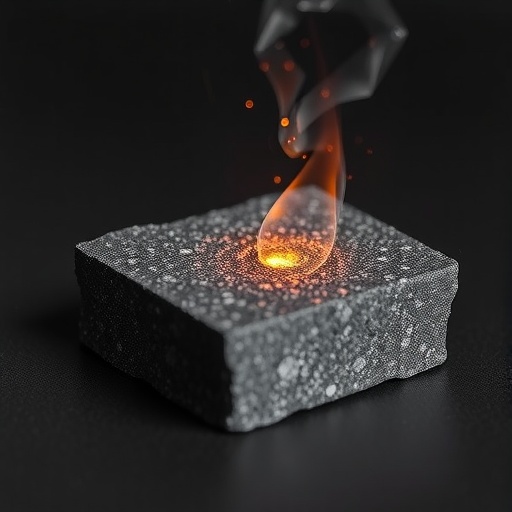
A new catalyst can slash the electricity required to destroy toluene pollution by more than 50-fold, according to a study that turns the catalyst itself into a miniature electric heater. The device, made from a manganese–cobalt composite oxide grown directly onto nickel foam, uses internal Joule heating to drive the catalytic oxidation of toluene, a volatile organic compound released by paints, solvents, fuels, adhesives and industrial manufacturing. In tests, the electrothermal system also achieved 90 percent toluene conversion at a temperature about 60 degrees Celsius lower than a conventional electrically heated catalytic system. The findings suggest that pairing electrical resistance with catalytic chemistry could provide a more energy-efficient route for treating polluted industrial air.
Toluene is a colorless aromatic hydrocarbon with a distinctive solvent-like smell, but its familiarity in factories and workshops does not make it harmless. As a volatile organic compound, it can contribute to photochemical smog and has been associated with adverse effects from prolonged or high-level exposure. Conventional pollution-control systems typically pass contaminated air over a catalyst maintained at a high temperature by an external furnace, heating coil or other energy-intensive device. That arrangement can waste substantial energy because the reactor walls, surrounding gas and hardware are heated along with the active catalytic surface. It can also be slow to start and inefficient when pollutant concentrations fluctuate. The new strategy instead sends electrical current through the catalytic monolith, concentrating heat where the chemical reaction occurs.
The research team prepared its catalyst using a one-step composite electrodeposition process. In this method, manganese- and cobalt-containing oxide material was grown in situ on a three-dimensional nickel-foam substrate. Nickel foam is a porous, electrically conductive material whose interconnected structure provides both a current pathway and a large open surface for gas flow. The manganese–cobalt oxide acts as the chemically active component, while the metal foam functions as a self-heating support and monolithic reactor body. Unlike a powder catalyst dispersed over pellets or coated onto a separate support, the electrodeposited structure forms an integrated piece. That architecture can reduce contact resistance between the heater and catalyst, while the foam’s pores expose the active oxide to passing toluene and oxygen.
The heating mechanism is straightforward but powerful. When current flows through a resistive conductor, electrical energy is converted directly into heat according to the Joule-heating relationship, in which generated power depends on the square of the current multiplied by the electrical resistance. In a conventional toluene oxidation system, electricity first heats an external element, which then transfers heat through reactor components and gas before the catalyst reaches its operating temperature. In the electrothermal toluene catalytic oxidation, or ETCO, arrangement, the MnOx–CoOx/nickel-foam monolith generates heat within the reactor’s catalytic structure. The authors report that this configuration reduced total electric power consumption by more than 50 times compared with conventional toluene catalytic oxidation. The comparison highlights not simply a lower reaction temperature, but a more direct coupling between electrical input and the active reaction zone.
Catalysts accelerate oxidation by providing a lower-energy route for breaking and rearranging chemical bonds. In the manganese–cobalt oxide system, the metal cations can participate in redox cycles, accepting and donating electrons as oxygen and toluene-derived intermediates react on the surface. The study’s characterization results indicate that electrothermal operation increased the concentration of Mn(II) and Co(III) oxidation states. It also increased the amount of chemically adsorbed oxygen species, which are oxygen atoms or oxygen-containing species bound to the catalyst surface rather than simply present as gas-phase oxygen. These surface species are often more reactive than molecular oxygen because they can attack adsorbed hydrocarbon fragments directly. A catalyst with more accessible redox sites and reactive oxygen can therefore promote oxidation without requiring the entire gas stream to be heated to the temperature demanded by a less active material.
The researchers also observed changes in oxygen mobility and catalyst reducibility under the electrothermal strategy. Oxygen mobility describes how readily oxygen species migrate across or through a catalyst to replenish sites consumed during reaction. Reducibility, commonly evaluated by measuring how a material reacts with hydrogen as temperature increases, reflects how easily the catalyst changes oxidation state. Both properties matter in oxidation catalysis. Toluene must first interact with the catalyst surface, where its aromatic structure is progressively activated and broken down through a sequence of intermediates. Surface oxygen then participates in oxidizing those fragments. If oxygen can move rapidly and the metal oxide can cycle efficiently between oxidation states, active sites may be regenerated more readily. The reported increase in these properties provides a mechanistic explanation for why the electrothermal system could achieve high conversion at a lower temperature.
The approximately 60-degree reduction in the temperature needed for 90 percent toluene conversion is particularly significant for systems treating dilute industrial emissions. High-temperature operation can dominate the energy budget of air-cleaning equipment, especially when large volumes of air contain relatively small amounts of pollutant. Lowering the required temperature may also reduce the time needed for start-up and make intermittent or demand-responsive operation more practical. Because the nickel foam is both conductive and porous, the reactor could in principle be adapted to compact, electrically powered modules rather than large furnace-heated units. However, the study reports a laboratory catalyst and performance comparison, not a commercial installation. Questions about long-term stability, resistance to water vapor and other contaminants, uniform heating in larger reactors, electrical-control strategies and performance under real exhaust conditions remain important before the technology can be judged ready for industrial deployment.
The work arrives as researchers explore electrification as a way to decarbonize chemical and environmental processes. Electrical heating can be especially attractive when powered by low-carbon electricity, but an electrically driven process is not automatically climate-friendly: its overall benefit depends on the electricity source, the efficiency of the reactor and the durability of the materials. The new catalyst addresses one part of that equation by minimizing the energy needed to reach a reactive state. Its monolithic design may also avoid some handling and pressure-drop issues associated with packed beds of catalyst powder, although the supplied study does not establish how the foam compares with conventional systems on those engineering measures. The authors report that all research data generated or used in the manuscript will be made available on request, offering a potential basis for further evaluation and replication.
The central idea is therefore less about making toluene disappear through heat alone than about integrating heating and chemistry into one responsive material. Manganese and cobalt oxides provide redox-active sites and mobile oxygen, while nickel foam supplies conductivity, mechanical structure and a gas-permeable geometry. Together, these features allow the catalyst to heat itself internally and use that heat to accelerate pollutant oxidation. If the reported power savings and low-temperature activity can be maintained over extended operation and across realistic mixtures of volatile organic compounds, electrothermal monoliths could become a useful design for compact air-pollution treatment. For now, the study provides a striking demonstration that changing where heat is generated—and how closely it is coupled to the catalyst surface—can reshape the energy demands of industrial emissions control.
Cite Scienmag News
Bethany Barker. (August 28, 2026). Electrothermal Strategy Boosts Toluene Oxidation Using Manganese-Cobalt Composite Oxide Monolith. Scienmag. https://scienmag.com/electrothermal-strategy-boosts-toluene-oxidation-using-manganese-cobalt-composite-oxide-monolith/
Bethany Barker. "Electrothermal Strategy Boosts Toluene Oxidation Using Manganese-Cobalt Composite Oxide Monolith." Scienmag, 28 August 2026, https://scienmag.com/electrothermal-strategy-boosts-toluene-oxidation-using-manganese-cobalt-composite-oxide-monolith/. Accessed 5 September 2026.
Bethany Barker. "Electrothermal Strategy Boosts Toluene Oxidation Using Manganese-Cobalt Composite Oxide Monolith." Scienmag. August 28, 2026. https://scienmag.com/electrothermal-strategy-boosts-toluene-oxidation-using-manganese-cobalt-composite-oxide-monolith/


