


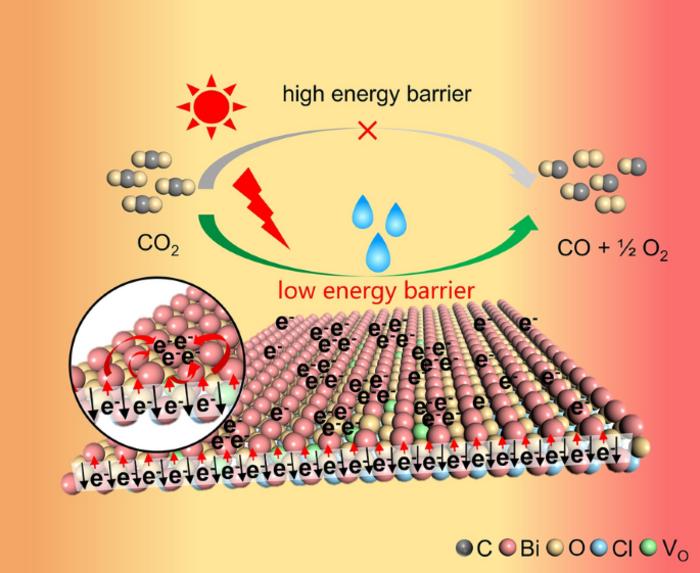
In the relentless pursuit of sustainable energy solutions, converting carbon dioxide (CO₂) into valuable chemicals using sunlight represents a beacon of hope against escalating climate challenges. Recent strides in photocatalysis have revealed a groundbreaking advancement led by researchers from Xi’an Jiaotong University and Tamkang University, culminating in the development of an innovative bismuth oxychloride (BiOCl) atomic layer material. This novel catalyst, termed BOCNSs-i, exhibits unprecedented efficiency in the photocatalytic splitting of CO₂, marking a significant leap toward practical solar fuel synthesis and carbon neutralization.
Photocatalytic CO₂ reduction has long presented an alluring avenue to address both energy scarcity and greenhouse gas mitigation. However, the fundamental obstacles inherent to many existing photocatalysts—namely, limited active site accessibility and rapid recombination of photoinduced charge carriers—have impeded widespread application. The breakthrough with BiOCl atomic layers surmounts these barriers by leveraging ultrathin nanoscale engineering and electronic structure modulation, thereby optimizing charge dynamics and surface chemistry to expedite CO₂ conversion.
At the heart of this advancement lies the strategic transformation of bulk BiOCl into atomically thin layers through a meticulous exfoliation process. Initially synthesized via hydrothermal methods, the BiOCl nanosheets (BOCNSs) undergo liquid-phase ultrasonication in isopropanol, resulting in atomic layer variants referred to as BOCNSs-i. These atomically thin sheets exhibit drastically reduced thicknesses, thereby amplifying the surface-to-volume ratio and profoundly increasing the exposure of electron-rich bismuth active sites essential for CO₂ activation.
The photocatalytic prowess of BOCNSs-i is striking. Under simulated solar illumination at 1.7 suns intensity, the catalyst achieves a CO evolution rate of 134.8 micromoles per gram per hour—an impressive figure that underscores its capacity for efficient light harvesting and conversion. When subjected to concentrated solar irradiation at 34 suns, this performance escalates remarkably, reaching CO production rates of 13.3 millimoles per gram per hour. Importantly, oxygen evolution accompanies CO at the stoichiometric ratio of two-to-one, confirming the catalyst’s capacity for overall CO₂ splitting rather than partial reduction.
This enhanced performance is intricately tied to the material’s exceptional charge carrier dynamics. Photoluminescence analyses reveal significantly prolonged lifetimes of photogenerated electrons and holes within BOCNSs-i compared to their bulk counterparts. The atomic layer configuration inherently shortens the diffusion path for charge carriers, minimizing recombination losses and facilitating the rapid transfer of electrons toward surface active sites. Simultaneously, an intensified built-in electric field across the ultrathin layers further promotes the separation of charges, thereby sustaining elevated photocatalytic activity.
Crucially, the site-specific enrichment of electrons at bismuth centers within the atomic layers greatly influences the activation of CO₂ molecules. Investigations employing in situ spectroscopic techniques, including X-ray photoelectron spectroscopy (XPS) and diffuse reflectance infrared Fourier transform spectroscopy (DRIFTS), demonstrate that oxygen vacancies introduced during synthesis act as electron reservoirs. These vacancies modulate the electronic structure of the surface, lowering the activation energy required for the rate-determining step of CO₂ reduction. The enriched electrons at Bi sites enable stronger chemisorption and activation of CO₂, facilitating its conversion into CO with enhanced selectivity.
An often-overlooked factor in photocatalytic CO₂ reduction is the role of water vapor. In this system, the presence of H₂O vapor proves beneficial by enabling oxygen atom exchange mechanisms between water molecules and adsorbed CO₂. This dynamic exchange assists in maintaining surface oxygen vacancies and reinforces catalytic turnover. As such, the synergy between the atomic layer architecture, vacancy engineering, and controlled reaction atmospheres collectively drives the observed superior catalytic behavior.
From a materials synthesis standpoint, the transformation of BiOCl nanosheets into atomic layers via ultrasonication in isopropanol showcases an elegant yet scalable methodology. The process not only thins the material to atomic-level thickness but also preserves its crystallinity and intrinsic photocatalytic attributes. This facile exfoliation technique holds promise for large-scale production of BOCNSs-i catalysts, an essential consideration for transitioning laboratory innovations into real-world applications.
The exceptional stability of BOCNSs-i under prolonged light irradiation further amplifies its practical utility. During extended photoreactions under concentrated solar fluxes, the catalyst maintains consistent activity without observable degradation. This robustness is vital for the deployment of photocatalytic systems in operational solar fuel generation setups, where durability directly influences economic and environmental feasibility.
The fundamental insights gained from this research extend beyond the specific catalyst studied. By establishing the relationship between atomic layer thickness, charge separation efficiency, oxygen vacancy-induced electronic modulation, and catalytic performance, the study lays down guiding principles for the design of next-generation photocatalysts. These principles can be extrapolated to other layered materials, potentially catalyzing a paradigm shift in solar-driven chemical transformations.
Looking ahead, the scientific community envisions exploring synergistic combinations of BiOCl atomic layers with complementary co-catalysts or alloying elements to further tailor surface electronic properties and enhance selectivity towards desired products. Additionally, optimizing reaction conditions such as light intensity, reactant concentrations, and reactor configurations may yield further improvements in efficiency and scalability.
As the momentum in photocatalytic CO₂ conversion builds, breakthroughs like the BOCNSs-i atomic layers underscore the profound impact of nanoscale engineering and electronic structure control. The work spearheaded by Professor Shaohua Shen and colleagues not only elevates the field’s understanding of photocatalytic mechanisms but also brings us closer to realizing sustainable, solar-driven chemical manufacturing technologies capable of mitigating climate change while generating renewable fuels.
Driven by an exquisite balance of materials design, mechanistic elucidation, and practical considerations, this research heralds a new era in photocatalytic innovation. The elegant manipulation of BiOCl at the atomic scale transforms it from a conventional semiconductor into a powerful platform for efficient CO₂ activation and conversion. As global efforts intensify to combat carbon emissions, such transformative approaches will be pivotal in developing green technologies that harmonize environmental stewardship and energy prosperity.
In conclusion, the synthesis and deployment of BiOCl atomic layers enriched with electron-rich active sites represent a compelling stride towards efficient, solar-powered CO₂ splitting. The merging of experimental rigor with insightful mechanistic studies provides a robust foundation for advancing photocatalytic science and technology. The promising results invite excitement for future developments that may unlock the full potential of sunlight-driven carbon conversion, propelling humanity toward a sustainable energy future.
News Publication Date: 18-Apr-2025
Web References:
http://dx.doi.org/10.1007/s40820-025-01723-2
Keywords
Photocatalysis, CO₂ Conversion, BiOCl Atomic Layers, Charge Carrier Dynamics, Oxygen Vacancies, Solar Fuels, Nanomaterials, Photochemical Splitting
Cite Scienmag News
Bethany Barker. (June 17, 2025). Electron-Enriched BiOCl Atomic Layers Unveil Highly Active Sites for Efficient Photocatalytic CO2 Splitting. Scienmag. https://scienmag.com/electron-enriched-biocl-atomic-layers-unveil-highly-active-sites-for-efficient-photocatalytic-co2-splitting/
Bethany Barker. "Electron-Enriched BiOCl Atomic Layers Unveil Highly Active Sites for Efficient Photocatalytic CO2 Splitting." Scienmag, 17 June 2025, https://scienmag.com/electron-enriched-biocl-atomic-layers-unveil-highly-active-sites-for-efficient-photocatalytic-co2-splitting/. Accessed 3 September 2026.
Bethany Barker. "Electron-Enriched BiOCl Atomic Layers Unveil Highly Active Sites for Efficient Photocatalytic CO2 Splitting." Scienmag. June 17, 2025. https://scienmag.com/electron-enriched-biocl-atomic-layers-unveil-highly-active-sites-for-efficient-photocatalytic-co2-splitting/


