


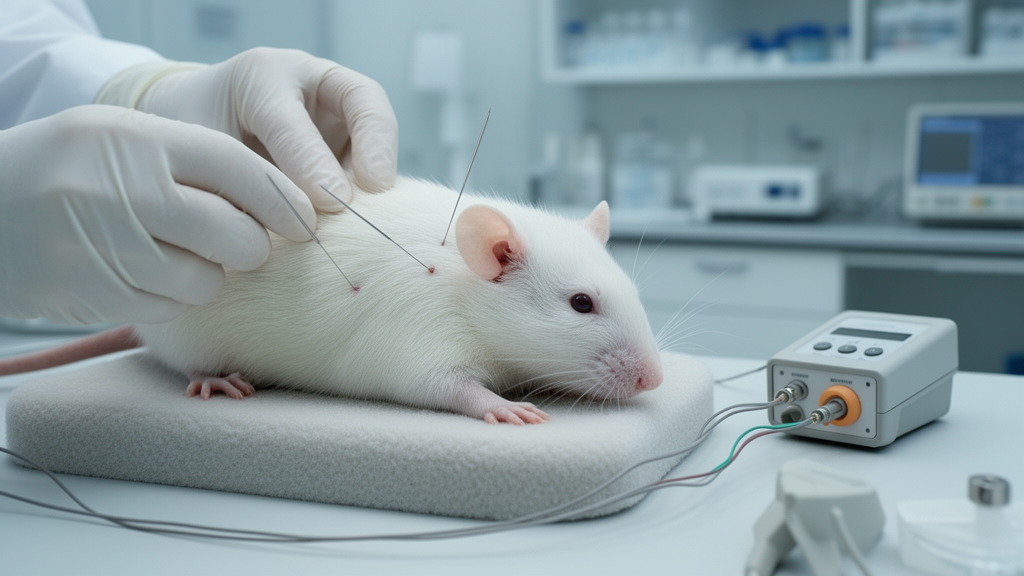
Chronic neuropathic pain does not damage memory uniformly, according to a new rat study published in Behavioral and Brain Functions. Rather than blunting cognition across the board, pain caused by nerve injury appeared to interfere selectively with long-term memory tasks that placed high demands on limited neural processing capacity, and repeated electroacupuncture reversed those deficits in the affected tasks.
The researchers used the spared nerve injury (SNI) model, a standard approach for producing chronic neuropathic pain in rats. SNI surgery induced robust mechanical hypersensitivity, meaning the animals became abnormally sensitive to touch. When the team then tested cognition under low-difficulty conditions, the injured rats performed normally on both novel object recognition (NOR), which measures memory for objects the animals have encountered before, and novel object location (NOL), which measures memory for where objects were placed.
The picture changed when task difficulty increased. Under high-difficulty conditions, SNI rats showed impaired long-term object recognition memory in the NOR task, while their NOL performance remained unaffected. When the researchers combined object novelty and spatial relocation into a single, more demanding task, the injured rats performed poorly across both the object-recognition component and the subsequent location component. This pattern supports the limited cognitive resource hypothesis, which holds that persistent pain consumes finite neural processing capacity and thereby impairs cognitive performance particularly when cognitive demand is high.
The intervention tested was electroacupuncture (EA). The researchers applied repeated EA at two acupoints, Zusanli (ST36) and Sanyinjiao (SP6). This treatment attenuated the animals’ mechanical hypersensitivity and restored their impaired performance in the high-demand memory tasks, effectively reversing the deficits that low-difficulty testing had never revealed.
In SNI rats, the percentage of CaMKII-positive cells that showed c-Fos immunoreactivity was reduced.
Electroacupuncture shifted that neural picture as well. In EA-treated rats, the proportion of CaMKII-positive cells showing c-Fos immunoreactivity in the rACC rose to a level comparable to that seen in sham-operated rats, which had undergone surgery without nerve injury. The authors therefore suggest that the behavioral improvements may be associated with this restored pattern of rACC neuronal activation, while framing the link as an association rather than a demonstrated causal mechanism.
The study’s conclusions position chronic neuropathic pain as selectively disrupting long-term memory performance under high cognitive demand, a pattern the authors describe as supporting a resource-competition model of the interaction between pain and cognition. In that framework, the ongoing processing demands of persistent pain compete with cognitive tasks for the same limited neural resources, and the competition only becomes behaviorally visible when the tasks are demanding enough.
Several caveats are worth keeping in view. The findings come from a rat model, so they cannot be directly generalized to human patients with chronic pain, and the reported association between rACC activation patterns and behavioral recovery does not establish that one causes the other. The published version reviewed here is an early-release, peer-reviewed accepted manuscript carrying a permanent DOI, subject to further edits before the final Version of Record appears. Even so, the work offers a concrete experimental demonstration that pain-related cognitive impairment can be task-dependent, and that a defined course of electroacupuncture at ST36 and SP6 can reverse both the pain hypersensitivity and the memory deficits that emerge only under the heaviest cognitive load.
Subject of Research: Effects of electroacupuncture on task-dependent memory deficits in a rat model of chronic neuropathic pain
Article Title: Electroacupuncture reverses task-dependent long-term memory deficits in rats with chronic neuropathic pain
Article References: Liu, Q., Ying, P., Zhang, C., Pan, Y., Li, Q., Shen, Z., Li, X., Fang, J., Shao, X., & Sun, J. (2026). Electroacupuncture reverses task-dependent long-term memory deficits in rats with chronic neuropathic pain. Behavioral and Brain Functions. https://doi.org/10.1186/s12993-026-00369-3
Image Credits: AI Generated
DOI: 10.1186/s12993-026-00369-3
Keywords: electroacupuncture, chronic pain, neuropathic pain, memory, cognitive dysfunction, spared nerve injury, anterior cingulate cortex, CaMKII, c-Fos, novel object recognition, rats, Zusanli
Cite Scienmag News
Glenn Wilkins. (October 28, 2026). Electroacupuncture Restores Memory Deficits in Rats With Chronic Nerve Pain. Scienmag. https://scienmag.com/electroacupuncture-restores-memory-deficits-in-rats-with-chronic-nerve-pain/
Glenn Wilkins. "Electroacupuncture Restores Memory Deficits in Rats With Chronic Nerve Pain." Scienmag, 28 October 2026, https://scienmag.com/electroacupuncture-restores-memory-deficits-in-rats-with-chronic-nerve-pain/. Accessed 28 October 2026.
Glenn Wilkins. "Electroacupuncture Restores Memory Deficits in Rats With Chronic Nerve Pain." Scienmag. October 28, 2026. https://scienmag.com/electroacupuncture-restores-memory-deficits-in-rats-with-chronic-nerve-pain/









