


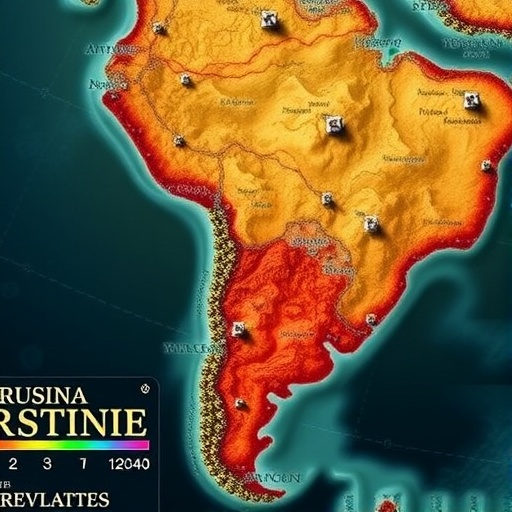
In a groundbreaking study published in Nature in 2025, researchers have unveiled an extraordinary chapter of human history from the heart of South America. The central Southern Cone, encompassing parts of modern-day Argentina, Chile, and surrounding regions, was among the final frontiers for early human settlement in the Americas. Until recently, this pivotal region remained a significant blind spot in ancient DNA research, leaving many questions about early human migrations and genetic lineages unanswered. This latest research provides unprecedented genome-wide data from 238 ancient individuals, spanning approximately ten millennia, offering a transformative view of population continuity, migration, and interaction in this underexplored area.
The study’s oldest DNA samples were recovered from the Pampas region of Argentina, dating back nearly 10,000 years before present (bp). These individuals exhibited distinct genetic affinities with later Middle Holocene populations from the Southern Cone, indicating that by this early period, clear genetic differentiation had already taken root between populations of the central Andes and the central-eastern region of Brazil. This early divergence challenges previous assumptions regarding the timeline and dynamics of human dispersals throughout South America, suggesting that population isolation and distinct evolutionary trajectories shaped the genetic landscape far earlier than widely assumed.
A remarkable finding from this research is the identification of a previously unsampled and deeply divergent genetic lineage centered in central Argentina. Earliest representatives of this lineage date back to around 8,500 bp, and individuals from various periods between 4,600 and 150 bp predominantly descended from this ancestral genetic signature. This lineage, previously unknown to science, persisted in central Argentina for millennia with minimal evidence of inter-regional gene flow. This prolonged continuity is suggestive of a stable population structure and cultural persistence, offering invaluable insights into pre-Columbian demographic dynamics.
During the Mid-Holocene era, researchers detected the coexistence of three discrete genetic lineages within the Southern Cone. Central Argentina’s unique lineage thrived alongside others, highlighting a mosaic pattern of human occupation characterized by regional differentiation rather than homogenization. This finding contradicts earlier models that depicted widespread genetic mixing and instead underscores localized population histories. Such a nuanced genetic landscape suggests complex social and demographic processes, including potential cultural boundaries that limited intermarriage and migration.
Gene flow analyses revealed that the central Argentina lineage did not remain static but influenced surrounding areas over time. By approximately 3,300 bp, this lineage mixed with populations in the Pampas, gradually becoming the dominant genetic component there by 800 bp. Additionally, the central Argentina lineage contributed to gene pools in northwest Argentina by interacting extensively with central Andean groups, as well as mixing with populations inhabiting tropical and subtropical forests of the Gran Chaco region. These interactions reveal intricate networks of mobility and exchange that shaped the genetic tapestry of South America through millennia.
Intriguingly, the northwest Argentine archaeological record indicates a significant increase in the frequency of close-kin unions by around 1,000 bp. This pattern aligns with similar findings in the central Andes, suggesting parallel social structures emerging independently across disparate regions. Such familial or clan-based mating practices may reflect adaptive responses to environmental pressures or social organization, underlining the complex interplay between genetics, culture, and ecology in ancient societies.
The region surrounding the Paraná River revealed another fascinating dimension of human history. The genome of a 400-year-old individual associated with the Guaraní people clusters genetically with contemporary Brazilian groups. This genetic affinity supports archaeological evidence of Guaraní presence and movement into the Paraná basin by at least the early Colonial period. The presence of Guaraní ancestry in this region enriches our understanding of pre-contact indigenous migration and settlement patterns extending into the last centuries before European colonization reshaped South American demographics.
Overall, this study offers a fresh, intricate narrative that sharply contrasts with simplified models of Americas peopling. The discovery of a hitherto unknown genetic lineage with sustained continuity over thousands of years challenges conventional wisdom. It suggests that human groups in the Southern Cone adapted and persisted with remarkable demographic stability and cultural resilience. Simultaneously, patterns of gene flow and kinship behaviors reflect complex social dynamics and migration networks that were far from monolithic.
Methodologically, this research leverages advances in ancient DNA extraction and genome-wide sequencing, underscoring the transformative impact of modern genomics in archaeology. By generating a substantial dataset covering various archaeological sites and temporal phases, the researchers achieved a fine-grained resolution of genetic changes and continuities. This approach offers a powerful template for future investigations aiming to unravel human prehistory in other undersampled and genetically diverse regions worldwide.
The insights gained have broad implications beyond basic science. They inform debates on ancestry and identity among contemporary South American indigenous groups, offering evidence of long-term local continuity that may influence cultural heritage perspectives. Additionally, elucidating the biological and cultural interplay through millennia enhances our understanding of human adaptability, migration, and social structure in environments as diverse as Andean highlands, subtropical forests, and vast grasslands.
As researchers continue to explore ancient genomes across the Americas, studies like this set a high standard for interdisciplinary integration of archaeology, genomics, and anthropology. They exemplify how sophisticated molecular tools combined with robust archaeological contexts can rewrite human history, revealing hidden chapters that provide a richer appreciation for the complexity of our species’ past.
Ultimately, the discovery of an enduring and previously unknown lineage anchoring central Argentina’s ancient population history underscores the deep roots and dynamic history of human life in South America. It invites us to rethink migration models and demographic scenarios while appreciating the intricate mosaic of peoples who shaped the continent’s pre-Columbian civilizations.
The research community eagerly anticipates further studies building on this foundation, potentially incorporating additional ancient samples, detailed paleoenvironmental reconstructions, and wider comparative genomic analyses. Such comprehensive approaches promise to deepen our understanding of how ancient peoples interacted with their environment and each other, shedding light on the forces that molded the populations of one of the world’s most intriguing regions.
This landmark study not only fills a significant knowledge gap but also sets the stage for transformative discoveries that will continue to illuminate the human saga in South America and beyond, demonstrating the power of science to illuminate the past and inspire future inquiry.
Cite Scienmag News
Juliet Wilcox. (November 6, 2025). Eight Millennia of Unknown Argentine Lineage Revealed. Scienmag. https://scienmag.com/eight-millennia-of-unknown-argentine-lineage-revealed/
Juliet Wilcox. "Eight Millennia of Unknown Argentine Lineage Revealed." Scienmag, 6 November 2025, https://scienmag.com/eight-millennia-of-unknown-argentine-lineage-revealed/. Accessed 3 September 2026.
Juliet Wilcox. "Eight Millennia of Unknown Argentine Lineage Revealed." Scienmag. November 6, 2025. https://scienmag.com/eight-millennia-of-unknown-argentine-lineage-revealed/


