

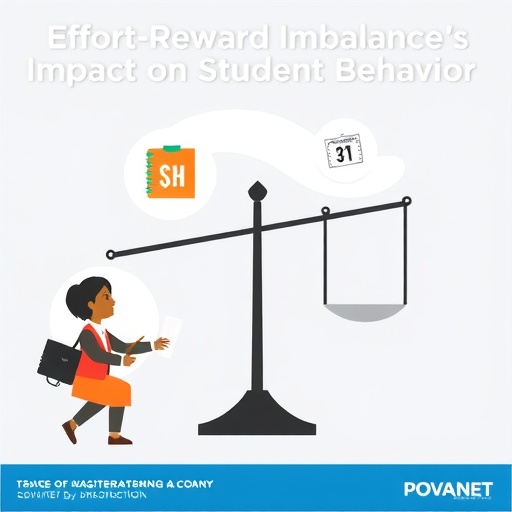
Recent groundbreaking research conducted by Chao and Hanjuan explores a pivotal psychological phenomenon affecting college students worldwide: the intricate relationship between effort-reward imbalance and behavioral inhibition/activation, with a critical focus on the moderating influence of social support. Published in BMC Psychology in 2026, this study offers profound insights into the psychological mechanics that govern motivation, stress, and behavioral responses in academic and social environments, shedding light on potential intervention strategies that could transform mental health paradigms in educational settings.
The concept of effort-reward imbalance (ERI) has long been a cornerstone in occupational health psychology, but its application to student populations marks a significant advancement in understanding stress dynamics outside traditional workplace models. ERI refers to the discrepancy between the efforts an individual invests in their tasks—such as studying, attending classes, or engaging in extracurriculars—and the rewards they perceive receiving, including grades, recognition, and future opportunities. When the balance tilts unfavorably, it sets off a cascade of psychological stressors that compromise well-being and cognitive functioning.
Chao and Hanjuan expand this model by investigating how ERI correlates with behavioral inhibition system (BIS) and behavioral activation system (BAS). These systems are neurological networks that regulate responses to stimuli: BIS is involved in avoidance behavior and sensitivity to punishment, while BAS governs approach behavior and sensitivity to reward. The nuanced interplay between these systems offers a sophisticated lens through which we can view student behavior under varying levels of stress and motivation.
A critical dimension of this research involves social support, which is theorized as a potent moderator capable of mitigating the negative consequences of ERI. Social support, be it emotional, informational, or practical, can buffer the adverse psychological effects of perceived imbalances in effort and reward. This moderation effect signifies that students surrounded by robust social networks may exhibit reduced behavioral inhibition and enhanced activation, promoting resilience and adaptive coping strategies in the face of academic and social pressures.
The methodology employed in this 2026 study is robust and multidimensional, incorporating validated psychometric tools to quantitatively assess ERI, BIS/BAS dynamics, and social support levels among a diverse cohort of college students. Through rigorous statistical modeling and longitudinal data analysis, the researchers delineate intricate causal pathways and interaction effects that go beyond correlational evidence, establishing a deeper understanding of temporal relationships and underlying mechanisms.
Findings reveal that students experiencing high effort-reward imbalance tend to exhibit significantly heightened behavioral inhibition, characterized by increased anxiety, avoidance tendencies, and reduced engagement in proactive behaviors. Conversely, high ERI is associated with diminished behavioral activation, manifesting as lower motivation to pursue academic goals, decreased energy, and attenuated reward-seeking behaviors. Such behavioral patterns have far-reaching implications for academic performance, mental health, and long-term career trajectories.
However, the study compellingly demonstrates that social support serves as a critical buffering agent, attenuating the impact of ERI on BIS/BAS responses. Students with strong social networks experience less behavioral inhibition and sustain higher levels of activation even when confronted with effort-reward imbalances. This protective effect underscores the vital role that peer support, mentorship, and institutional resources play in fostering psychological resilience within academic populations.
The neurobiological underpinnings of BIS and BAS provide further depth to the discussion. BIS is primarily linked to the septo-hippocampal system and the neurotransmitter serotonin, which modulate anxiety and caution. Meanwhile, BAS is tied to dopaminergic pathways in the mesolimbic system, which govern reward processing and goal-directed behavior. By contextualizing ERI within these neural frameworks, the study bridges psychological theory with neurophysiological evidence, enhancing the scientific community’s understanding of stress responses in students.
Moreover, this research addresses potential gender differences in ERI and behavioral tendencies, highlighting that males and females might differ in sensitivity to effort-reward imbalance and the efficacy of social support. Such demographic nuances pave the way for tailored interventions that are sensitive to individual and cultural variability, optimizing mental health outcomes.
In practice, the implications of Chao and Hanjuan’s findings extend well beyond theoretical discourse. Academic institutions can harness this knowledge to design social support programs and policies aimed at balancing effort and reward perceptions. Initiatives such as peer mentoring, counseling services, and reward recognition systems could be strategically implemented to enhance behavioral activation and reduce inhibition among students, thereby promoting healthier academic engagement and psychological well-being.
The study also prompts further questions regarding the dynamic interplay between motivational systems and environmental factors. How might digital social networks and online learning platforms influence the moderating role of social support? To what extent do temporal fluctuations in effort and reward perceptions impact long-term behavioral patterns? These avenues for future research are ripe for exploration.
Importantly, the research situates ERI and BIS/BAS in a developmental context, recognizing that college years are a critical period of neurocognitive maturation and identity formation. Stress and motivation patterns established during this phase may have enduring effects on individuals’ trajectories, underscoring the importance of early identification and intervention.
Chao and Hanjuan’s work exemplifies interdisciplinary rigor, integrating psychological theory, neurobiology, and social sciences to unpack complex behavioral phenomena. The viral potential of this research lies in its immediate relevance and practical applicability, resonating not only with scholars but also with students, educators, mental health practitioners, and policymakers.
As mental health challenges among college populations continue to rise globally, this study offers a scientifically grounded framework for understanding and addressing the root causes of stress-related behavioral dysfunctions. By highlighting the transformative power of social support, it advocates for a shift towards more empathetic and community-oriented approaches within academia.
Ultimately, the research advances a holistic model in which effort, reward, motivation, and social environment intersect, charting a path toward enhanced psychological resilience and improved educational outcomes. This paradigm not only enriches academic literature but serves as a clarion call for systemic changes designed to nurture student well-being in increasingly complex educational landscapes.
In summary, the association between effort-reward imbalance and behavioral inhibition/activation among college students, moderated by social support, represents a critical frontier in psychological research. Chao and Hanjuan’s 2026 study opens new vistas for understanding motivation and stress, with profound implications for science, education, and society at large.
Subject of Research: The psychological interplay between effort-reward imbalance and behavioral inhibition/activation systems among college students, emphasizing the moderating role of social support.
Article Title: The Association between effort-reward imbalance and behavioral inhibition/activation among college students: the moderating role of social support.
Article References:
Chao, L., Hanjuan, C. The Association between effort-reward imbalance and behavioral inhibition/activation among college students: the moderating role of social support. BMC Psychol (2026). https://doi.org/10.1186/s40359-026-04034-2
Image Credits: AI Generated


