


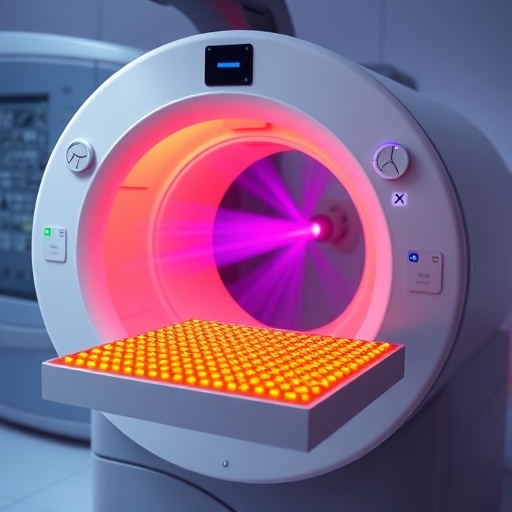
Medical computed tomography may be approaching a major detector upgrade after researchers reported a perovskite X-ray photon-counting device capable of operating at fluxes comparable to those encountered in clinical CT scanning. The detector, described by S. Wang, M. Li, A. Wood and colleagues in Nature Photonics, combines an edge-on architecture with chloride-alloyed formamidinium lead bromide crystals. Together, these strategies produced a response time of 37 nanoseconds after deconvolution and allowed the device to count 120-kilovolt-peak X-ray photons at a flux of approximately 2 × 10^8 photons per second per square millimetre. The result addresses one of the most persistent barriers preventing perovskite semiconductors from moving into high-speed photon-counting imaging.
Photon-counting CT detectors work differently from conventional detectors. Instead of simply measuring the total energy deposited by a beam, they register individual X-ray photons and estimate their energies. This makes it possible to distinguish materials more precisely, suppress certain sources of image noise and potentially reduce radiation exposure while preserving diagnostic quality. The approach is especially attractive for medical imaging because X-ray photons carry information not only through their number but also through their energy distribution. Yet photon-counting systems must process a huge stream of events without confusing one photon for another. At common CT operating conditions, the required counting rate can range from 3 × 10^6 to 1 × 10^8 photons per second per square millimetre, placing extraordinary demands on detector speed.
Traditional semiconductor photon-counting materials have struggled to meet that demand, while perovskites have offered a compelling but incomplete alternative. Metal halide perovskites absorb X-rays strongly because they contain relatively heavy elements, including lead and bromine. Their electronic properties can also be tuned through composition, and their crystals can be produced at potentially lower cost than many established detector materials. These advantages have generated intense interest in perovskites for radiation detection. However, a detector may absorb X-rays efficiently and still fail as a high-speed counter if the electrical charges created by each photon move too slowly, become trapped or arrive at the electrodes in a distorted sequence.
The new work tackles the transport problem through an edge-on configuration. In a conventional detector arrangement, X-rays enter through the broad face of the semiconductor, and the charge carriers may need to travel through a relatively thick crystal before reaching the electrodes. That thickness is useful for stopping energetic X-rays, but it also creates a long route for electrons and holes. In the edge-on design, the X-rays travel along the length of the perovskite crystal, while the charges are collected across its much shorter width. According to the researchers, this geometry shortens the charge-collection distance by 15 times without sacrificing the material’s X-ray absorption path. Because carrier transit time scales approximately with the square of the collection distance under comparable conditions, the reduction in distance can lower the transit time by about 225 times.
That geometric improvement alone does not explain the detector’s performance. The researchers found that nearly every incident X-ray photon generated free charges that encountered shallow traps in FAPbBr3, the perovskite crystal known chemically as formamidinium lead bromide. Shallow traps are defects or imperfections that capture charge carriers temporarily rather than removing them permanently from the electrical signal. A trapped electron or hole can eventually be released, but its delayed arrival broadens the detector response and may cause signals from successive photons to overlap. At high flux, this phenomenon can produce pulse pile-up, in which the detector interprets several closely spaced events as one distorted event, reducing counting accuracy and undermining energy resolution.
The discovery is significant because it identifies a microscopic bottleneck that can remain hidden when a detector is tested only at modest X-ray intensities. If almost every photon produces charge that interacts with a shallow trap, even a material with excellent absorption and high intrinsic mobility may respond too slowly for CT. The researchers addressed this issue by alloying the perovskite with chloride. Introducing chloride into the FAPbBr3 crystal structure dramatically reduced the density of shallow traps, allowing a larger fraction of photogenerated charges to travel promptly toward the electrodes. The alloying strategy therefore complements the edge-on architecture: the geometry shortens the distance charges must travel, while the altered composition reduces the interruptions they encounter along the way.
The device also benefits from a strong electric field established across the short charge-collection distance. A high field accelerates charge carriers and increases the likelihood that they will be extracted before recombination or prolonged trapping. Importantly, the researchers report that the field can still extract charges that have been temporarily captured by shallow defects. This means the detector is not dependent on eliminating every imperfection in the crystal. Instead, it combines fewer traps with conditions that rapidly release and collect carriers when trapping does occur. That combination is crucial for maintaining a sharp electrical response when photons arrive only nanoseconds apart.
After accounting for the detector’s measured response characteristics through deconvolution, the resulting response time was reported as 37 nanoseconds. Deconvolution is a mathematical process used to separate the intrinsic timing response of a detector from distortions introduced by the measurement system and signal electronics. The reported value indicates that the device can resolve extremely rapid changes in the X-ray signal, although practical imaging performance will also depend on factors such as pulse-processing electronics, pixel cross-talk, noise, calibration and long-term stability. The researchers further demonstrated edge-on detectors with pixels measuring 200 × 200 micrometres, a scale relevant to high-resolution imaging, under 120-kVp X-ray operation.
The ability to count at 2 × 10^8 photons per second per square millimetre is the headline result because it reaches, and in this case exceeds, the upper end of the flux range associated with common CT scanning. At such intensities, a detector must remain linear, prevent pulse pile-up and preserve enough information about each photon’s energy to support spectral imaging. Perovskite devices that previously appeared too slow for this environment could now become candidates for photon-counting CT, provided the performance can be reproduced across large detector areas and maintained under prolonged radiation exposure. The result may also interest researchers developing high-speed X-ray cameras, industrial inspection systems, security scanners and other instruments that must monitor intense radiation without losing individual events.
Several challenges remain before the technology can be considered ready for routine clinical deployment. Perovskite materials can be sensitive to heat, moisture, electrical stress and prolonged radiation, so packaging and environmental protection will be essential. Manufacturing large, uniform crystals with consistent trap densities and precisely defined edge-on electrodes may also prove difficult. Medical detectors must operate reliably over years, not merely during laboratory demonstrations, and they must meet demanding standards for calibration, safety and reproducibility. Nevertheless, the study offers a clear design principle: high-flux photon counting requires both a short electrical collection path and control over the defects that delay charge transport. By joining those two ideas, the researchers have pushed perovskite X-ray detectors into a performance regime once considered beyond their reach, bringing the material a step closer to reshaping the future of photon-counting computed tomography.
Cite Scienmag News
Denise Maddox. (August 25, 2026). Edge-on perovskite detectors suppress shallow traps for photon-counting medical CT. Scienmag. https://scienmag.com/edge-on-perovskite-detectors-suppress-shallow-traps-for-photon-counting-medical-ct/
Denise Maddox. "Edge-on perovskite detectors suppress shallow traps for photon-counting medical CT." Scienmag, 25 August 2026, https://scienmag.com/edge-on-perovskite-detectors-suppress-shallow-traps-for-photon-counting-medical-ct/. Accessed 4 September 2026.
Denise Maddox. "Edge-on perovskite detectors suppress shallow traps for photon-counting medical CT." Scienmag. August 25, 2026. https://scienmag.com/edge-on-perovskite-detectors-suppress-shallow-traps-for-photon-counting-medical-ct/


