

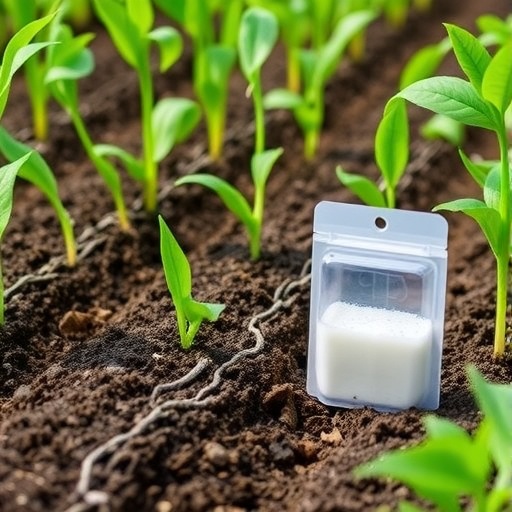
In a groundbreaking study published in the journal “Discover Sustainability,” researchers Amjad, S., Malaika, and Zaib, S. investigate the exciting potential of green synthesized nanofertilizers in the ongoing quest for sustainable agriculture. By harnessing environmentally friendly methods for nanoparticle synthesis, the authors aim to not only improve crop yield but also bolster resilience against abiotic stresses such as drought and salinity. This dual goal addresses two critical challenges faced by modern agriculture and promises a way forward that is both innovative and eco-conscious.
Nanotechnology has long been heralded as a transformative force across various scientific domains. In agriculture, the incorporation of nanoparticles into fertilizer formulations is gaining traction. This research meticulously documents how green synthesized nanofertilizers can revolutionize plant nutrition while minimizing ecological footprints. Utilizing natural biopolymers and extracts, the researchers highlight an eco-friendly synthesis route that differentiates these nanofertilizers from their conventional counterparts that often rely on harsh chemicals.
One of the pivotal findings in the study is the remarkable effectiveness of these nanofertilizers in enhancing nutrient uptake in plants. The authors demonstrate that nanoparticles exhibit a unique capability to penetrate plant tissues more effectively than traditional fertilizers, thus facilitating a more efficient delivery of vital nutrients such as nitrogen and phosphorus. This is essential for improving crop productivity, particularly in nutrient-depleted soils where conventional fertilizers often fall short.
Moreover, the methods employed in the synthesis of these nanofertilizers play a critical role in their performance. The research highlights the utilization of plant extracts rich in phytochemicals, which not only serve as reducing and capping agents during the nanoparticle formation but also enhance the bioavailability of nutrients. This biogenic approach ensures that the resulting nanofertilizers are not only potent but are also safe for both the environment and human health.
Another significant aspect of the research involves the impact of these nanofertilizers on plants under abiotic stress conditions. The authors provide compelling evidence that the application of green synthesized nanofertilizers leads to improved stress tolerance in crops. Through various physiological and biochemical analyses, it was observed that plants treated with these nanofertilizers exhibited better growth rates, enhanced root development, and improved leaf water retention under drought conditions.
As the world faces increasing threats from climate change, the ability to cultivate crops that can withstand extreme weather scenarios is becoming increasingly vital. The findings from this study suggest that green synthesized nanofertilizers may be an essential tool in developing resilient agricultural systems capable of adapting to changing climates. By maintaining crop health and promoting growth even in less-than-ideal conditions, these innovative fertilizers could significantly contribute to global food security.
The scalability of the synthesis process is another topic of discussion in this research. The authors address potential concerns regarding the practical applicability of their methods on a larger scale. By utilizing common agricultural waste materials and plant-based resources, the green synthesis of nanofertilizers can be both cost-effective and sustainable. This opens new avenues for farmers worldwide, particularly in developing regions where traditional agricultural practices may be unsustainable.
Additionally, the environmental implications of adopting green synthesized nanofertilizers extend beyond just agricultural practices. The study emphasizes the reduced chemical runoff in ecosystems, which is a prevalent issue associated with conventional fertilizers. This not only mitigates soil degradation but also protects water bodies from eutrophication, a dangerous process largely driven by the excess nutrients commonly found in synthetic fertilizers.
Public perception and acceptance of nanotechnology in agriculture is yet another dimension that the authors touch upon. Through educational outreach and awareness programs, the researchers believe that farmers and consumers alike can reap the benefits of these technologies. Building trust through transparency around the synthesis and application of nanofertilizers may pave the way for widespread adoption and a significant shift towards greener farming practices.
Moreover, the role of regulatory bodies cannot be overlooked in this discussion. The authors advocate for the establishment of guidelines and frameworks surrounding the use of nanotechnology in agriculture. This step is vital to ensure that innovations are integrated safely and effectively into farming practices while maintaining ecological integrity.
An interdisciplinary approach, combining insights from agriculture, environmental science, and nanotechnology, is deemed necessary by the authors to fully realize the potential of green synthesized nanofertilizers. Collaborative efforts among researchers, policymakers, and farmers can facilitate the creation of sustainable practices that not only address current challenges but also lay the foundation for future innovations in the field of agriculture.
The implications of this research extend well beyond the confines of a laboratory study. As we stand on the cusp of an agricultural revolution driven by nano-innovations, the findings presented by Amjad, S., Malaika, and Zaib, S. serve as a clarion call for the adoption of sustainable and eco-friendly practices in farming. The future of agriculture will undoubtedly rely on such advancements, guiding us toward a path that reconciles food production needs with environmental stewardship.
As consumers become more conscious about the origin of their food and its environmental impact, the demand for sustainably produced crops will likely surge. The introduction of green synthesized nanofertilizers embodies a solution that not only meets these consumer demands but also aligns with global sustainability goals.
In conclusion, the study’s findings suggest an exciting and promising direction for the future of agriculture. Green synthesized nanofertilizers represent a unique convergence of science and sustainability, potentially revitalizing agricultural practices around the world. With continued research and development, these innovative solutions could well be the answer to some of the most pressing challenges in the quest for sustainable food production.
Subject of Research: Green synthesized nanofertilizers for sustainable agriculture and abiotic stress management.
Article Title: Green synthesized nanofertilizers for sustainable agriculture and abiotic stress management.
Article References:
Amjad, S., Malaika, Zaib, S. et al. Green synthesized nanofertilizers for sustainable agriculture and abiotic stress management.
Discov Sustain 6, 1341 (2025). https://doi.org/10.1007/s43621-025-02257-8
Image Credits: AI Generated
DOI: https://doi.org/10.1007/s43621-025-02257-8
Keywords: nanotechnology, sustainable agriculture, green synthesis, nanofertilizers, abiotic stress, crop resilience, environmentally friendly practices, food security, climate change adaptation.


