

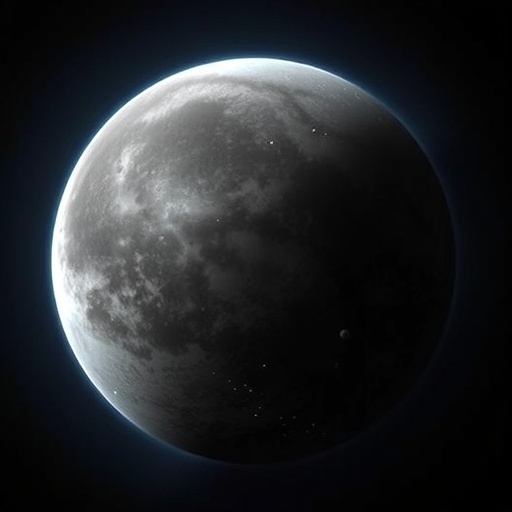
The scientific landscape continues to reveal the intricate connections between celestial bodies and our home planet, Earth. In the latest groundbreaking research, an international team of scientists has presented compelling evidence suggesting that terrestrial atmospheric ion implantation has played a significant role in the development of lunar regolith on the Moon’s nearside. This monumental discovery sheds new light on the potential interactions between the Earth and Moon throughout geological history, while also offering profound implications for our understanding of planetary evolution and the dynamics of ancient Earth.
The study, spearheaded by esteemed researchers Paramanick, Blackman, and Tarduno, delves into the long-standing relationship between the Earth’s dynamo and the effects it has had on both the Moon and the broader solar system. By meticulously analyzing samples from lunar regolith, the team has identified traces of ion implantation that suggest a direct connection between terrestrial atmospheric phenomena and the Moon’s surface. This brings forth a revolutionary perspective suggesting that not only solar winds but also Earth-based atmospheric interactions have influenced the lunar environment.
In their research, the scientists employed advanced analytical techniques to assess the elemental and isotopic composition of lunar materials. By utilizing cutting-edge mass spectrometry among other methodologies, they were able to detect specific isotopes indicative of ion implantation processes, providing empirical support for their hypotheses. This rigorous methodology underscores the importance of interdisciplinary collaboration in modern science, as it combines geology, planetary science, and atmospheric physics to forge a comprehensive understanding of such complex interactions.
The intriguing findings of this study offer a new avenue for exploring lunar geochemistry and its ties to Earth’s historical environmental conditions. Previous theories primarily focused on cosmic and solar influences being responsible for lunar regolith formation. However, this research promotes a paradigm shift towards acknowledging that terrestrial influences—namely, ions emitted from Earth during its varying atmospheric conditions—may have intermingled with the lunar surface. This revelation is emblematic of the evolving nature of scientific inquiry as it continuously seeks to unravel the myriad complexities inherent within planetary science.
The implications of this research extend beyond the Moon, suggesting that Earth itself has experienced an evolutionary feedback loop, where its own atmospheric dynamics have had a hand in shaping not only the lunar landscape but possibly other celestial bodies as well. The researchers hypothesize that similar processes could exist for other moons and planets within our solar system, paving the way for future investigations into how planetary atmospheres interact with their neighbors in the vast cosmic landscape.
What makes this study particularly fascinating is its potential to deepen our understanding of the early solar system’s dynamics. The researchers posit that during specific epochs of Earth’s dynamo activity, heightened ionic emissions could have dramatically influenced the shaping of the Moon’s surface. This interaction raises questions about the broader implications for the habitability of other extraterrestrial bodies, especially those in orbits close to their parent planets. It hints at a complex history of interplanetary exchanges that have been previously overlooked by the scientific community.
Furthermore, the study’s findings hold relevance for future lunar exploration missions. As humanity’s gaze turns towards the Moon with plans for sustainable habitation and exploration, understanding the composition of lunar regolith becomes crucial. This newfound evidence of ion implantation could inform prospective missions on the Moon by pinpointing areas rich in resources or by indicating how terrestrial atmospheric conditions might have unrecognized effects on lunar materials.
The realization that Earth’s atmospheric interactions influenced the Moon adds a layer of complexity to our understanding of planetary relationships in the solar system. It calls for a collaborative approach where scientists from various disciplines can converge to challenge existing narratives and explore the potential for shared histories among celestial bodies. Whether it’s the nuances of atmospheric dynamics or the minute processes of surface alteration, these interconnections reveal an enriching tapestry which converging fields of research can further uncover.
Scientists have long been fascinated by the Moon’s surface, and this study invites us to re-examine our relationship with our nearest neighbor. In exploring how Earth’s atmosphere has left its mark on the nearside lunar regolith, we are reminded that the Moon is not merely an inert rock but a dynamic entity that has mirrored Earth’s evolutionary journey over billions of years. Hence, this research not only paves the way for future studies on inter-celestial interactions but also revitalizes interest in studying the Moon as a key player in understanding our own planet’s history.
As our understanding of the relationship between the Earth and Moon deepens, the research opens new chapters in the ongoing quest to decipher the history of our solar system. With each new revelation about the Moon’s past, we inch closer to grasping the intricate mechanics that govern not only our own planet but also the worlds beyond our own. This essential perspective not only enriches our current knowledge but also sets the stage for future scientific inquiries, ensuring a continuous dialogue about the interconnections within our celestial neighborhood.
The study symbolizes a remarkable advancement in the study of planetary sciences, and it signals a shift towards an inclusive approach that recognizes the interplay of various forces acting on planetary bodies. As researchers continue to unravel the mysteries of the cosmos, the knowledge gleaned from such intricate investigations will undoubtedly influence ensuing generations of scientists and encourage a more holistic view of how planets interact through space and time.
This groundbreaking research authored by Paramanick et al. is not just a testament to the capabilities of contemporary science but also a clarion call for collective efforts in understanding our place within the cosmos. As we uncover new relationships and dynamic processes that have shaped the histories of distant celestial bodies, it becomes imperative to nurture curiosity and collaboration across diverse scientific domains. Through such efforts, we may continue to unveil the secrets of our solar system, enlightening our understanding of the intrinsic connections that bind all planetary bodies in a delicate dance of evolution and change.
In conclusion, the findings surrounding atmospheric ion implantation within the Moon’s regolith significantly enrich our comprehension of both the Moon and Earth’s dynamo phenomena. Researchers have opened an exciting dialogue about how interplanetary relationships have influenced geological processes and vice versa. As we look forward to exploring the Moon and beyond, this study provides an essential foundation for future research, encouraging us to peer deeper into the cosmic origins that define our existence. This research heralds a transformative era in planetary sciences, poised to reveal even more of the intricate narrative that binds us to the world beyond our own.
Subject of Research: Terrestrial atmospheric ion implantation in lunar regolith
Article Title: Terrestrial atmospheric ion implantation occurred in the nearside lunar regolith during the history of Earth’s dynamo.
Article References:
Paramanick, S., Blackman, E.G., Tarduno, J.A. et al. Terrestrial atmospheric ion implantation occurred in the nearside lunar regolith during the history of Earth’s dynamo. Commun Earth Environ 6, 1001 (2025). https://doi.org/10.1038/s43247-025-02960-4
Image Credits: AI Generated
DOI: https://doi.org/10.1038/s43247-025-02960-4
Keywords: Lunar Regolith, Terrestrial Ion Implantation, Earth’s Dynamo, Planetary Science, Interplanetary Interactions, Atmospheric Dynamics.


