


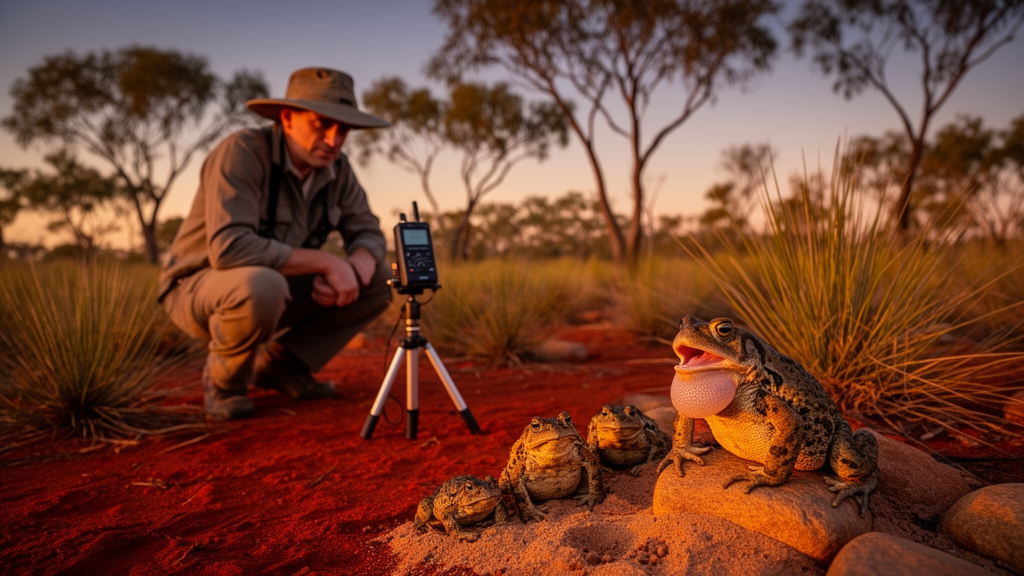
Across northern Australia, an invasion announces itself every night in sound. Male cane toads gather at waterbodies and call in choruses that can stretch from dusk to dawn, a mating signal that also happens to be one of the most detectable traces of one of the world’s worst invasive species. Now, a study published in NeoBiota has harnessed that signal at a continental scale, using a network of autonomous recorders and a machine-learning classifier to map when, where and under what conditions the toads call across most of their Australian range.
The research team drew on the Australian Acoustic Observatory, a continent-wide sensor network of 62 monitoring sites spanning seven major ecoregions, from rainforests to arid landscapes. Previous work had already identified cane toad occurrence at more than 20 sites within the network, across the Northern Territory, Queensland and Western Australia. Building on that foundation, the new analysis processed recordings from 41 potential toad sites, collected between February 2019 and September 2023, covering roughly 15 degrees of latitude and 27 degrees of longitude and three Australian States.
The technical heart of the study is a custom acoustic classifier built on the BirdNET algorithm, trained on manually labelled recordings from the observatory. Because isolated single detections are often false positives, the researchers refined their results with a contextual thresholding framework that aggregated time-series features, requiring an average confidence above 0.5163 over a 12-hour window and a maximum confidence above 0.997. The final pipeline produced 3,274,015 three-second call detections from approximately 405,588 hours of audio, with 95.6 percent precision and 80.8 percent recall. After filtering, 21 sites across three climate zones yielded 33,799 nights of data and a staggering 163,701 minutes of detected cane toad calls.
Two parallel statistical models formed the analytical core. A calling-probability model, using a binomial distribution, asked whether calling occurred on a given night, effectively capturing chorus initiation. A calling-intensity model, using a gamma distribution, measured how many minutes of calling occurred on nights when calling happened, capturing chorus persistence. Together, the framework resembles a hurdle approach, separating the transition from silence to calling from the amount of calling once that threshold is crossed. Both models shared the same suite of predictors: nightly temperature, humidity, wind speed, cloud cover, rainfall at multiple lag windows, moonlight, day of year, waterbody distance and flow regime, water permanence, canopy cover and, crucially, the toads’ own recent calling history.
The environmental data came from gridded sources: daily weather from the SILO climate database at 0.05-degree resolution, hourly cloud cover and wind components from the ECMWF Reanalysis v5 dataset at 0.25-degree resolution, and clear-sky astronomical moonlight estimates from a dedicated R package. Habitat and hydrology were assembled by merging four national hydrological datasets and creating a 264-metre buffer around each recorder, chosen based on the average nightly movement distance of cane toads. Within each buffer, the researchers measured distance to the nearest waterbody, classified its flow regime as lentic or lotic, and categorised its permanence as absent, temporary or perennial. Canopy cover was collapsed into three levels from the Digital Earth Australia Land Cover dataset.
The results paint a vivid picture. Cane toads chorused nearly year-round, with seasonal peaks rising sharply between March and April, coinciding with the late wet season, and declining through the dry months. Calling began shortly after sunset, ramped up within about an hour, plateaued through the evening and tapered off towards dawn. Wet-season choruses started later in the night but sustained higher activity levels, often past midnight. Notably, despite the continental span, there was no consistent latitudinal gradient in monthly calling patterns, and even southern sites recorded occasional winter choruses, suggesting that climate alone does not fully explain calling behaviour.
The strongest and most consistent driver was not weather at all, but the toads’ own recent activity. Calling on the previous night overwhelmingly elevated both the probability and intensity of calling the next night, across every climate zone analysed. The cumulative number of calling nights in the preceding week also increased calling probability steeply, though the effect plateaued after several consecutive nights. This pattern is consistent with social facilitation, a phenomenon in which the sound of conspecific calls draws additional males and females to breeding sites, creating a positive feedback loop. Experimental field studies have shown that cane toads exhibit strong phonotaxis, orienting and moving towards conspecific calls to locate aggregations.
Temperature effects were strikingly context-dependent. Without a prior chorus, calling probability and intensity peaked at moderate nightly minimum temperatures, following a hump-shaped relationship consistent with the thermal performance breadth reported for anuran calling. Calling was least likely to initiate or persist below roughly 6 to 7 degrees Celsius. But once a chorus had occurred the previous night, calling remained likely across a much broader thermal range, including cooler and very warm nights. The researchers suggest that social context reshapes the cost-benefit trade-off: once males are already at the water and a chorus is underway, the reproductive payoff of continued calling may outweigh physiological costs, even under conditions that would otherwise suppress initiation.
Among abiotic factors, moonlight stood out. Toads called less often and for shorter periods on brighter nights, consistent with predator-avoidance behaviour, as greater nocturnal illumination may increase conspicuousness. Wind also suppressed calling, likely by increasing evaporative water loss, elevating convective cooling and degrading acoustic transmission through turbulence and vegetation noise. High relative humidity at the nightly minimum temperature had a clear positive effect on both calling probability and intensity, plausibly reflecting a water-balance mechanism that reduces evaporative water loss and the energetic cost of calling. Same-day rainfall slightly reduced calling probability, possibly due to storm noise, while accumulated rainfall over three days boosted calling intensity and over seven days increased calling probability at sites lacking permanent water, where rain pulses likely create ephemeral breeding ponds.
Habitat structure mattered too. Toads called most often and for longer in open habitats with low canopy cover, matching their known preference for breeding on relatively open ground with sparse vegetation. Dense cover likely hampers acoustic communication by attenuating calls and shortening effective transmission distance. Temporary waterbodies supported higher calling probability and longer bouts than locations without surface water, likely because ephemeral ponds offer short, predator-poor breeding opportunities, whereas permanent waterbodies more often harbour fish and aquatic insect larvae that prey on eggs and tadpoles. Lentic systems, such as ponds, lakes and reservoirs, were strongly favoured over lotic channels, matching the toads’ tendency to spawn in still pools and avoid flowing water.
When the researchers stratified their analysis by Köppen climate zones, the relative importance of drivers shifted. In subtropical and semi-arid sites, atmospheric and lunar factors, including wind, moonlight and seasonality, were more influential for initiating choruses. In the Tropics, where ambient conditions sit closer to the species’ optimal climatic niche, habitat and hydrology contributed more to sustaining choruses. Prior-night calling dominated in every zone, reinforcing the centrality of social dynamics. These zone-specific patterns help clarify how calling correlates vary across broad environmental settings and may support more targeted interpretation of acoustic activity by climate zone.
The study demonstrates the value of ecoacoustics for investigating vocal invasive species at large spatial scales. Passive acoustic monitoring operates continuously with minimal disturbance, scales to large deployments and provides call detections from remote sites that would be costly or impossible to survey in person. The approach has already been used in invasive-species studies worldwide, and the cane-toad classifier developed for this work may have broader utility beyond Australia, having generally performed well in a Japanese acoustic dataset despite the presence of a native frog species with a potentially confusing vocalisation.
For management, the findings sharpen surveillance strategy. Because calling can occur outside the main wet season, even in marginal areas, monitoring may need to extend beyond conventional seasonal windows. Ephemeral, still waters emerge as key foci for calling activity and monitoring. The strong effect of prior-week calling suggests that once choruses get underway, social and logistical carry-over, not just nightly conditions, keeps calling elevated across successive nights, meaning a single detection night can signal sustained breeding activity. The researchers note that pairing acoustic monitoring with on-site microclimate measurements, higher-resolution environmental data and independent field evidence of breeding, such as eggs or tadpoles, would strengthen ecological interpretation and improve the value of acoustic surveillance for future research and management, particularly at range edges and invasion fronts where the toads continue to advance.
Subject of Research: Continental-scale passive acoustic monitoring of cane toad calling activity in Australia
Article Title: Acoustic monitoring of invasive species: Continental patterns in calling activity of the invasive cane toads
Article References: Leung, F. K. W., Allen-Ankins, S., & Schwarzkopf, L. (2026). Acoustic monitoring of invasive species: Continental patterns in calling activity of the invasive cane toads. NeoBiota, 108, 89-119. https://doi.org/10.3897/neobiota.108.181967
Image Credits: AI Generated
DOI: 10.3897/neobiota.108.181967
Keywords: cane toad, invasive species, passive acoustic monitoring, ecoacoustics, Australia, machine learning, amphibian, chorusing, invasion biology, Rhinella marina, acoustic surveillance, breeding ecology
Cite Scienmag News
Patricia Pace. (October 17, 2026). Ears on the Outback: Listening Network Maps the Secret Chorus of Australia’s Cane Toad Invasion. Scienmag. https://scienmag.com/ears-on-the-outback-listening-network-maps-the-secret-chorus-of-australias-cane-toad-invasion/
Patricia Pace. "Ears on the Outback: Listening Network Maps the Secret Chorus of Australia’s Cane Toad Invasion." Scienmag, 17 October 2026, https://scienmag.com/ears-on-the-outback-listening-network-maps-the-secret-chorus-of-australias-cane-toad-invasion/. Accessed 17 October 2026.
Patricia Pace. "Ears on the Outback: Listening Network Maps the Secret Chorus of Australia’s Cane Toad Invasion." Scienmag. October 17, 2026. https://scienmag.com/ears-on-the-outback-listening-network-maps-the-secret-chorus-of-australias-cane-toad-invasion/


