


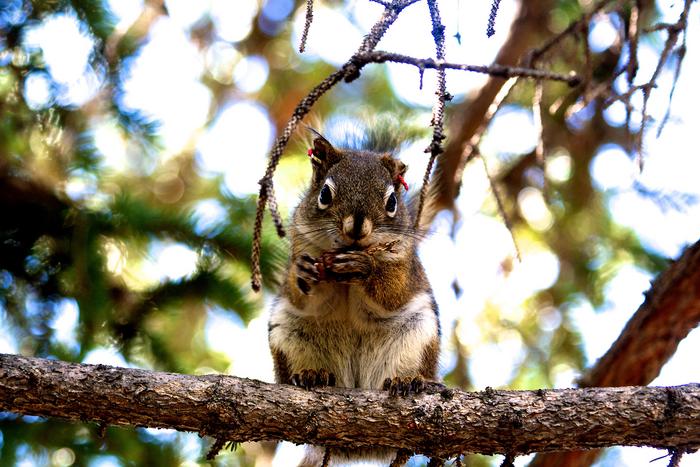
Life in the Yukon can be tough for young red squirrels.

Credit: Ryan Taylor
Life in the Yukon can be tough for young red squirrels.
Frigid winters, food scarcity, intense competition for territories and the threat of becoming prey to large predators like the Canada lynx are just some of the trials they face.
Early-life struggles and trauma can literally get under their skin, affecting long-term survival, said Lauren Petrullo, a University of Arizona assistant professor in the Department of Ecology and Evolutionary Biology. Scientists want to know what factors, if any, can buffer young squirrels against these threats.
Petrullo is part of the Kluane Red Squirrel Project, a multi-university long-term field project involving the University of Alberta, University of Michigan, University of Colorado Boulder and University of Saskatchewan. The project has tracked and studied thousands of wild North American red squirrels in the southwestern part of Canada’s Yukon territory for over 30 years.
A new study – which Petrullo led with David Delaney, a postdoctoral fellow at the University of Colorado Boulder – finds that the more challenges young squirrels face in the year they are born, the shorter their adult lifespan.
Red squirrels who make it past their first year of life live about 3 1/2 years, on average, but early life adversity can cut life expectancy by at least 14%.
But there’s a big caveat.
“The ecosystem red squirrels inhabit in this region is unique,” Petrullo said. “Every three to seven years, their favorite food – seed from cones of white spruce trees – is produced in superabundance during what we call a food boom. We found that these booms, even though rare, can interrupt the biological embedding of early-life adversity. If a squirrel had a harsh first year of life, if they were lucky enough to experience a food boom in their second year of life, they lived just as long – if not longer – in spite of early-life adversity.”
The team replicated a food boom by offering wild squirrels in the Yukon peanut butter as a supplemental food source. The peanut butter didn’t have the same effect as the naturally occurring food boom did.
“This suggests that the buffering effect we see is not really just about an increase in available calories,” Petrullo said. “It’s probably about shifts in larger population-level dynamics, like competition.”
What squirrels can teach us about humans
Petrullo and her colleagues are eager to tease out the mechanisms that link squirrels’ early developmental conditions with later-life survival. What they learn could inform scientific understanding of human resilience, too.
“Our findings in red squirrels echo what we know about how early-life adversity can shorten adult lifespan in humans and other primates,” Petrullo said. “Humans vary widely in how vulnerable or resilient they are to challenges faced during early development. Our study demonstrates that future environmental quality might be an important factor that can explain why some individuals appear to be more, or less, susceptible to the consequences of early-life adversity.”
While it might be surprising that scientists can glean insights about human resilience from wild red squirrels, Petrullo pointed out that squirrels are rodents, and rodents are commonly used as models for humans in laboratory settings.
“Many lab experiments have limited relevance for broader dynamics between ecology and evolution, because it can be hard to really replicate the ecological challenges that animals have evolved to cope with in a lab setting,” she said.
Wild red squirrels, on the other hand, allow for such investigations and are an especially useful study group for questions regarding the early-life environment, Petrullo said. Although growing up as a young squirrel in the Yukon can be difficult, with lots of things making early development challenging, there are also things that can go right.
“Some red squirrels have the luck of being born into gentler early environments, akin to being born with a silver spoon,” Petrullo said. “Because of this, we’ve got this really nice individual variation in early-life environmental quality across a natural ecological environment.”
This environment, however, is expected to experience a great deal of change as global temperatures continue to rise.
“As food boom patterns begin to change,” Petrullo said, “the pathways that connect early-life experiences and lifespan may change as well, potentially offering important insight into how animals may adapt to increasingly challenging environments.”
Journal
Proceedings of the Royal Society B Biological Sciences
Method of Research
Observational study
Article Title
A future food boom rescues the negative effects of early-life adversity on adult lifespan in a small mammal
Article Publication Date
24-Apr-2024
Cite Scienmag News
Sloane Callahan. (April 24, 2024). Early trauma cuts life short for squirrels, and climate change could make matters worse. Scienmag. https://scienmag.com/early-trauma-cuts-life-short-for-squirrels-and-climate-change-could-make-matters-worse/
Sloane Callahan. "Early trauma cuts life short for squirrels, and climate change could make matters worse." Scienmag, 24 April 2024, https://scienmag.com/early-trauma-cuts-life-short-for-squirrels-and-climate-change-could-make-matters-worse/. Accessed 5 September 2026.
Sloane Callahan. "Early trauma cuts life short for squirrels, and climate change could make matters worse." Scienmag. April 24, 2024. https://scienmag.com/early-trauma-cuts-life-short-for-squirrels-and-climate-change-could-make-matters-worse/

