


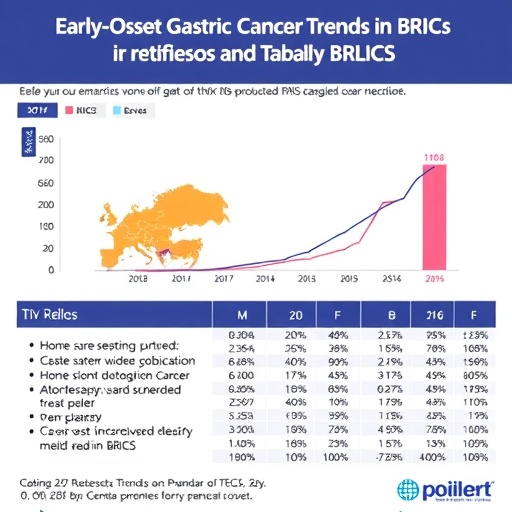
A groundbreaking epidemiological analysis has shed new light on the burden and trajectory of early-onset gastric cancer (EOGC) across the 11 BRICS countries, offering critical insights grounded in the most recent and comprehensive Global Burden of Disease (GBD) 2021 database. This study meticulously dissects the incidence patterns, risk factors, and future projections of EOGC, a malignancy historically underexplored despite its growing public health significance.
Gastric cancer remains the fifth most common cancer globally, posing a formidable challenge due to its often late diagnosis and poor prognosis. Remarkably, early-onset cases, defined as those occurring at a younger age, constitute approximately 10% of total gastric cancer incidents. This demographic shift demands a nuanced understanding, as younger patients frequently exhibit distinct clinical and genetic profiles influencing disease progression and treatment responses.
The investigative team employed advanced statistical modeling, including joinpoint regression analysis, to rigorously evaluate temporal trends from 1990 through 2021. Their focus on the 11 BRICS nations—Brazil, Russia, India, China, South Africa, and six additional emerging economies—reflects a strategic choice to explore regions undergoing rapid demographic, socioeconomic, and environmental transitions that may impact cancer epidemiology.
Key findings reveal a substantive decline in absolute EOGC cases by nearly 12% and a more pronounced reduction of over 33% in disability-adjusted life years (DALYs) over the study period. Such decreases might suggest improvements in cancer control policies or shifts in risk factor exposures, although the burden remains unevenly distributed. Notably, China and India represent the epicenters of absolute case counts, whereas the United Arab Emirates maintains the lowest reported burden.
Age-standardized rates (ASRs) unveil further complexities. China and Russia exhibit the highest incidence and burden rates, correlating with environmental exposures and lifestyle factors prevalent in these regions. Contrastingly, the UAE’s lower ASRs raise intriguing questions about potential protective factors or differences in healthcare access and reporting accuracy.
The study emphasizes pronounced gender disparities, with males generally exhibiting a higher EOGC burden except in Ethiopia, the UAE, and Saudi Arabia where this pattern does not hold. These differences may reflect divergent behavioral risk factors, such as smoking prevalence and dietary habits, necessitating targeted interventions.
Temporal trend analysis uncovers predominantly declining ASRs across most nations, a beacon of progress linked to improved public health measures and possibly heightened awareness and earlier diagnosis. Egypt emerges as an anomaly with a slight uptick in age-standardized incidence and DALY rates, signaling an urgent need for focused healthcare strategies in this region.
A notable discovery involves transient surges in incidence observed in South Africa and Saudi Arabia during specific intervals, underscoring the dynamic nature of cancer epidemiology shaped by socio-political, environmental, or healthcare system changes.
Investigations into health inequalities reveal persistent disparities concentrated within higher socio-demographic index (SDI) countries. Although absolute inequalities are statistically insignificant, the sustained relative gaps highlight the imperative for equitable healthcare delivery and resource allocation.
Population dynamics play a pivotal role in shaping epidemiological trends. For most BRICS nations, population growth and aging significantly drive upward burden trends. However, China and Russia mainly experience changes due to population growth, whereas aging is more influential in Ethiopia, highlighting the heterogeneous demographic influences on disease patterns.
The interplay between risk factors and disease burden emerges vividly through decomposition and exposure analyses. Smoking consistently ranks as a leading modifiable risk factor, with variable population attributable fractions (PAFs) across countries. The Russian Federation and China report the highest smoking-associated risks, linked to increasing summary exposure values (SEVs), reflecting worsening risk profiles or improved risk exposure estimations.
Dietary factors, particularly high sodium consumption, remain a steadfast concern. India and Ethiopia register peak PAFs for high-sodium diets coupled with increasing exposure, a combination that perpetuates gastric carcinogenesis risk. These insights underscore the urgency of integrating nutritional policy reforms into cancer prevention frameworks.
Crucially, projections to 2035 anticipate an overall continued decline in EOGC burden nationally within the BRICS countries. Yet, these predictions paradoxically highlight South Africa’s potential rise to the second-highest age-standardized DALY rate, a trend warranting intensified surveillance and intervention efforts.
The study’s methodological rigor is further enhanced by sensitivity analyses employing the Nordpred model, substantiating the robustness of the Bayesian age-period-cohort (BAPC) model projections and providing policymakers with reliable foresight for strategic planning.
This comprehensive evaluation reveals that despite encouraging declines in EOGC burden, the BRICS nations face disparate epidemiological realities. Higher-SDI countries and male populations bear disproportionate disease loads, underscoring the critical necessity for demographically tailored preventive measures.
The identification of smoking and high-sodium diets as principal modifiable risk factors offers actionable targets for health authorities. Coordinated regional strategies focused on tobacco control and nutritional interventions can significantly mitigate the EOGC burden.
Looking ahead, strengthening regional collaboration among BRICS countries is paramount. Shared expertise, harmonized data systems, and unified prevention campaigns can streamline efforts to curb EOGC, enhancing outcomes through resource synergy and policy coherence.
Furthermore, improved surveillance mechanisms are essential to detect emerging trends, evaluate intervention efficacy, and adapt strategies dynamically, ensuring sustained progress against early-onset gastric cancer.
The comprehensive nature of this analysis not only illuminates the evolving landscape of EOGC within critical emerging economies but also establishes a replicable framework for future cancer burden studies in similar global contexts.
In sum, the pioneering research underscores an urgent call to action—integrating epidemiological insights with public health innovation—to confront the nuanced challenges of early-onset gastric cancer and safeguard future generations across the BRICS nations.
Cite Scienmag News
Nathaniel Bowman. (October 1, 2025). Early-Onset Gastric Cancer Trends in BRICS. Scienmag. https://scienmag.com/early-onset-gastric-cancer-trends-in-brics/
Nathaniel Bowman. "Early-Onset Gastric Cancer Trends in BRICS." Scienmag, 1 October 2025, https://scienmag.com/early-onset-gastric-cancer-trends-in-brics/. Accessed 3 September 2026.
Nathaniel Bowman. "Early-Onset Gastric Cancer Trends in BRICS." Scienmag. October 1, 2025. https://scienmag.com/early-onset-gastric-cancer-trends-in-brics/


