


Electric bicycle rebates have exploded in popularity in North America as transportation planners try to get people out of their cars and into healthier, more climate-friendly alternatives. However, there is limited understanding of the full impacts of these incentives.

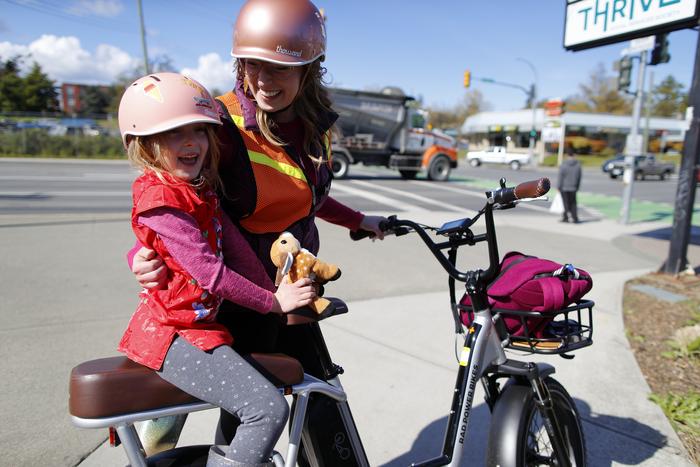
Credit: Photo credit: District of Saanich
Electric bicycle rebates have exploded in popularity in North America as transportation planners try to get people out of their cars and into healthier, more climate-friendly alternatives. However, there is limited understanding of the full impacts of these incentives.
Are new cycling habits sustainable? Who benefits most from these incentives? And are they worth the cost?
Researchers at UBC’s Research on Active Transportation (REACT) Lab have some answers. They surveyed participants in an e-bike incentive program offered by the District of Saanich, B.C. and found that most new e-bike users continued to regularly use their bikes as a substitute for car travel, even a year after purchase. Low-income households reduced their car trips and decreased carbon emissions the most. And incentives are a cost-effective way of reducing carbon emissions.
Reduced car travel
The Saanich program, available in 2021 and 2022, offered three different rebates to offset the cost of new e-bikes, depending on one’s income. The basic rebate amounted to $350, while the lowest-income households could receive up to $1,600.
Results showed a significant surge in e-bike adoption, with 93 per cent of users being new to e-bikes, and 60 per cent new to cycling altogether.
One year after purchase, users continued to be satisfied with their e-bikes, integrating them into their routines for three to four days a week. They reduced weekly car travel by an average of 48 kilometres per week, a reduction of 30-40 per cent.
“The incentive not only encouraged people to switch to e-bikes, it also resulted in remarkable changes in travel behaviour that persisted long after the purchase,” said Dr. Alex Bigazzi, principal investigator and associate professor of civil engineering at UBC who leads REACT.
The incentives had the greatest impact on lower-income groups. Among those who received the $1,600 incentive, eight out of 10 would not have purchased an e-bike without it, compared to just two out of 10 who received the $350 incentive.
Lower carbon emissions
With less driving, users reduced their travel-related greenhouse gas (GHG) emissions by an average of 16 kilograms of CO2 per week, one year after buying their e-bikes. Notably, those who received the biggest incentives reduced car use and carbon emissions the most.
“The larger incentives aimed at lower-income families did a great job getting new riders in the saddle and gave them a lower-cost alternative to using their cars,” Dr. Bigazzi said.
More cost-effective than EV rebates
A common criticism of e-bike incentives is their high cost relative to their climate benefits, but the Saanich program was competitive with other transportation subsidies in Canada at a cost of approximately $190 to $720 per tonne of GHG emissions.
“This suggests that e-bike incentives are more cost-effective in reducing emissions compared to electric car incentives, and that’s without including a range of cycling-related benefits such as increased physical activity, reduced local air pollutants and decreased travel costs,” Dr. Bigazzi said.
The REACT Lab has partnered with the Province of B.C. and other researchers to study the provincewide e-bike incentive program. The broader scope will allow researchers to look at factors including variations in climate and terrain and the availability of safe cycling routes, to better understand their influences.
Interview language(s): English
Images: Dropbox
Article Title
Travel Behaviour and Greenhouse Gas Impacts of the Saanich E-Bike Incentive Program
Article Publication Date
30-Apr-2024
Cite Scienmag News
Denise Maddox. (April 30, 2024). E-bike incentives prove to be worth the investment. Scienmag. https://scienmag.com/e-bike-incentives-prove-to-be-worth-the-investment/
Denise Maddox. "E-bike incentives prove to be worth the investment." Scienmag, 30 April 2024, https://scienmag.com/e-bike-incentives-prove-to-be-worth-the-investment/. Accessed 9 September 2026.
Denise Maddox. "E-bike incentives prove to be worth the investment." Scienmag. April 30, 2024. https://scienmag.com/e-bike-incentives-prove-to-be-worth-the-investment/

