


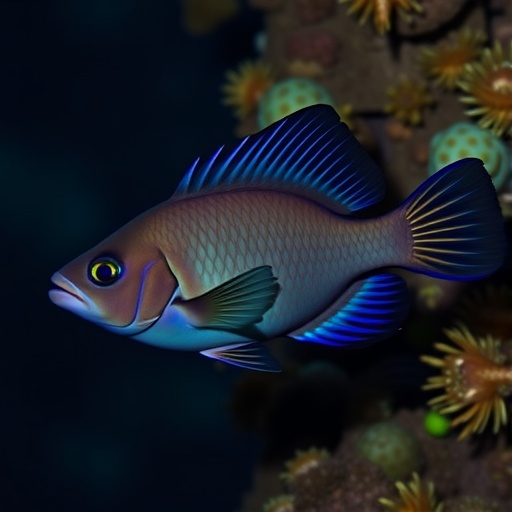
In the vast underwater realms, where the dance of flora and fauna paints a vivid picture of life, researchers have ventured to unearth the cognitive capabilities of one of the ocean’s more intriguing inhabitants: the dusky damselfish. In an innovative study spearheaded by a team of scientists, the cognitive performance of these fish was examined through a detour task that gradually increased in difficulty. The results shed light on the complexities of fish behavior and challenge preconceived notions about marine intelligence.
The dusky damselfish, found predominantly in coral reef ecosystems, is not just a beautiful specimen but also a fascinating subject of cognitive research. These fish are noted for their vibrant colors and territorial nature, often showcasing interactions that can be sophisticated. The current study investigates the cognitive flexibility and problem-solving abilities of these fish in a controlled experimental scenario. The experiment not only provides insights into their learning processes but also contributes to a broader understanding of fish intelligence as it relates to environmental challenges.
The detour task used in the study is a well-established method for assessing cognitive performance in various species, allowing researchers to measure how animals navigate obstacles to reach a goal. By progressively increasing the difficulty of this task, the researchers were able to evaluate not only the damselfish’s ability to learn and adapt but also their persistence in overcoming challenges. This gradual escalation in difficulty mirrors the adaptive challenges animals face in their natural habitats, thus lending ecological validity to the results.
Through the tasks designed, the research team observed the fish engaging in behaviors indicative of complex cognitive processing, such as planning and decision-making. These behaviors align closely with what is seen in birds and mammals, suggesting that cognitive abilities may not be strictly limited to more traditionally studied species. Such findings open new avenues for researchers interested in comparative cognition, as they challenge marine biologists to reconsider how we perceive intelligence across different species, especially those in often-overlooked aquatic environments.
The significance of this study extends beyond merely observing behavior; it addresses crucial questions about the evolutionary pressures that shape cognitive abilities in fish. As environments become increasingly complex due to factors such as climate change and habitat loss, the ability to navigate challenges may be crucial for survival. By understanding the cognitive landscape of species like the dusky damselfish, we can gain insights into how they may adapt to rapidly changing ecosystems and the implications for their conservation.
The researchers employed a meticulous approach, ensuring that the fish were acclimatized to the testing environment and that the tasks were structured to minimize stress. Each fish underwent a series of trials, enabling a comprehensive assessment of their learning curves and error rates. Data collected from these trials were meticulously analyzed, showcasing how individual differences among the fish may influence their performance on these tasks. Such variations underscore the dynamic nature of cognitive performance, offering a glimpse into the personalities that exist within fish populations.
Moreover, the experiment demonstrates the impact of social dynamics on cognitive performance. The dusky damselfish are known for their social structures within their habitats, and this social element may play a critical role in their cognitive development. By considering the social interactions observed during the trials, researchers are poised to explore further how communal living and social learning might enhance or sometimes hinder cognitive abilities in aquatic species.
This innovative research not only revitalizes interest in fish cognition but also emphasizes the importance of interdisciplinary approaches in marine biology. By integrating principles from ethology, psychology, and neuroscience, scientists can unravel the sophisticated cognitive worlds of aquatic life. The implications of these findings stretch far into fields such as conservation biology and ecology, as a deeper understanding of animal cognition can inform strategies for protecting vulnerable species.
In sum, the study reveals that cognitive performance among dusky damselfish is not just a matter of basic learning; it represents a rich tapestry of behavior that encompasses decision-making, problem-solving, and possibly even social influences. These insights serve as a powerful reminder of the intricate life that inhabits our oceans and the intellectual lives of creatures that have often been underestimated.
As researchers continue to explore and document these behaviors, it becomes increasingly clear that the ocean teems with life that is not only biologically rich but also cognitively diverse. Understanding the cognitive abilities of marine species like the dusky damselfish will open further investigations into the evolutionary implications of intelligence and adaptation in a changing world. As we delve deeper into the mysteries of marine life, studies such as this will play a critical role in redefining our comprehension of intelligence and resilience in the face of environmental challenges.
Thus, it is evident that the dusky damselfish, through their active engagement in complex tasks, exhibit cognitive skills that warrant recognition and deeper exploration. As we amplify our understanding of these capabilities, we reshape the narrative surrounding aquatic life and cognition, embracing the notion that intelligence is a spectrum that spans across all life forms within our planet’s diverse ecosystems.
Cite Scienmag News
Drew Townsend. (January 20, 2026). Dusky Damselfish Navigate Challenging Detour Tasks Successfully. Scienmag. https://scienmag.com/dusky-damselfish-navigate-challenging-detour-tasks-successfully/
Drew Townsend. "Dusky Damselfish Navigate Challenging Detour Tasks Successfully." Scienmag, 20 January 2026, https://scienmag.com/dusky-damselfish-navigate-challenging-detour-tasks-successfully/. Accessed 6 September 2026.
Drew Townsend. "Dusky Damselfish Navigate Challenging Detour Tasks Successfully." Scienmag. January 20, 2026. https://scienmag.com/dusky-damselfish-navigate-challenging-detour-tasks-successfully/


