


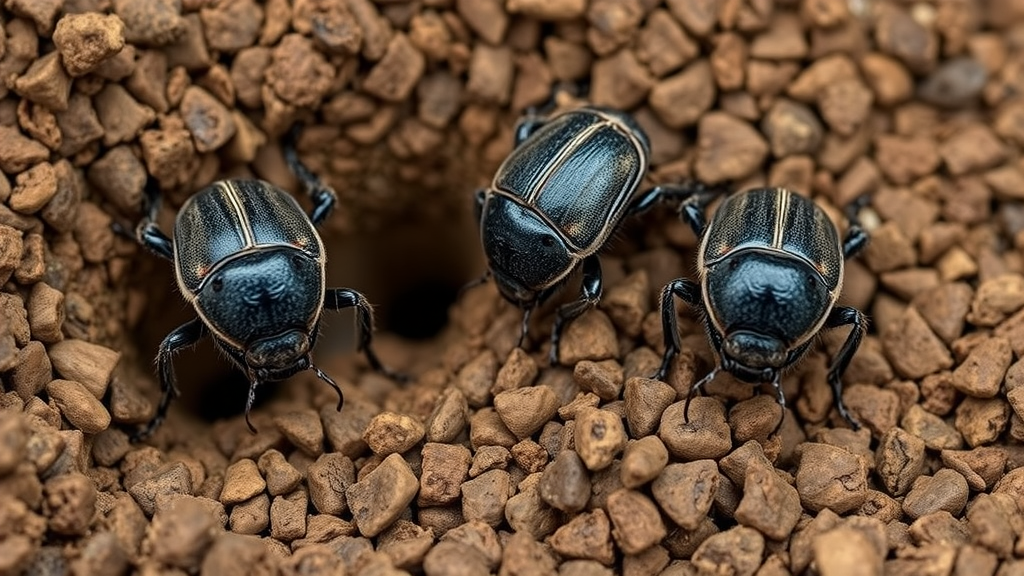
In the humid forests of Mexico, a metallic blue-green dung beetle engages in a form of parental devotion that is rare among insects. The subsocial roller beetle Canthon cyanellus cyanellus constructs brood balls from carrion, buries them, and remains with its young as they develop. Scientists have long known that this care is essential for offspring survival, but the precise mechanisms behind its protective power have remained elusive. A new study published in The Science of Nature reveals that the answer lies in an unexpected combination of physics and microbiology: parental beetles keep their nurseries from drying out, and in doing so, they also cultivate a community of beneficial bacteria on the walls of the brood ball.
The research team, led by Daniel Antonio Ortega-Rosas of the Instituto de Ecología A.C. together with colleagues from the Instituto Politécnico Nacional, set out to test whether the benefits of parental care go beyond the microbial transfer from parents to brood balls that earlier studies had proposed. Their hypothesis was that the physical maintenance of the brood ball itself—the moisture it retains, its acidity, and its structural consistency—might be just as important as any microbial inheritance. To investigate, they designed a controlled experiment that manipulated both the presence of parents and the humidity of the surrounding environment, creating a factorial matrix of conditions under which brood balls and their developing larvae could be observed.
The experiment exposed brood balls, some tended by parents and some left alone, to four levels of relative humidity: 30 percent, 50 percent, 65 percent, and 70 percent. At each level, the researchers measured the gravimetric water content of the brood balls, their pH, and their hardness, while simultaneously tracking larval survival and developmental progress. The design allowed the team to disentangle the effects of parental behavior from those of ambient moisture, a distinction that previous work had not clearly established.
The results were striking. Parental care significantly contributed to maintaining both the moisture and the structural integrity of brood balls, but these benefits were strongly dependent on the ambient relative humidity. High humidity of at least 65 percent emerged as a critical threshold for larval survival and for progression to advanced developmental stages, and this was true regardless of whether parents were present. At the other end of the spectrum, when relative humidity dropped to 50 percent or below, larval mortality reached a devastating 100 percent, even when parents remained in attendance. In other words, parental care could not rescue offspring from an environment that was simply too dry.
This finding reframes our understanding of what parental care actually does for these beetles. Rather than acting primarily as a shield against fungal infection through microbial transfer, as had been suggested, the parents’ most vital contribution appears to be preventing brood ball desiccation. A brood ball that retains its moisture preserves a crucial physical property: structural plasticity. The developing larva must be able to migrate through the ball to reach the food chamber where it feeds, and a hardened, dried-out ball turns this journey into an impassable obstacle. By keeping the ball pliable, parents ensure that their offspring can physically access the resources they need to grow.
Beyond moisture, the researchers found that parental care produced a slightly more alkaline pH in the brood balls across most treatments. While this shift might seem subtle, pH is a fundamental driver of microbial ecology, and the change appeared to be associated with measurable differences in the bacterial communities colonizing the brood ball surface. To characterize these communities, the team employed metataxonomic analysis of the 16S ribosomal RNA gene, sequencing the V3–V4 region to identify the bacteria present under each experimental condition.
The microbiome results added a rich new dimension to the story. Parental care significantly influenced the bacterial assemblage on the brood ball surface, increasing alpha diversity and favoring genera associated with organic matter degradation and antimicrobial activity. Among the genera enriched in the presence of parents were Nocardioides, known for its ability to break down complex pollutants; Bacillus, a genus famous for producing antimicrobial compounds; and Nannocystis, a myxobacterium with documented bioactivity. These taxa suggest that caring parents are not merely keeping their nests damp but are actively cultivating a microbial community that may help suppress harmful fungi and accelerate the decomposition processes that make the brood ball’s contents digestible for the larva.
Equally intriguing was the discovery of a bacterial core shared across all brood balls regardless of treatment. Eight genera, including Acinetobacter, Sphingobacterium, and Micromonospora, were consistently present, forming a baseline microbiome that appears to be a stable feature of the brood ball environment. The presence of Micromonospora is particularly noteworthy, as members of this genus are renowned producers of bioactive natural products and have been isolated from diverse insect systems, where they may contribute to host defense. The combination of a consistent core community with parentally enhanced diversity suggests a layered system: a foundational microbiome that comes with the brood ball, overlaid by parental modifications that tip the ecological balance toward microbes beneficial to offspring.
The implications of this work extend beyond the biology of a single beetle species. Dung beetles and their necrophagous relatives are keystone decomposers in tropical ecosystems, responsible for nutrient cycling, soil aeration, and secondary seed dispersal. Canthon cyanellus cyanellus, as a subsocial species that invests heavily in each brood ball, may be especially vulnerable to environmental perturbations that disrupt its delicate reproductive calculus. The study’s authors point out that shifts toward drier conditions, whether driven by climate change or deforestation, could significantly compromise the reproductive success of this species. If ambient humidity falls below the critical threshold of roughly 65 percent, no amount of parental diligence can save the brood, meaning that habitat drying translates directly into reproductive failure.
This research also speaks to a broader question in evolutionary biology: why has subsocial behavior, in which parents remain with offspring long after egg-laying, evolved repeatedly in scarabaeine beetles? The answer emerging from this study is that parental care in these insects functions through multiple synergistic channels. It is at once a hydraulic engineering project, maintaining the moisture that keeps the nursery habitable; a microbiological stewardship program, enriching the bacterial community with degradative and antimicrobial taxa; and a modest chemical intervention, shifting brood ball pH toward conditions that may favor beneficial microbes. The convergence of these mechanisms explains why parental presence so dramatically improves offspring outcomes under suitable humidity, and why it becomes powerless when the environment itself turns hostile. As tropical forests warm and dry, understanding these finely tuned dependencies becomes essential for predicting which species will persist and which will quietly disappear, one failed brood ball at a time.
Subject of Research: Parental care effects on brood ball physicochemical properties and bacterial communities in the subsocial dung beetle Canthon cyanellus cyanellus
Article Title: Parental care in Canthon cyanellus cyanellus maintains brood ball moisture and shapes bacterial communities: implications for offspring survival
Article References: Parental care in Canthon cyanellus cyanellus maintains brood ball moisture and shapes bacterial communities: implications for offspring survival. (n.d.). https://doi.org/10.1007/s00114-026-02160-w
Image Credits: AI Generated
DOI: 10.1007/s00114-026-02160-w
Keywords: Canthon cyanellus cyanellus, parental care, brood balls, relative humidity, larval survival, bacterial communities, metataxonomy, dung beetles, subsocial behavior, microbiome, desiccation, climate change
Cite Scienmag News
Morgan Morrow. (September 22, 2026). Dung Beetle Parents Keep Nests Moist and Recruit Helpful Bacteria to Save Their Young. Scienmag. https://scienmag.com/dung-beetle-parents-keep-nests-moist-and-recruit-helpful-bacteria-to-save-their-young/
Morgan Morrow. "Dung Beetle Parents Keep Nests Moist and Recruit Helpful Bacteria to Save Their Young." Scienmag, 22 September 2026, https://scienmag.com/dung-beetle-parents-keep-nests-moist-and-recruit-helpful-bacteria-to-save-their-young/. Accessed 4 October 2026.
Morgan Morrow. "Dung Beetle Parents Keep Nests Moist and Recruit Helpful Bacteria to Save Their Young." Scienmag. September 22, 2026. https://scienmag.com/dung-beetle-parents-keep-nests-moist-and-recruit-helpful-bacteria-to-save-their-young/


