


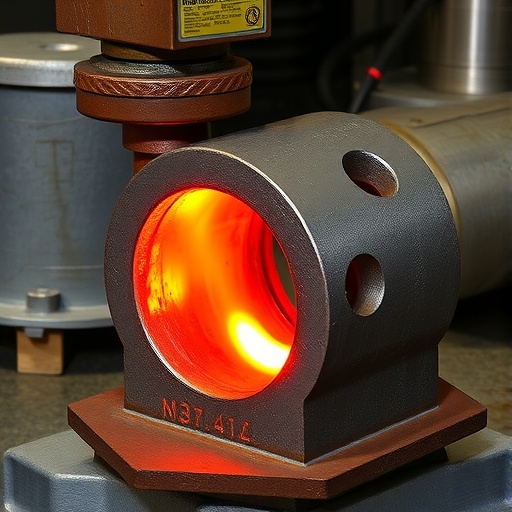
A groundbreaking study introduces a novel chromium–molybdenum (Cr–Mo) alloy exhibiting exceptional ductility and remarkable resistance to high-temperature oxidation, potentially transforming materials engineering for extreme environments. Developed through precise arc-melting processes, the alloy compositions containing approximately 37 at.% Mo, with a variant incorporating 3 at.% Si, demonstrate an unprecedented combination of mechanical robustness and oxidation endurance at temperatures as high as 1,100 °C.
The Cr–Mo alloys were synthesized from ultra-high-purity elemental precursors—99.95% Mo, 99+% Cr, and 99.99% Si—using a controlled arc-melting protocol under an inert argon atmosphere at sub-atmospheric pressure. To mitigate residual oxygen contamination, a zirconium getter was incorporated prior to remelting cycles, ensuring the chemical homogeneity of ingots weighing between 100 and 150 grams. Each ingot underwent five remelting iterations, with one batch additionally subjected to long-duration homogenization at 1,600 °C for 48 hours under flowing argon to refine microstructural uniformity.
Cyclic oxidation studies were meticulously conducted on machined cuboidal specimens with dimensions optimized for surface-area-to-volume analysis. The specimens’ surfaces were polished to a fine grit using silicon carbide abrasives and their oxidation behavior was tested in ambient laboratory air at incremental temperatures of 800 °C and 1,100 °C. Oxidation profiles included varying cycle durations—from rapid 1-hour exposures to extended 10-hour periods—allowing detailed evaluation of oxide scale development over timeframes extending to 100 hours. Mass changes were tracked with micron-scale precision, enabling calculation of mass changes normalized to initial surface area, while scanning electron microscopy techniques provided cross-sectional insights into oxide morphology and thickness.
The reliability of oxidation quantification was bolstered by advanced uncertainty quantification through error propagation analyses that considered variability in oxide scale thickness and mass changes across multiple specimens and measurement surfaces. This statistical rigor enhanced confidence in derived parameters characterizing oxide composition ratios and provided robust metrics for oxidation resistance evaluation under realistic operating scenarios.
Mechanical characterization of the alloy at elevated temperatures employed precision-engineered compression tests across a broad thermal range (100 °C to 1,100 °C). Samples were fabricated with polished interfaces and tested within custom fixtures minimizing frictional disturbances using boron nitride lubricants. Temperature stabilization protocols and dual-strain measurement systems ensured accurate determination of both engineering and true stress-strain relationships. Particular attention was given to the analysis of plastic deformation, which presented with serrated flow behavior, leading to evaluation under a 1% plastic offset strain criterion for standardized mechanical comparison.
Comprehensive microstructural investigations embraced multimodal electron microscopy approaches. Samples in various states—cast, homogenized, oxidized, and deformed—were prepared with meticulous polishing sequences up to sub-micron diamond suspensions to achieve mirror finish for electron backscatter diffraction (EBSD) analysis. High-voltage scanning electron microscopy, combined with energy-dispersive X-ray spectroscopy (EDS), elucidated the elemental distribution within oxide scales and substrate regions, while EBSD mapping revealed crystallographic orientations and the presence of deformation twins, providing critical insight into microstructural evolution under thermal and mechanical stress.
Atom probe tomography (APT) provided atomic-scale compositional maps of the chromia scale and its interface with the substrate. Specimens prepared via focused ion beam lift-out methods facilitated pulsed laser atomization analyses at cryogenic temperatures, enabling near-atomic resolution of oxidation-induced nanostructures. Despite challenges intrinsic to oxide measurements—such as trajectory aberrations due to varying evaporation fields and oxygen’s propensity to evaporate as neutrals—careful volume selection permitted quantitative characterization of oxide particles, validating the oxidation mechanisms proposed by the researchers.
X-ray diffraction (XRD) techniques complemented microstructural data by characterizing crystalline phases and lattice parameters. Measurement conditions employing Bragg–Brentano geometry and high-resolution detectors enabled precise determination of cubic lattice constants. Analytical extrapolation methods corrected angular dependencies, leading to accurate assessments of solid solution structures, which underpin the alloy’s high-temperature stability and mechanical performance.
Thermodynamic modeling via the CALPHAD approach, utilizing the Pandat software and proprietary databases, predicted phase equilibria and solidus temperatures, corroborating experimental findings. Such simulations are essential for alloy design, enabling the tailoring of compositions to achieve targeted melting points and phase stability regimes, which directly impact mechanical and oxidation behavior at elevated operating temperatures.
The alloy’s unique combination of ductility and oxidation resistance at high temperatures marks a significant advancement for applications demanding materials that sustain structural integrity under oxidative and mechanical duress. Potential sectors benefiting from this breakthrough include aerospace components, power generation turbines, and chemical processing environments, where traditional refractory metals often falter due to brittle failure modes or rapid oxidation.
This research sets a new paradigm in refractory alloy development by overcoming the trade-offs typically observed between oxidation resistance and mechanical ductility. The Cr–Mo–Si alloy system demonstrated herein provides an instructive model for engineering next-generation materials tailored for extreme service conditions, while the comprehensive experimental and analytical toolkit employed serves as a benchmark for future alloy design and characterization protocols.
The integration of advanced synthesis, microstructural characterization, mechanical testing, and computational modeling exemplifies a holistic approach that bridges materials science fundamentals with practical engineering needs. The implications for materials innovation extend beyond the immediate alloy system, suggesting pathways toward multifunctional metallic materials combining high-temperature resilience with robust mechanical properties.
As the demand for materials capable of withstanding harsher environments escalates, this pioneering work offers a vital foundation. It challenges existing paradigms and invites further exploration into ternary and quaternary alloy systems as candidates for next-generation high-performance metals suitable for diverse industrial applications where longevity and reliability at high temperature are paramount.
Cite Scienmag News
Neil Sanderson. (October 8, 2025). Ductile Cr-Mo Alloy Resists High-Temp Oxidation. Scienmag. https://scienmag.com/ductile-cr-mo-alloy-resists-high-temp-oxidation/
Neil Sanderson. "Ductile Cr-Mo Alloy Resists High-Temp Oxidation." Scienmag, 8 October 2025, https://scienmag.com/ductile-cr-mo-alloy-resists-high-temp-oxidation/. Accessed 3 September 2026.
Neil Sanderson. "Ductile Cr-Mo Alloy Resists High-Temp Oxidation." Scienmag. October 8, 2025. https://scienmag.com/ductile-cr-mo-alloy-resists-high-temp-oxidation/


