


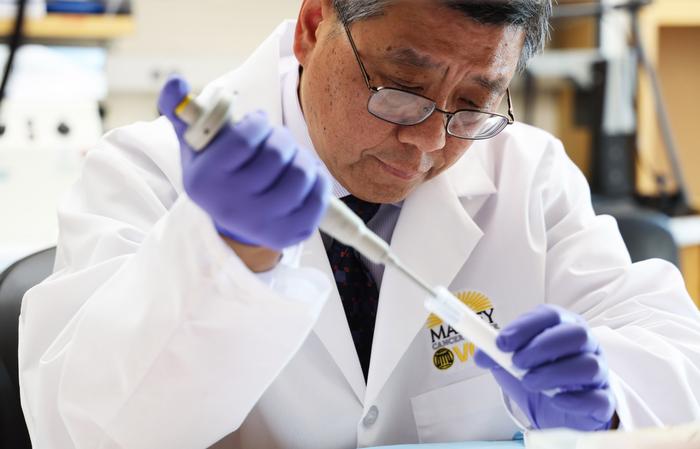
New research out of VCU Massey Comprehensive Cancer Center — recently published in Drug Resistance Updates — revealed a previously unknown biological process through which breast tumor cells develop resistance to standard treatment, which could open the door for cancer scientists around the world to further target this vulnerability in hopes of creating more effective therapies for disease.

Credit: VCU Massey Comprehensive Cancer Center
New research out of VCU Massey Comprehensive Cancer Center — recently published in Drug Resistance Updates — revealed a previously unknown biological process through which breast tumor cells develop resistance to standard treatment, which could open the door for cancer scientists around the world to further target this vulnerability in hopes of creating more effective therapies for disease.
Additionally, the research team tested a promising drug in combination with an existing therapy that achieved total remission in one breast cancer model that was resistant to the standard of care, and reduced cancer growth by nearly 70% in other models of advanced disease.
“Overcoming drug resistance is very important; we’re talking about developing new drugs that will provide hope to cancer patients who have exhausted all options available to them,” said study author Yuesheng Zhang, M.D., Ph.D., the Harrigan, Haw and Luck Families Chair in Cancer Research and a member of the Developmental Therapeutics research program at Massey.
HER2-positive breast cancers represent nearly one-fifth of all breast tumors and often grow and spread much faster than tumors that are HER2-negative, according to the American Cancer Society.
In the clinic, there are three classes of drugs approved to treat this type of cancer: 1) monoclonal antibodies (trastuzumab, sold under the brand name Herceptin, is the most commonly used drug to treat HER2-positive breast cancer), 2) tyrosine kinase inhibitors and 3) antibody small molecule conjugates.
These drugs are all designed to target the HER2 protein receptor, but Zhang’s team found that none of them are actually strong enough to completely eliminate it, offering the tumor cells more freedom to partner with other proteins within the cells to initiate cancer signaling, continue to multiply and spread.
“It’s actually quite striking. It turns out the efficacy of the standard of care is very limited, and not only do a small percentage of patients respond to treatment, even the ones who are responding will very quickly develop resistance,” said Zhang, who is also a professor in the Department of Pharmacology and Toxicology at the VCU School of Medicine.
This paper shines a light on the clinical need to more completely rid the cancer cells of HER2, but it also points a finger at the EGFR gene family being just as important in these tumors, suggesting that truly effective drugs need to target both the HER2 and EGFR receptors to eradicate disease.
“This study shows that an agent that targets the degradation of both HER2 and EGFR is highly effective in overcoming drug resistance in this disease,” Zhang said. “The findings provide new insights and innovations for advancing treatment of drug-resistant HER2-positive breast cancer that remains an unmet problem.”
In addition to unveiling a key flaw hindering current treatment options for breast cancer, Zhang and his research team also tested a novel agent that showed promising results against these tumors.
In one model, the drug achieved complete remission in combination with garadacimab, another type of monoclonal antibody. In other models where the tumors had spread to the brain, the researchers found their drug inhibited tumor growth by up to 68%.
“This means that this drug can actually cross the blood-brain barrier to attack the tumor in the brain,” Zhang said.
Zhang added they are currently in talks with the National Cancer Institute for them to manufacture the drug in an effort to gain FDA approval and move it into clinical trials.
While the team observed encouraging results with the drug they tested in the study, Zhang said the most important impact of this research is to inform other investigators about the underlying mechanism that can be targeted in HER2-positive breast cancer to improve patient outcomes.
“This paper will move the field forward because cancer scientists can develop other drugs to target this vulnerability; our agent is only one of those,” Zhang said.
Collaborators on this study include Lu Yang, Ph.D., Arup Bhattacharya, Ph.D., Yun Li, M.S., and Valentina Robila, M.D., Ph.D., of the VCU School of Medicine; Darrell Peterson, Ph.D., of the VCU School of Pharmacy; Xiaozhuo Liu, Ph.D., of Roswell Park Comprehensive Cancer Center; and Elisabetta Marangoni, Ph.D., of the Institute of Curie in France.
Journal
Drug Resistance Updates
Method of Research
Experimental study
Article Title
Targeted dual degradation of HER2 and EGFR obliterates oncogenic signaling, overcomes therapy resistance, and inhibits metastatic lesions in HER2-positive breast cancer models
Article Publication Date
1-May-2024
COI Statement
The authors declare that they have no known competing financial interests or personal relationships that could have appeared to influence the work reported in this paper.
Cite Scienmag News
Nathaniel Bowman. (May 29, 2024). Drug resistance discovery could “move the field forward” for breast cancer treatment. Scienmag. https://scienmag.com/drug-resistance-discovery-could-move-the-field-forward-for-breast-cancer-treatment/
Nathaniel Bowman. "Drug resistance discovery could “move the field forward” for breast cancer treatment." Scienmag, 29 May 2024, https://scienmag.com/drug-resistance-discovery-could-move-the-field-forward-for-breast-cancer-treatment/. Accessed 4 September 2026.
Nathaniel Bowman. "Drug resistance discovery could “move the field forward” for breast cancer treatment." Scienmag. May 29, 2024. https://scienmag.com/drug-resistance-discovery-could-move-the-field-forward-for-breast-cancer-treatment/

