Sunday, November 1, 2026
Science
No Result
View All Result
  • Login
  • HOME
  • SCIENCE NEWS
  • CONTACT US
  • HOME
  • SCIENCE NEWS
  • CONTACT US
No Result
View All Result
Scienmag
No Result
View All Result
Home Science News Biotechnology

Droplet Microfluidics Yields Uniform Core-Shell Microspheres for 3D NSCLC Models

October 29, 2026
in Biology, Biotechnology
Gregory Coleman
By Gregory Coleman Scienmag Editorial Profile - Synthetic Biology
Reading Time: 2 mins read
0
Droplet Microfluidics Yields Uniform Core-Shell Microspheres for 3D NSCLC Models

Droplet Microfluidics Yields Uniform Core-Shell Microspheres for 3D NSCLC Models

65
SHARES
587
VIEWS
Share on FacebookShare on Twitter
ADVERTISEMENT

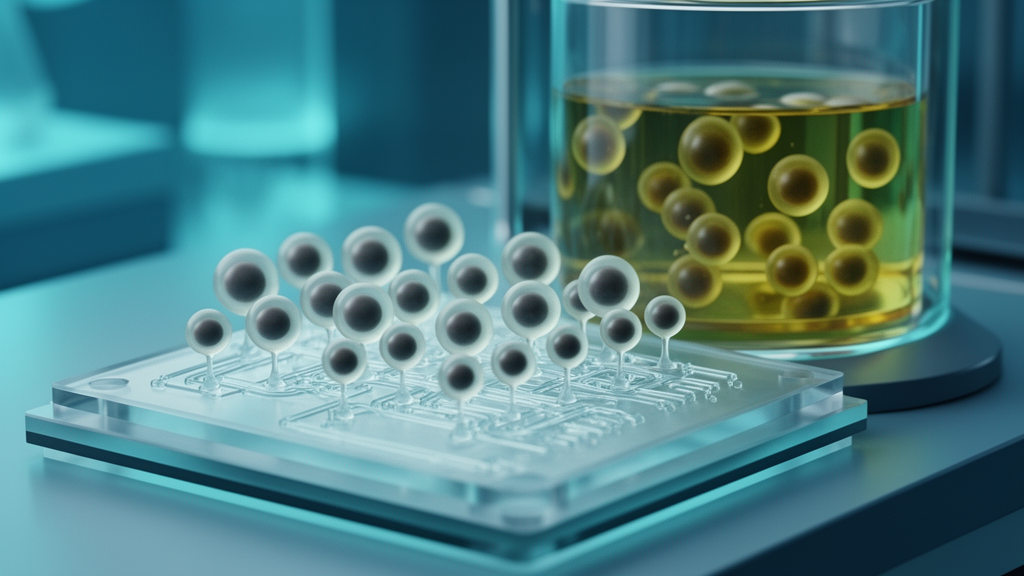
Researchers report a droplet microfluidic platform that produces tumor-laden core-shell hydrogel microspheres at high throughput, offering a new route to three-dimensional in vitro models of non-small cell lung cancer (NSCLC). The work, published in BMC Biotechnology as an open-access research article, addresses a persistent bottleneck in tumor modeling: fabricating large numbers of uniform 3D constructs that reliably recapitulate key structural features of solid tumors, something conventional two-dimensional culture systems cannot do.

The platform is built around a three-channel microfluidic device in which Matrigel serves as the core phase and HAMA, a methacrylated hyaluronic acid, forms the shell. Through coaxial flow combined with shearing by the oil phase, the device generates core-shell droplets that are then stabilized by blue-light photocrosslinking of the HAMA shell. Because the geometry of each droplet is set by fluid dynamics rather than by manual handling, the process lends itself to continuous, scalable production of tumor-bearing microspheres.

A central advantage of the approach is tunability. By adjusting the flow rates of the core, shell, and oil phases, the team obtained core-shell microspheres with controllable size and good uniformity. Under optimized conditions — core and shell flow rates of 10:10 µL/min, an oil flow rate of 200 µL/min, and a HAMA concentration of 4% — the platform generated microspheres approximately 450 μm in diameter. These standardized constructs were then used to build an in vitro NSCLC microsphere model.

The authors performed an initial characterization of the resulting constructs, examining morphology, cell viability, and the response to a model anticancer drug. Compared with a conventional 3D culture approach, the core-shell microspheres showed improved structural integrity and supported cell survival over the tested culture period. The researchers emphasize that these findings demonstrate the feasibility of the microfluidic fabrication strategy for producing tumor-laden core-shell microspheres and suggest its potential as a basis for future in vitro tumor modeling and drug-response studies. As an early-access, peer-reviewed accepted article, the version is subject to further edits before the final Version of Record appears.

Subject of Research: High-throughput droplet microfluidic fabrication of HAMA/Matrigel core-shell hydrogel microspheres for three-dimensional in vitro NSCLC tumor models

Article Title: High-throughput fabrication of HAMA/matrigel core-shell hydrogel microspheres by droplet microfluidics for in vitro NSCLC model

Article References: Wu, Q., Tang, R., Luo, T., Wang, Z., Wang, Y., Zhou, S., Yan, F., Deng, L., & He, L. (2026). High-throughput fabrication of HAMA/matrigel core-shell hydrogel microspheres by droplet microfluidics for in vitro NSCLC model. BMC Biotechnology. https://doi.org/10.1186/s12896-026-01228-9

Image Credits: AI Generated

DOI: 10.1186/s12896-026-01228-9

Keywords: droplet microfluidics, core-shell microspheres, HAMA, Matrigel, hydrogel, 3D tumor model, NSCLC, photocrosslinking, cell viability, drug response, in vitro culture, BMC Biotechnology

Cite Scienmag News

Gregory Coleman. (October 29, 2026). Droplet Microfluidics Yields Uniform Core-Shell Microspheres for 3D NSCLC Models. Scienmag. https://scienmag.com/droplet-microfluidics-yields-uniform-core-shell-microspheres-for-3d-nsclc-models/


Gregory Coleman. "Droplet Microfluidics Yields Uniform Core-Shell Microspheres for 3D NSCLC Models." Scienmag, 29 October 2026, https://scienmag.com/droplet-microfluidics-yields-uniform-core-shell-microspheres-for-3d-nsclc-models/. Accessed 1 November 2026.

Gregory Coleman. "Droplet Microfluidics Yields Uniform Core-Shell Microspheres for 3D NSCLC Models." Scienmag. October 29, 2026. https://scienmag.com/droplet-microfluidics-yields-uniform-core-shell-microspheres-for-3d-nsclc-models/

Tags: 3D non-small cell lung cancer microspheres3D tumor modeladvanced tumor tissue engineeringbiomimetic lung cancer in vitro modelsBMC Biotechnologycell viabilitycoaxial flow droplet generationcore-shell microfluidic devicecore-shell microspheresdroplet microfluidic tumor modelingdroplet microfluidicsdrug responseHAMAhigh-throughput hydrogel microsphere fabricationhydrogelin vitro cultureMatrigelmicrofluidics for cancer researchNSCLCphotocrosslinked HAMA shellphotocrosslinkingscalable 3D tumor constructstunable tumor microenvironment modelsuniform tumor spheroid production
Share26Tweet16
Previous Post

Hospital-pharmacy partnership removes payment barriers for psychiatric patients in France

Next Post

Running habits linked to knee status in recreational runners, cross-sectional study finds

Related Posts

Microbial Sources and Stress Shape the Hidden Endophytes of an Invasive Plant
Biology

Microbial Sources and Stress Shape the Hidden Endophytes of an Invasive Plant

October 30, 2026
Firebreaks Leave Lasting Scars in Grasslands While Wildfire Heals Fast
Biology

Firebreaks Leave Lasting Scars in Grasslands While Wildfire Heals Fast

October 30, 2026
One gene locus flags atrial fibrillation risk after major surgery, UK Biobank study finds
Medicine

One gene locus flags atrial fibrillation risk after major surgery, UK Biobank study finds

October 30, 2026
Hidden Peptides in Non-Coding RNAs Reshape Cardiovascular Biology
Biology

Hidden Peptides in Non-Coding RNAs Reshape Cardiovascular Biology

October 30, 2026
Phage K Holin’s C-Terminal Region Shapes Antibacterial Activity, Study Finds
Biotechnology

Phage K Holin’s C-Terminal Region Shapes Antibacterial Activity, Study Finds

October 30, 2026
Computational screen flags five natural compounds that bind a tuberculosis virulence enzyme
Chemistry

Computational screen flags five natural compounds that bind a tuberculosis virulence enzyme

October 30, 2026
Next Post
Running habits linked to knee status in recreational runners, cross-sectional study finds

Running habits linked to knee status in recreational runners, cross-sectional study finds

  • Mothers who receive childcare support from maternal grandparents show more optimized

    Mothers who receive childcare support from maternal grandparents show more parental warmth, finds NTU Singapore study

    27656 shares
    Share 11059 Tweet 6912
  • University of Seville Breaks 120-Year-Old Mystery, Revises a Key Einstein Concept

    1061 shares
    Share 424 Tweet 265
  • Bee body mass, pathogens and local climate influence heat tolerance

    682 shares
    Share 273 Tweet 171
  • Researchers record first-ever images and data of a shark experiencing a boat strike

    546 shares
    Share 218 Tweet 137
  • Groundbreaking Clinical Trial Reveals Lubiprostone Enhances Kidney Function

    531 shares
    Share 212 Tweet 133
Science

Embark on a thrilling journey of discovery with Scienmag.com—your ultimate source for cutting-edge breakthroughs. Immerse yourself in a world where curiosity knows no limits and tomorrow’s possibilities become today’s reality!

RECENT NEWS

  • Trademarks Meet Patents in New Method to Spot Technology Opportunities
  • Reddit self-declarations offer auditable labels for demographic inference
  • Scots pine needles map trace element pollution in Polish industrial town
  • Dual-blockchain scheme secures vehicle handovers without pre-shared keys

Categories

  • Agriculture
  • Anthropology
  • Archaeology
  • Athmospheric
  • Biology
  • Biotechnology
  • Blog
  • Bussines
  • Cancer
  • Chemistry
  • Climate
  • Earth Science
  • Editorial Policy
  • Marine
  • Mathematics
  • Medicine
  • Pediatry
  • Policy
  • Psychology & Psychiatry
  • Science Education
  • Science News
  • Social Science
  • Space
  • Technology and Engineering

Subscribe to Blog via Email

Enter your email address to subscribe to this blog and receive notifications of new posts by email.

Join 5,150 other subscribers

© 2025 Scienmag - Science Magazine

Welcome Back!

Login to your account below

Forgotten Password?

Retrieve your password

Please enter your username or email address to reset your password.

Log In
No Result
View All Result
  • HOME
  • SCIENCE NEWS
  • CONTACT US

© 2025 Scienmag - Science Magazine

Discover more from Science

Subscribe now to keep reading and get access to the full archive.

Continue reading