


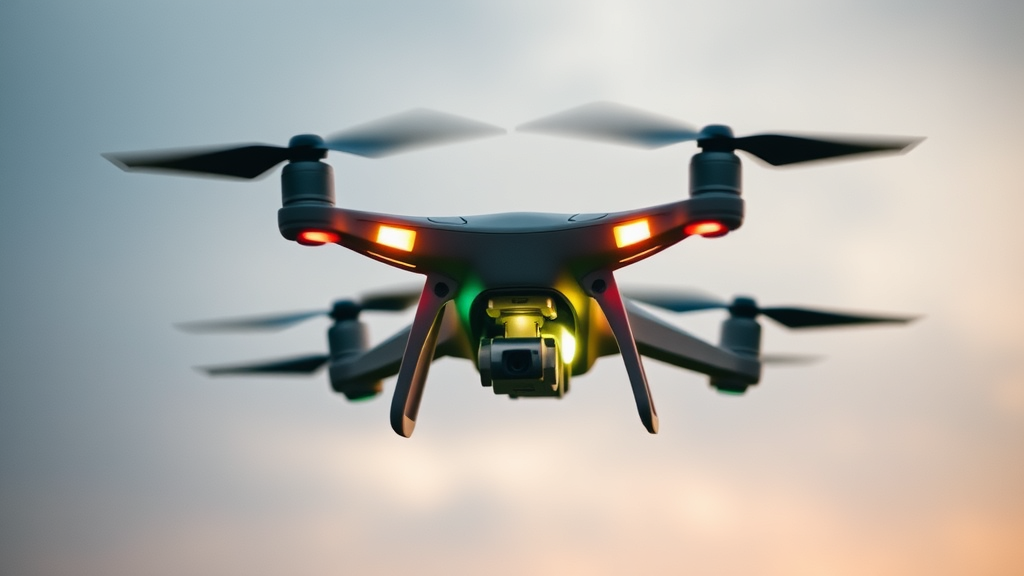
When disaster strikes, the drones dispatched to search for survivors often fly into an electronic dead zone. Jamming, spoofing, infrastructure collapse, and spectrum congestion can strip a drone swarm of the radio links it depends on, leaving individual vehicles to improvise without any shared picture of the mission. A new study published in Autonomous Robots proposes a strikingly different way for unmanned aerial vehicles to stay coordinated in these conditions: they talk to each other with their bodies. By combining choreographed flight maneuvers with synchronized light-emitting diode signals, a three-quadrotor team can broadcast bio-inspired messages that nearby drones see directly, interpret with a small onboard language model, and answer with physically executable flight paths, no radio required.
The research, led by Bryan Starbuck, Won Jang, Saee Sholapurkar, and Bert Bras at the Georgia Institute of Technology’s George W. Woodruff School of Mechanical Engineering, borrows its visual vocabulary from nature. Honey bees convey the direction and distance of food through the waggle dance, white-tailed deer flag danger with a flashing tail, peacocks advertise state with conspicuous displays, and wolf packs coordinate hunts through shared orientation. The team translated each of these behaviors into a drone-readable signal: a bee-style waggle becomes a pitch and altitude oscillation with a green blinking light that encodes search direction; a deer-style tail flag becomes a roll oscillation with red LEDs signaling a hazard; a peacock-style slow broadcast with blue LEDs announces that a target has been found; and the response, a wolf-pack-inspired yaw-dominant maneuver, aligns the receivers toward the target for a cooperative encirclement.
What separates this work from earlier gesture-based robot communication is its mathematical grounding. Every signal the drones exchange is a point in what the authors call a hybrid execution manifold: a 24-dimensional space whose coordinates describe the amplitude, frequency, and phase of oscillations along roll, pitch, yaw, and altitude, plus the color and blinking frequency of four separate LED channels. Because a drone cannot execute every conceivable signal, the researchers embedded a reduced six-parameter semantic chart inside the larger manifold, capturing only the coordinates that actually change meaning from one message to the next. When a receiver interprets an incoming signal, it needs to translate only those six numbers; the remaining eighteen are supplied by the event definition and guarantee the response can be flown.
Translation itself is performed by fine-tuned large language models. The researchers serialized each perceived glyph as a structured text prompt and trained two Qwen-family transformer models, a 14-billion-parameter Large Model and a 4-billion-parameter Small Model, to map corrupted input coordinates to the correct response coordinates using supervised fine-tuning with quantized low-rank adaptation. The training data deliberately included degraded observations: values pulled outside the admissible signaling intervals to simulate the distortion caused by distance, camera field of view, and occlusion. The compact model was then merged, converted to the GGUF format, and quantized to 8-bit precision, producing a Quantized Small Model that could run in real time on an NVIDIA Jetson Orin Nano companion computer bolted beneath a standard F450-class quadrotor.
To test the concept, the team ran 200 simulated three-drone search-and-rescue trials, each containing three sequential communication events. Crucially, the simulation computed each receiver’s visibility in real time from sensing range, side-camera field of view, and line-of-sight blockage by terrain, trees, a tower, and other drones, assigning each receiver its own degradation tier. Under clean conditions, both the quantized model and a traditional rule-based translator achieved perfect semantic accuracy. The decisive difference emerged when observations degraded: the quantized model recovered the correct meaning in 64.7 percent of singly corrupted and 64.1 percent of doubly corrupted cases, while the rule-based translator, which faithfully applies known rules to faulty inputs, managed only 44.8 and 35.2 percent. The learned translator also cut mean multi-agent trajectory error from 2.902 meters to 0.993 meters relative to the ideal reference flight.
The comparison against classical machine learning baselines yielded a subtle but important lesson. A k-nearest-neighbor regressor and a multilayer perceptron produced trajectories nearly as close to the reference as the quantized model, yet their semantic correctness lagged far behind the learned translators. Smooth flight paths, in other words, do not guarantee that a message was understood. A drone can fly a plausible-looking route while completely misreading the hazard it was warned about. Only by jointly evaluating semantic correctness, trajectory fidelity, formation spacing, rotor-thrust margins, and finite-horizon feasibility could the researchers see which methods actually preserved the intent of the communication through the full control stack.
Dynamically, every method survived: all six maintained 100 percent rotor-allocation feasibility and 100 percent finite-horizon feasibility across the trials. But the details revealed how misinterpretation stresses an airframe. The rule-based translator, propagating corrupted observations into its responses, drove the simulated quadrotors to a worst-case rotor-thrust margin of just 0.178 newtons, a maximum speed of 12.657 meters per second, and a 52-degree tilt, whereas the quantized model kept a comfortable 1.887-newton margin, 6.693 meters per second, and a 30.9-degree tilt. Correct semantics, it turns out, produce gentler physics. The quantized model also matched the unquantized Small Model almost exactly on aggregate semantic correctness, 83.3 versus 83.4 percent, while nearly halving inference latency to 2.789 seconds.
The most vivid validation came from the sky. On an F450 quadrotor carrying the Jetson Orin Nano and a Pixhawk flight controller, the pilot triggered autonomy in flight, and the Quantized Small Model inferred a bee-waggle response in roughly 3.5 seconds while airborne. The parsed six-coordinate answer was expanded into a full 24-dimensional glyph, converted into a six-degree-of-freedom reference trajectory in 0.37 seconds, and streamed as bounded velocity and yaw-rate commands through MAVLink to the Pixhawk, which tracked them while retaining low-level stabilization. The aircraft moved approximately 3.41 meters eastward during guided autonomous flight, with every command staying inside a conservative safety envelope. The complete chain, from degraded visual observation to semantic interpretation to physical motion, had been demonstrated on real hardware.
The implications reach well beyond drone choreography. Search-and-rescue teams operating after earthquakes, wildfires, or in contested airspace increasingly face degraded or denied radio environments, and optical, motion-based signaling offers a channel that cannot be jammed in the conventional sense because it is read directly by a receiver’s cameras. The Georgia Tech framework also advances a broader argument about how learned multi-agent communication should be evaluated: not as isolated prediction accuracy on clean inputs, but as a closed-loop, embodied process in which perception quality shapes semantics, semantics shapes trajectories, and trajectories shape the actuator demands and coordination geometry of the whole swarm. The authors note that future work will move from geometrically modeled observations to genuine onboard camera detection of motion-LED glyphs, extend the experiments to full multi-UAV flight, and explore richer signal vocabularies and adaptive response policies, bringing nature’s visual languages one step closer to the machines that now share our skies.
Subject of Research: Learning-enabled multi-UAV coordination through embodied bio-inspired visual communication in radio-degraded environments
Article Title: Implicit semantic control manifolds for learning-enabled multi-UAV coordination
Article References: Starbuck, B., Jang, W., Sholapurkar, S., & Bras, B. (2026). Implicit semantic control manifolds for learning-enabled multi-UAV coordination. Autonomous Robots, 50(3), Article 37. https://doi.org/10.1007/s10514-026-10265-4
Image Credits: AI Generated
DOI: 10.1007/s10514-026-10265-4
Keywords: UAV swarms, drone communication, bio-inspired signaling, large language models, quadrotor dynamics, search and rescue, visual communication, edge inference, semantic manifolds, autonomous robotics, RF-degraded environments, onboard AI
Cite Scienmag News
Denise Maddox. (September 12, 2026). Drones That Talk With Light and Motion When Radio Links Fail. Scienmag. https://scienmag.com/drones-that-talk-with-light-and-motion-when-radio-links-fail/
Denise Maddox. "Drones That Talk With Light and Motion When Radio Links Fail." Scienmag, 12 September 2026, https://scienmag.com/drones-that-talk-with-light-and-motion-when-radio-links-fail/. Accessed 5 October 2026.
Denise Maddox. "Drones That Talk With Light and Motion When Radio Links Fail." Scienmag. September 12, 2026. https://scienmag.com/drones-that-talk-with-light-and-motion-when-radio-links-fail/


