


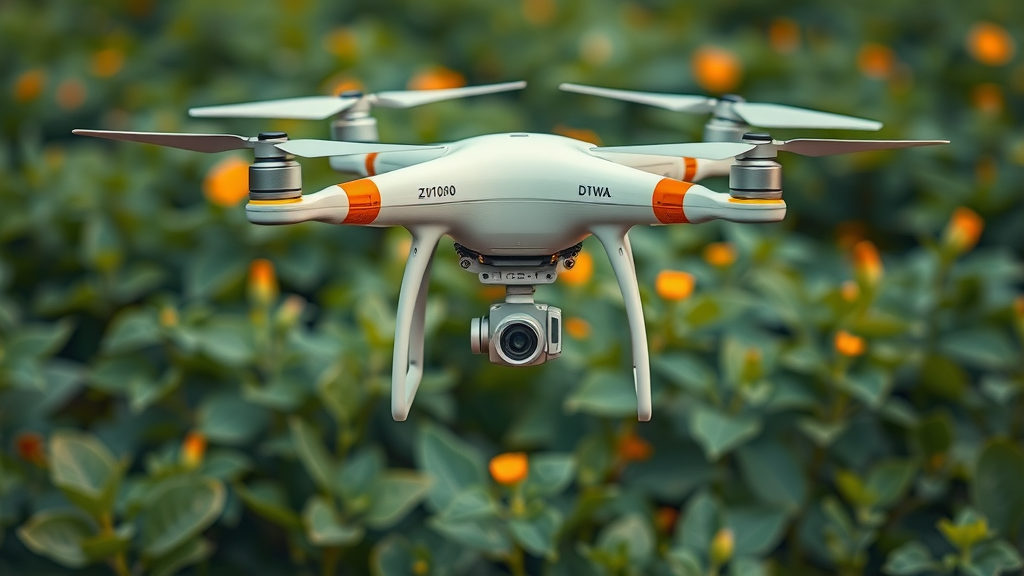
Blanket pesticide spraying has long been the default answer to foliar disease in agriculture, from smallholder plots to mechanised farms: when disease is suspected anywhere in a field, the whole field gets treated. A new study published in Discover Artificial Intelligence argues that this habit wastes chemicals, inflates costs for farmers on thin margins, accelerates pesticide resistance in pathogen populations, and adds unnecessary chemical load to soil and water. The work, by Jigneshkumar P. Desai of Parul University in India, presents a complete pipeline designed to answer a deceptively simple question: instead of asking whether to spray, exactly where should we spray, and how much? The system chains together deep-learning disease classification, explainable artificial intelligence, and drone-based spatial zone mapping into a single decision-making workflow tailored to pepper, potato, and tomato — three Solanaceous crops that share overlapping fungal and viral disease pressures.
The technical core of the pipeline is a lightweight convolutional neural network, MobileNetV2 with a 0.75 width multiplier, fine-tuned through a two-phase transfer-learning schedule. In the first phase, the network’s backbone, pre-trained on ImageNet, is frozen while a new classification head learns to interpret leaf imagery; in the second phase, the last twenty backbone layers are unfrozen and gently fine-tuned at a very low learning rate to avoid catastrophic forgetting of the low-level visual features. The model was trained on a stratified subset of 6,001 images drawn from the PlantVillage dataset, spanning fifteen classes — twelve disease categories and three healthy classes. Crucially, the study reports results over five independently seeded runs rather than a single measurement, yielding a mean validation accuracy of 67.8 percent with a standard deviation of 2.0 percent, and a weighted F1 score of 67.5 percent. A single, more thoroughly profiled run reached 82 percent accuracy, and under an identical protocol the compact MobileNetV2 outperformed the far larger ResNet50V2, which reached 79.5 percent with fourteen times more parameters.
What distinguishes the study from much of the plant-disease-detection literature is its insistence on honesty about uncertainty. The author explicitly shows that regenerating data splits from a seed assumption can shift aggregate accuracy by more than ten percentage points, and argues that notebook-scale machine-learning pipelines deserve far more scrutiny than they typically receive. The five-run mean, not the best single run, is presented as the trustworthy headline number. Performance also varies sharply across classes in ways that track both data support and visual similarity: well-supported classes such as Tomato Yellow Leaf Curl Virus reach an F1 of 0.94, while visually similar diseases like early blight and leaf mould fall to the mid-0.60s. Notably, one confusion direction — diseased potato leaves being called healthy — carries direct economic consequence, since under the spray planner’s logic such a tile would be exempted from treatment.
Explainability receives unusual quantitative treatment. Grad-CAM, the standard technique for producing heatmaps of where a network is looking, is evaluated not only visually but through the deletion/insertion faithfulness protocol, in which salient pixels are progressively removed or revealed while tracking the collapse and recovery of the model’s predicted probability. Across eight validation images, the mean deletion AUC was 0.26 and insertion AUC 0.47, with standard deviations roughly 55 to 60 percent of the means — evidence that explanation quality varies considerably from image to image. The study also identifies an instructive failure mode: for a systemic, whole-leaf disease such as Yellow Leaf Curl Virus, where symptoms are diffuse rather than localised lesions, Grad-CAM’s localisation assumption breaks down and the heatmap becomes uniformly low. The author cautions that explanation output should be interpreted differently for lesion-forming versus systemic diseases.
Robustness testing reveals a striking vulnerability with direct relevance to drone deployment. While the classifier remains comparatively stable under brightness and contrast changes, it degrades catastrophically under Gaussian noise and blur: at the most severe noise level tested, accuracy collapsed to 22.5 percent — worse than random guessing across fifteen classes. An independently trained, reduced-scale replica reproduced the same pattern, corroborating the finding. The practical implication is sobering, because motion blur from drone vibration and sensor noise under low light are exactly the conditions real UAV imagery is prone to. Camera-tilt simulation showed the model tolerates moderate off-nadir angles up to about 20 degrees, degrading by roughly nine points at 40 degrees, suggesting survey flights should stay close to nadir. A resolution sweep showed accuracy rising from roughly 50 percent at 64 pixels to a plateau near 70 percent at 128 to 160 pixels, supporting the choice of 96-pixel inputs as a reasonable latency trade-off.
The spray planner is where the vision system becomes an agronomic tool. Rather than issuing binary spray/no-spray commands, it converts per-tile disease confidence into a continuous, dose-weighted factor: a tile with confidence 0.82 against a 0.55 threshold receives 60 percent of the maximum labelled dose, while a tile exactly at threshold receives the minimum triggering dose. Class-balanced weighting was shown to measurably improve minority-class recall — rare healthy-class recall rose from 0.455 to 0.727 in a matched comparison — at a small cost to raw accuracy. Perhaps the study’s most consequential geometric finding concerns grid resolution. Using a ground-sample-distance heuristic for a typical 20-metre survey altitude and a consumer drone camera, the author calculates that a 32-by-32 tile grid is appropriate — sixteen times finer than the 8-by-8 default common in demonstration systems. At the coarse default, each tile corresponds to a patch roughly the size of a dinner plate; at the recommended resolution, each approaches the size of a single leaf, the scale at which a spray decision actually maps onto individual plant health.
The study is equally candid about its limits, and the most important is the laboratory-to-field domain gap. Every image in the training data is a laboratory photograph: uniform background, controlled lighting, a single leaf per frame, no soil, occlusion, or canopy. When the model was tested on PlantDoc, an independently collected dataset of field-condition images, top-1 classification accuracy collapsed to 20.6 percent from roughly 70 percent on laboratory imagery. Yet the coarser binary signal — distinguishing diseased from healthy rather than identifying the specific pathogen — degraded far less, holding precision of 0.870 and recall of 0.930, with mean disease confidence of 0.904. This partial resilience suggests the pipeline’s triage function may be more field-robust than its fine-grained diagnosis, a distinction with real implications for how conservatively the spray planner should be trusted outside the laboratory domain.
Additional caveats round out the picture. The planner does not model wind, spray drift, or nozzle dynamics, and its output is explicitly a coverage map requiring review by a licensed operator, not a certified variable-rate application plan. Latency was measured on a cloud GPU with unbatched calls rather than on true edge hardware; benchmarking an INT8-quantised export on devices such as a Jetson Nano or Coral Edge TPU remains necessary. There is no plant-age or growth-stage robustness test, because the dataset carries no such metadata — and the author declines to manufacture a synthetic substitute, arguing it would only test robustness to the synthetic transform rather than to genuine physiological ageing. The confidence-based rejection mechanism was demonstrated but not validated for recognising genuinely unseen diseases, since no class was truly excluded from training.
The study’s conclusion is measured rather than promotional. A lightweight, ImageNet-pretrained network, fine-tuned with a class-weighted two-phase schedule, can distinguish twelve diseases and three healthy classes across three Solanaceous crops with five-run accuracy in the high 60s to low 70s percent range — a genuinely useful signal for triage applications with human review, but well short of what unsupervised, fully automated spray decisions require. The dose-weighted, geometry-aware spray planner, the quantitative faithfulness evaluation of Grad-CAM, and the multi-run statistical protocol represent real methodological progress, and the finding that a physically motivated grid is sixteen times finer than typical illustrative defaults is a concrete data point for anyone building similar systems. But the author is unambiguous: without drone-acquired, expert-annotated field imagery, no accuracy number, however carefully measured, should be read as a claim about field performance. Closing that gap — with larger faithfulness evaluations, edge-hardware benchmarks, and genuine in-field validation — is the clearly signposted next step toward putting this pipeline to work over real crops.
Subject of Research: Precision pesticide application in Solanaceous crops using transfer learning, explainable AI, and drone-based spatial zone mapping
Article Title: Precision pesticide application in solanaceous crops using transfer learning explainable artificial intelligence and drone based spatial zone mapping
Article References: Desai, J. P. (2026). Precision pesticide application in solanaceous crops using transfer learning explainable artificial intelligence and drone based spatial zone mapping. Discover Artificial Intelligence, 6(1), Article 1213. https://doi.org/10.1007/s44163-026-02276-y
Image Credits: AI Generated
DOI: 10.1007/s44163-026-02276-y
Keywords: precision agriculture, plant disease detection, transfer learning, MobileNetV2, Grad-CAM, drone spraying, PlantVillage, solanaceous crops, explainable AI, UAV imagery, pesticide reduction, domain gap
Cite Scienmag News
Alan Morgan. (September 22, 2026). Drones and Explainable AI Aim to Cut Pesticide Waste in Solanaceous Crops. Scienmag. https://scienmag.com/drones-and-explainable-ai-aim-to-cut-pesticide-waste-in-solanaceous-crops/
Alan Morgan. "Drones and Explainable AI Aim to Cut Pesticide Waste in Solanaceous Crops." Scienmag, 22 September 2026, https://scienmag.com/drones-and-explainable-ai-aim-to-cut-pesticide-waste-in-solanaceous-crops/. Accessed 4 October 2026.
Alan Morgan. "Drones and Explainable AI Aim to Cut Pesticide Waste in Solanaceous Crops." Scienmag. September 22, 2026. https://scienmag.com/drones-and-explainable-ai-aim-to-cut-pesticide-waste-in-solanaceous-crops/


