


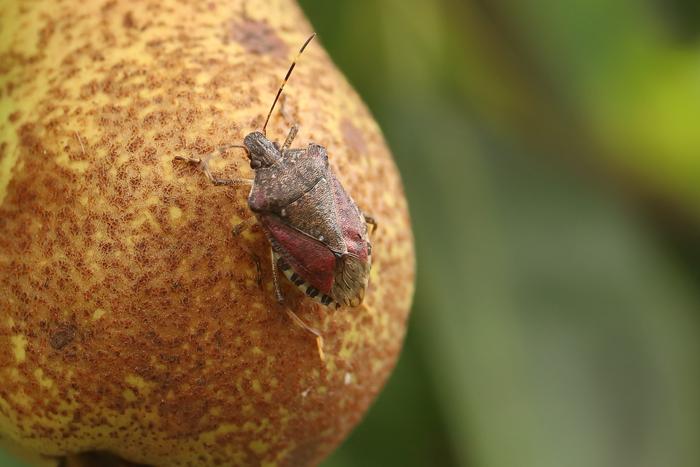
Researchers in Italy have unveiled the first successful application of commercial drones combined with artificial intelligence (AI) to monitor the invasive agricultural pest, Halyomorpha halys, commonly known as the brown marmorated stink bug. This research, published in the SCI journal Pest Management Science, marks a significant advancement in the use of unmanned aerial vehicles (UAVs) for automated monitoring of invasive species.

Credit: University of Modena and Reggio Emilia
Researchers in Italy have unveiled the first successful application of commercial drones combined with artificial intelligence (AI) to monitor the invasive agricultural pest, Halyomorpha halys, commonly known as the brown marmorated stink bug. This research, published in the SCI journal Pest Management Science, marks a significant advancement in the use of unmanned aerial vehicles (UAVs) for automated monitoring of invasive species.
Halyomorpha halys is notorious for its extensive damage to orchard crops across North America and southern Europe. In Italy, this invasive pest caused an estimated €588 million in damage to fruit production in 2019. Traditional monitoring methods, such as pheromone traps, visual sampling and sweep-netting are labour-intensive and often ineffective over large areas.
‘Current monitoring methods have some important drawbacks, such as “trap spillover” and the need and cost for operators to perform active monitoring,’ explained Daniele Giannetti, a researcher at the University of Parma and co-lead author on the paper.
‘Our aim was to find a reliable way of monitoring these invasive insects without the negative effects of the time and energy consuming methods currently used’ points out Lara Maistrello, a professor at the University of Modena and Reggio Emilia and co-lead author of the study.
Drones reduce disruption
The researchers developed an automated flight protocol, controlled via a mobile app, to capture high-resolution images of pear orchards at heights of up to eight metres. Notably, the drones were found to be much less disruptive to bugs than the presence of human observers, allowing more accurate data capture on pest distribution. Adult bugs were found to exhibit a freezing behaviour in response to the presence of an UAV, which helped to facilitate the capture of high-resolution images.
AI for autonomous pest recognition
The image dataset was used to train, validate and test AI models on identifying H. Halys. Transfer learning models, which leverage pre-existing recognition capacities, significantly outperformed models trained from scratch, with the highest performing model achieving a detection accuracy of 97%. On the effectiveness of the AI models, Giannetti noted, ‘Overall, this novel monitoring system demonstrated the potential of integrating UAV and AI to detect and quantify the presence of insect pests with the size and shape of H. halys.’
The implications of this technology are significant for integrated pest management strategies, including the development of precise forecasting models that adapt to meteorological and environmental conditions. ‘This is particularly important today in the face of rapid climate change,’ noted Giannetti.
Looking beyond stink bugs
The novel monitoring system has the potential for wide-ranging applications.
‘The imaging application can be easily adapted to different crops,’ explained Maistrello. ‘Of course, if you want to move on to other insects, you will have to train new models, but this experience is really encouraging. We find these results exciting, especially because their future applications are so many.’
Journal
Pest Management Science
DOI
Method of Research
Experimental study
Subject of Research
Not applicable
Article Title
First use of unmanned aerial vehicles to monitor Halyomorpha halys and recognize it using artificial intelligence
Cite Scienmag News
Alan Morgan. (June 5, 2024). Drones and AI harnessed to monitor invasive stink bugs. Scienmag. https://scienmag.com/drones-and-ai-harnessed-to-monitor-invasive-stink-bugs/
Alan Morgan. "Drones and AI harnessed to monitor invasive stink bugs." Scienmag, 5 June 2024, https://scienmag.com/drones-and-ai-harnessed-to-monitor-invasive-stink-bugs/. Accessed 4 September 2026.
Alan Morgan. "Drones and AI harnessed to monitor invasive stink bugs." Scienmag. June 5, 2024. https://scienmag.com/drones-and-ai-harnessed-to-monitor-invasive-stink-bugs/

