


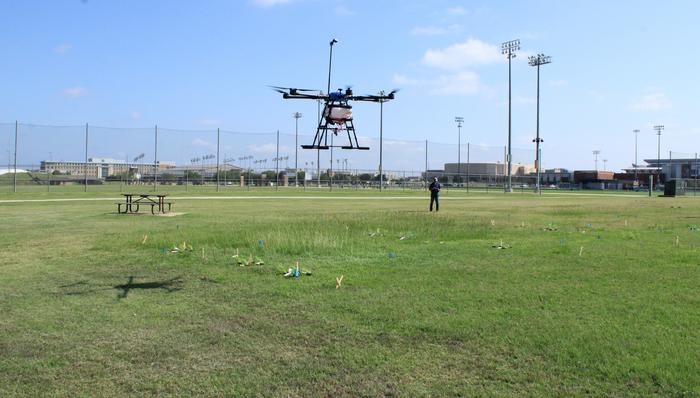
Recent advancements in agricultural technology have revealed promising methods for effective weed management in turfgrass settings, particularly through the utilization of remotely piloted aerial application systems (RPAAS). Traditional methods of weed control have often relied heavily on ground sprayers, requiring significant amounts of herbicide to achieve effective control. However, groundbreaking research from Texas A&M University offers a new perspective, demonstrating that the use of low-drift nozzles in RPAAS can yield comparable results in weed management while significantly reducing herbicide volumes.
This research, recently published in the esteemed journal "Weed Technology," explores the efficacy of various nozzle types and application volumes when applied via drone technology. The study’s findings indicate that employing low-drift nozzles at low application rates—specifically between 1.0 and 1.5 gallons per acre—results in levels of weed control that are on par with conventional ground spraying methods that utilize higher application rates of around 10 gallons per acre. Such efficiency presents a significant breakthrough in turf management strategies and prompts a reevaluation of traditional practices.
The impetus behind this study was to address a noticeable gap in our understanding of how the type of nozzle and the volume of spray influence the effectiveness of herbicide applications. As turfgrass managers become increasingly responsible for maintaining managed landscapes, insights derived from this research can empower them to adopt novel technologies that enhance their pest control measures while being mindful of environmental impacts. The research team, led by Dr. Muthukumar Bagavathiannan, aimed to provide clear guidelines that turfgrass managers can use to optimize their herbicide applications using RPAAS.
The practical implications of this research are significant, especially as concerns around chemical usage in agriculture continue to escalate. By demonstrating that lower volumes of herbicide can effectively manage weeds without compromising efficacy, this study advocates for more sustainable agricultural practices. The use of low-drift nozzles minimizes the risk of herbicide drift, which poses considerable threats to non-target species and contributes to the broader issue of environmental degradation.
Conducted over the course of 2022 at multiple sites in College Station, Texas, the study utilized three distinct types of flat-fan nozzles—extended range, drift guard, and air induction—applying them at varying low spray volumes. A four-nozzle boom backpack sprayer served as a baseline for comparison to validate the effectiveness of the drone-based applications. Results consistently indicated that applications using drift guard and air induction nozzles delivered similar weed control outcomes when compared to the standard backpack sprayer method, which operated at a higher volume.
The collaboration among researchers extended beyond Texas A&M University, involving contributions from various institutions, including the Brazilian Agricultural Research Corporation. This interdisciplinary approach enriched the research’s breadth, enabling a comprehensive analysis of the efficacy of aerial spray technologies in weed management.
The outcome of the research not only highlights the capabilities of drone technology in agriculture but also emphasizes the importance of site-specific herbicide applications. Employing RPAAS allows for targeted treatments, ensuring that herbicides are applied precisely where needed, thus reducing waste and the potential for environmental contamination. As turf managers seek to enhance the efficiency and effectiveness of their agricultural practices, this research provides a vital reference point for integrating these advanced technologies.
Furthermore, the utility of RPAAS is not limited to just weed control; the principles of precision agriculture can be applied across a wide range of agricultural problems, presenting opportunities for innovation and improvement in pest management strategies. As technology continues to evolve, the prospect of utilizing drones for various agricultural applications grows increasingly viable, paving the way for a future of more sustainable and efficient farming practices.
This cutting-edge research fosters a growing body of evidence that supports the integration of technology into traditional agricultural practices. By shifting towards modern methods of pest control like drone technology, the agricultural sector can not only improve its productivity but also address environmental concerns that have become paramount in recent years. Therefore, this research may serve as a pivotal point in the shift towards a more sustainable agricultural ecosystem where technology and ecology coexist harmoniously.
In conclusion, the findings presented by the researchers from Texas A&M University signify a remarkable leap forward in turfgrass management and herbicide application strategies. By employing RPAAS with low-drift nozzles and low application volumes, turfgrass managers can optimize their weed control measures while minimizing environmental impact. This research embodies the spirit of innovation within the agricultural community, promising a future where technology aids not only efficiency but also sustainability in farming practices.
With the momentum building around drone technology in agriculture, future studies may expand on this groundbreaking research, exploring further innovations that may enhance the precision of agricultural applications even more. As the industry collectively moves towards more environmentally responsible practices, the potential for RPAAS in achieving sustainable, effective weed control continues to broaden, making it an essential area for ongoing exploration and application within the agricultural realm.
Keywords
Herbicides, Weeds, Environmental methods, Environmental management
Cite Scienmag News
Denise Maddox. (April 8, 2025). Drone Spraying Technology Shows Promising Results for Crabgrass Control in Turf Management. Scienmag. https://scienmag.com/drone-spraying-technology-shows-promising-results-for-crabgrass-control-in-turf-management/
Denise Maddox. "Drone Spraying Technology Shows Promising Results for Crabgrass Control in Turf Management." Scienmag, 8 April 2025, https://scienmag.com/drone-spraying-technology-shows-promising-results-for-crabgrass-control-in-turf-management/. Accessed 9 September 2026.
Denise Maddox. "Drone Spraying Technology Shows Promising Results for Crabgrass Control in Turf Management." Scienmag. April 8, 2025. https://scienmag.com/drone-spraying-technology-shows-promising-results-for-crabgrass-control-in-turf-management/


