


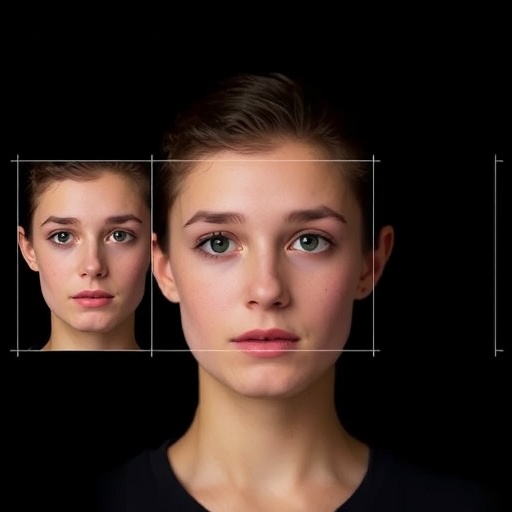
From airport security to verifying a driver’s licence, matching an unfamiliar face to a photograph is something people do every day. Yet despite its widespread use, people often get it wrong – especially when comparing a person’s current appearance with a photo that may be years old.
Now, researchers at Adelaide University and the University of Stirling (UK) have found a simple way to improve face-matching accuracy that doesn’t require training, artificial intelligence or specialist expertise – asking the same person to take another look.
While the solution may sound simple, revisiting the same decision improved face-matching accuracy by around 8% – a result comparable to gains achieved through specialist training.
Published in the Quarterly Journal of Experimental Psychology, the study tested whether asking people to make the same face-matching decision multiple times could improve identification accuracy.
Adelaide University researcher Dr Daniel Carragher said unfamiliar face matching plays an important role in everyday identity verification, but people are often less accurate at the task than they realise.
“Whether it’s checking a passport, driver’s licence or other form of photo identification, people regularly make decisions about faces they have never seen before,” Dr Carragher said.
“Laboratory studies consistently show that the average person makes mistakes in about 10-30% of face-matching decisions, which is around one mistake every five decisions.
“When you consider how often these decisions are used to verify a person’s identity, even small improvements in accuracy can have important real-world implications.”
Study participants viewed the same 80 pairs of unfamiliar faces three separate times and were asked on each occasion to decide whether the photographs showed the same person or two different people. Researchers then combined participants’ responses across all three attempts and compared the results with their performance on each individual attempt.
Researchers found that while participants achieved around 80% accuracy each time they completed the task, they often gave different answers to the same face pairs, answering correctly on some attempts and incorrectly on others.
Combining two decisions made by the same person improved accuracy by around 6%, while combining three decisions improved performance by around 8%.
These improvements were comparable to, and in some cases exceeded, gains reported for specialised face-matching training programs, despite participants receiving no training or feedback in the study.
“The important part of this study is that people didn’t just improve with practice,” Dr Carragher said.
“Their accuracy remained virtually unchanged each time they completed the task.
“What changed was the decisions themselves. When presented with particularly challenging face pairs – such as two photos that looked very similar but showed different people, or two very different-looking photos of the same person – participants didn’t always make the same judgement.
“What we found is that they were more likely to be right two times out of three than wrong two times out of three, so combining their responses reduced many of the one-off errors and improved overall accuracy.”
The findings build on the well-established ‘wisdom of the crowd’ effect, where combining decisions from many different people often leads to better outcomes than relying on a single judgement.
While combining decisions from different people still produced the largest improvements – increasing accuracy by around 8.5% when two people were involved and up to 12% when three independent decisions were combined – the study confirms that a similar ‘wisdom of the crowd’ effect can occur within a single person.
Dr Carragher said more research was needed before recommendations could be made about how the findings might be applied in real-world settings.
“We need to better understand how this effect translates outside the laboratory,” he said.
“But our findings suggest there may be value in taking a second look when making difficult face-matching decisions.
“In many situations, having multiple trained people independently assess an identification decision may not be practical. And at the point of needing to make a decision, additional training is no longer possible. In these circumstances, our results suggest that asking the same person to revisit a difficult decision could be beneficial.”
………………………………………………………………………………………………………………………………………………..
Media contact:
Dr Daniel Carragher, School of Psychology, Adelaide University. E: daniel.carragher@adelaide.edu.au
Annabel Mansfield, Senior Media Adviser Adelaide University. T: +61 479 182 489
E: Annabel.Mansfield@Adelaide.edu.au
Journal
Quarterly Journal of Experimental Psychology
Method of Research
Experimental study
Subject of Research
People
Article Title
Two Out of Three Ain’t Bad: Aggregating Multiple Identification Decisions from the Same Observer Improves Unfamiliar Face Matching Performance.
Article Publication Date
13-May-2026
COI Statement
The authors declared no potential conflicts of interest with respect to the research, authorship, and/or publication of this article.
Annabel Mansfield
Adelaide University
annabel.mansfield@adelaide.edu.au
Journal
Quarterly Journal of Experimental Psychology
Method of Research
Experimental study
Subject of Research
People
Article Title
Two Out of Three Ain’t Bad: Aggregating Multiple Identification Decisions from the Same Observer Improves Unfamiliar Face Matching Performance.
Article Publication Date
13-May-2026
COI Statement
The authors declared no potential conflicts of interest with respect to the research, authorship, and/or publication of this article.
Tags
Cite Scienmag News
Courtney Benton. (June 8, 2026). Double-Checking Boosts Accuracy in Face-Matching: A Simple Step Enhances Identification Results. Scienmag. https://scienmag.com/double-checking-boosts-accuracy-in-face-matching-a-simple-step-enhances-identification-results/
Courtney Benton. "Double-Checking Boosts Accuracy in Face-Matching: A Simple Step Enhances Identification Results." Scienmag, 8 June 2026, https://scienmag.com/double-checking-boosts-accuracy-in-face-matching-a-simple-step-enhances-identification-results/. Accessed 4 September 2026.
Courtney Benton. "Double-Checking Boosts Accuracy in Face-Matching: A Simple Step Enhances Identification Results." Scienmag. June 8, 2026. https://scienmag.com/double-checking-boosts-accuracy-in-face-matching-a-simple-step-enhances-identification-results/


