


A new way to combat Alzheimer’s disease has been discovered by Takaomi Saido and his team at the RIKEN Center for Brain Science (CBS) in Japan. Using mice with the disease, the researchers found that treatment with dopamine could alleviate physical symptoms in the brain as well as improve memory. Published in the scientific journal Science Signaling on August 6, the study examines dopamine’s role in promoting the production of neprilysin, an enzyme that can break down the harmful plaques in the brain that are the hallmark of Alzheimer’s disease. If similar results are found in human clinical trials, it could lead to a fundamentally new way to treat the disease.
The formation of hardened plaques around neurons is one of the earliest signs of Alzheimer’s disease, often beginning decades before behavioral symptoms such as memory loss are detected. These plaques are formed from pieces of the peptide beta-amyloid that accumulate over time. In the new study, Saido’s team at RIKEN CBS focuses on the enzyme neprilysin because previous experiments showed that genetic manipulation that produces excess neprilysin in the brain—a process called upregulation—resulted in fewer beta-amyloid plaques and improved memory in mice.
While genetically manipulating mice to produce neprilysin is useful experimentally, to treat people with the disease, we need a way to do it using medication. Neprilysin pills or an injection are not feasible because it cannot enter the brain from the blood stream. The first step in the new study was therefore a tedious screening of many molecules to determine which ones can naturally upregulate neprilysin in the correct parts of the brain. The team’s previous research led them to narrow down the search to hormones produced by the hypothalamus, and they discovered that applying dopamine to brain cells cultured in a dish yielded increased levels of neprilysin and reduced levels of free-floating beta-amyloid.
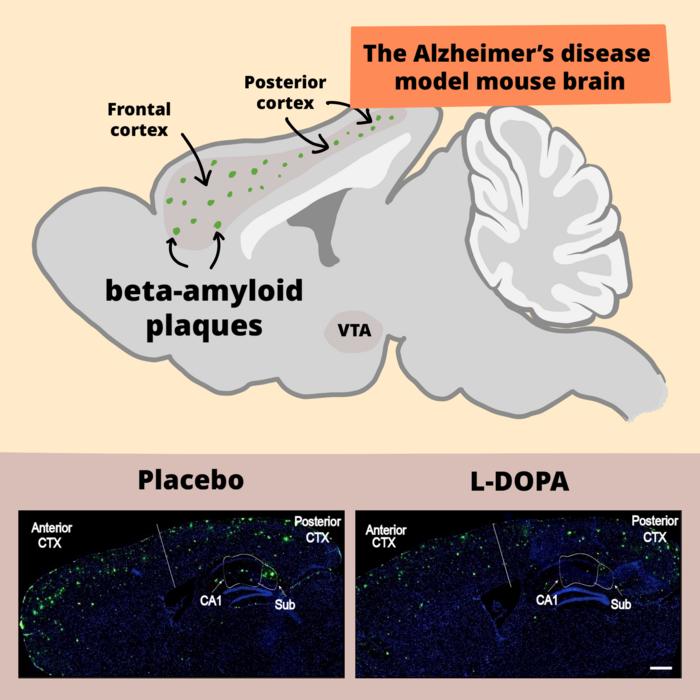
Now the serious experiments began. Using a DREADD system, they inserted tiny designer receptors into the dopamine producing neurons of the mouse ventral tegmental area. By adding a matching designer drug to the mice’s food, the researchers were able to continuously activate those neurons, and only those neurons, in the mouse brains. As in the dish, activation led to increased neprilysin and decreased levels of free-floating beta-amyloid, but only in the front part of the mouse brain. But could the treatment remove plaques? Yes. The researchers repeated the experiment using a special mouse model of Alzheimer’s disease in which the mice develop beta-amyloid plaques. Eight weeks of chronic treatment resulted in significantly fewer plaques in the prefrontal cortex of these mice.
The DREADD system is an incredible system for precise manipulation of specific neurons. But it is not very useful for human clinical settings. The final experiments tested the effects of L-DOPA treatment. L-DOPA is a dopamine precursor molecule often used to treat Parkinson’s disease because it can enter the brain from the blood, where it is then converted into dopamine. Treating the model mice with L-DOPA led to increased neprilysin and decreased beta-amyloid plaques in both frontal and posterior parts of the brain. Model mice treated with L-DOPA for 3 months also performed better on memory tests than untreated model mice.
Tests showed that neprilysin levels naturally decreased with age in normal mice, particularly in the frontal part of the brain, perhaps making it a good biomarker for preclinical or at-risk Alzheimer’s disease diagnoses. How dopamine causes neprilysin levels to increase remains unknown, and is the next research topic for Saido’s group.
“We have shown that L-DOPA treatment can help reduce harmful beta-amyloid plaques and improve memory function in a mouse model of Alzheimer’s disease,” explains Watamura Naoto, first author of the study. “But L-DOPA treatment is known to have serious side effects in patients with Parkinson’s disease. Therefore, our next step is to investigate how dopamine regulates neprilysin in the brain, which should yield a new preventive approach that can be initiated at the preclinical stage of Alzheimer’s disease.”

Credit: RIKEN
A new way to combat Alzheimer’s disease has been discovered by Takaomi Saido and his team at the RIKEN Center for Brain Science (CBS) in Japan. Using mice with the disease, the researchers found that treatment with dopamine could alleviate physical symptoms in the brain as well as improve memory. Published in the scientific journal Science Signaling on August 6, the study examines dopamine’s role in promoting the production of neprilysin, an enzyme that can break down the harmful plaques in the brain that are the hallmark of Alzheimer’s disease. If similar results are found in human clinical trials, it could lead to a fundamentally new way to treat the disease.
The formation of hardened plaques around neurons is one of the earliest signs of Alzheimer’s disease, often beginning decades before behavioral symptoms such as memory loss are detected. These plaques are formed from pieces of the peptide beta-amyloid that accumulate over time. In the new study, Saido’s team at RIKEN CBS focuses on the enzyme neprilysin because previous experiments showed that genetic manipulation that produces excess neprilysin in the brain—a process called upregulation—resulted in fewer beta-amyloid plaques and improved memory in mice.
While genetically manipulating mice to produce neprilysin is useful experimentally, to treat people with the disease, we need a way to do it using medication. Neprilysin pills or an injection are not feasible because it cannot enter the brain from the blood stream. The first step in the new study was therefore a tedious screening of many molecules to determine which ones can naturally upregulate neprilysin in the correct parts of the brain. The team’s previous research led them to narrow down the search to hormones produced by the hypothalamus, and they discovered that applying dopamine to brain cells cultured in a dish yielded increased levels of neprilysin and reduced levels of free-floating beta-amyloid.
Now the serious experiments began. Using a DREADD system, they inserted tiny designer receptors into the dopamine producing neurons of the mouse ventral tegmental area. By adding a matching designer drug to the mice’s food, the researchers were able to continuously activate those neurons, and only those neurons, in the mouse brains. As in the dish, activation led to increased neprilysin and decreased levels of free-floating beta-amyloid, but only in the front part of the mouse brain. But could the treatment remove plaques? Yes. The researchers repeated the experiment using a special mouse model of Alzheimer’s disease in which the mice develop beta-amyloid plaques. Eight weeks of chronic treatment resulted in significantly fewer plaques in the prefrontal cortex of these mice.
The DREADD system is an incredible system for precise manipulation of specific neurons. But it is not very useful for human clinical settings. The final experiments tested the effects of L-DOPA treatment. L-DOPA is a dopamine precursor molecule often used to treat Parkinson’s disease because it can enter the brain from the blood, where it is then converted into dopamine. Treating the model mice with L-DOPA led to increased neprilysin and decreased beta-amyloid plaques in both frontal and posterior parts of the brain. Model mice treated with L-DOPA for 3 months also performed better on memory tests than untreated model mice.
Tests showed that neprilysin levels naturally decreased with age in normal mice, particularly in the frontal part of the brain, perhaps making it a good biomarker for preclinical or at-risk Alzheimer’s disease diagnoses. How dopamine causes neprilysin levels to increase remains unknown, and is the next research topic for Saido’s group.
“We have shown that L-DOPA treatment can help reduce harmful beta-amyloid plaques and improve memory function in a mouse model of Alzheimer’s disease,” explains Watamura Naoto, first author of the study. “But L-DOPA treatment is known to have serious side effects in patients with Parkinson’s disease. Therefore, our next step is to investigate how dopamine regulates neprilysin in the brain, which should yield a new preventive approach that can be initiated at the preclinical stage of Alzheimer’s disease.”
Journal
Science Signaling
Cite Scienmag News
Cassandra Pierce. (August 6, 2024). Dopamine treatment alleviates symptoms in Alzheimer’s disease. Scienmag. https://scienmag.com/dopamine-treatment-alleviates-symptoms-in-alzheimers-disease/
Cassandra Pierce. "Dopamine treatment alleviates symptoms in Alzheimer’s disease." Scienmag, 6 August 2024, https://scienmag.com/dopamine-treatment-alleviates-symptoms-in-alzheimers-disease/. Accessed 3 September 2026.
Cassandra Pierce. "Dopamine treatment alleviates symptoms in Alzheimer’s disease." Scienmag. August 6, 2024. https://scienmag.com/dopamine-treatment-alleviates-symptoms-in-alzheimers-disease/

