


In a groundbreaking advance in energy storage technology, researchers from Dongguk University and Kyungpook National University have developed a novel composite material that promises to significantly enhance the performance of lithium-ion batteries. This innovative work, led by Professor Jae-Min Oh and his team, demonstrates how careful engineering at the nanoscale can yield synergetic effects in battery performance. Published in the Chemical Engineering Journal, their findings promise to open new avenues for energy storage solutions, addressing the critical demands for higher energy density and faster-charging capabilities.
At the heart of this research is a hybrid material that combines reduced graphene oxide (rGO) and nickel-iron layered double hydroxides (NiFe-LDH). The unique structure of this composite is designed as a hierarchical heterostructure that leverages the intrinsic properties of its components. While graphene oxide offers a reliable conductive pathway enabling efficient electron transport, the nickel-iron compounds serve as effective charge storage mediums via a pseudocapacitive mechanism. The strategic layering and controlled interfacing of these materials results in what researchers describe as a "superior energy storage system."
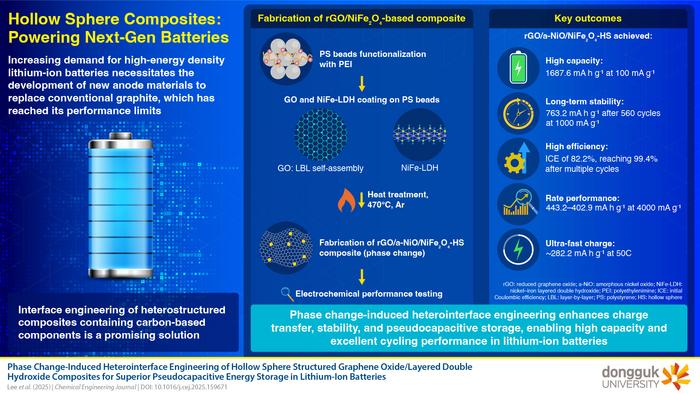
To synthesize this advanced composite material, the researchers employed an intricate layer-by-layer self-assembly method utilizing polystyrene (PS) bead templates. This innovative approach begins with coating the polystyrene beads with both GO and precursor materials for NiFe-LDH. By meticulously removing these templates, researchers were able to create a complex hollow sphere architecture, which plays a vital role in the final performance characteristics of the composite.
Once the hollow structure is established, the synthesis process continues with a carefully controlled thermal treatment. This phase transformation is pivotal; it induces changes in the NiFe-LDH, resulting in the formation of nanocrystalline nickel-iron oxide (NiFe₂O₄) and an amorphous nickel oxide (a-NiO). In conjunction, the thermal process effectively reduces GO to rGO, culminating in a finely integrated hybrid composite consisting of rGO/NiFe₂O₄/a-NiO. This new structure not only enhances conductivity but also serves as an efficient anode material for lithium-ion batteries.
An important feature of this composite is its hollow structure, which strategically prevents direct contact between the a-NiO/NiFe₂O₄ nanoparticles and the electrolyte, enhancing the overall stability of the battery system. The innovative design directly addresses previous limitations found in conventional anode materials, which often suffer from instability under operational conditions.
To confirm the effectiveness of this engineered hybrid composite, advanced characterization techniques were employed, including X-ray diffraction and transmission electron microscopy. Electrochemical testing revealed that the material acts as a formidable anode for lithium-ion batteries, achieving a remarkable specific capacity of 1687.6 mAh/g at a current density of 100 mA/g after an impressive 580 charge-discharge cycles. This performance significantly overshoots the capabilities of traditional materials, underscoring its potential for real-world applications.
Moreover, the rGO/NiFe₂O₄/a-NiO composite demonstrates excellent rate performance, maintaining high capacity levels even under fast charging and discharging conditions. The versatility of this composite material could lead to batteries that are not only powerful but also responsible in terms of sustainability, providing benefits for both users and the environment.
The collaborative nature of this research reflects a deep integration of expertise across diverse fields. Professor Seung-Min Paek remarked on the synergistic collaboration between institutions, highlighting how the pooling of knowledge and skills allowed for the optimization of this innovative composite system. This cooperative effort showcases what is achievable when specialists from varying backgrounds come together to solve pressing challenges in energy storage technology.
As the researchers highlighted, the implications of this work extend beyond mere incremental improvements in battery life or charge speed. There is a growing anticipation that future energy storage materials will comprise multiple materials that interact in beneficial ways, leading to even more efficient and reliable energy devices. The current research lays the groundwork for such advancements, promising a future where energy storage systems will be increasingly compact, lightweight, and efficient.
The timeline for commercialization of this revolutionary hybrid system is ambitious, with a target of developing significantly improved batteries over the next 5 to 10 years. As consumer demands for electronics that can last longer and charge faster continually increase, the impact of this research could be profound, potentially reshaping the landscape of energy storage and usage in our electronic devices.
In summary, the development of the rGO/NiFe₂O₄/a-NiO composite presents a significant leap forward in the field of lithium-ion batteries. With its unique design, innovative synthesis techniques, and impressive performance metrics, this new hybrid material stands poised to offer solutions to the urgent challenges of modern energy storage technologies. The future of energy storage is on the horizon, driven by research that champions cooperation, ingenuity, and breakthrough advancements.
Keywords
Energy storage, Composite materials, Lithium ion batteries, Renewable energy, Pseudocapacitive energy storage.
Cite Scienmag News
Faith Mcneil. (April 11, 2025). Dongguk University Researchers Propel Lithium-Ion Battery Innovation with Hybrid Anode Material. Scienmag. https://scienmag.com/dongguk-university-researchers-propel-lithium-ion-battery-innovation-with-hybrid-anode-material/
Faith Mcneil. "Dongguk University Researchers Propel Lithium-Ion Battery Innovation with Hybrid Anode Material." Scienmag, 11 April 2025, https://scienmag.com/dongguk-university-researchers-propel-lithium-ion-battery-innovation-with-hybrid-anode-material/. Accessed 5 September 2026.
Faith Mcneil. "Dongguk University Researchers Propel Lithium-Ion Battery Innovation with Hybrid Anode Material." Scienmag. April 11, 2025. https://scienmag.com/dongguk-university-researchers-propel-lithium-ion-battery-innovation-with-hybrid-anode-material/


