


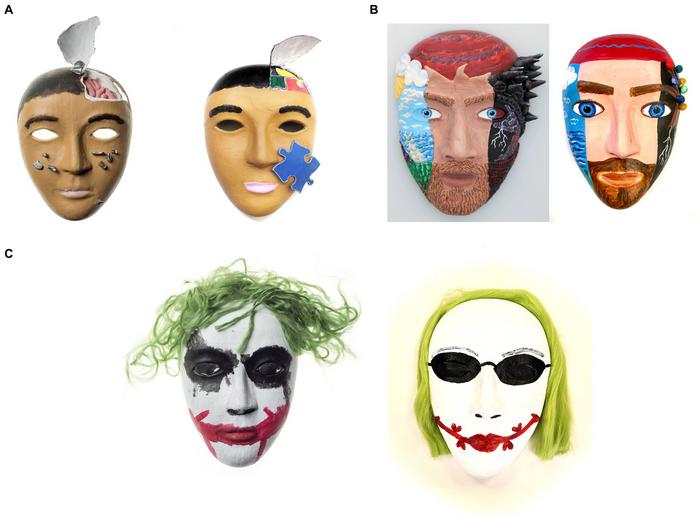
The human visual system is a dominant part of the brain’s processes and navigation of the world. To better understand an aspect of this system, researchers from Drexel University’s College of Nursing and Health Professions examined how life experiences impact a person’s perception of imagery – specifically decorated masks.

Credit: Creative Arts Therapies Department, Drexel University’s College of Nursing and Health Professions
The human visual system is a dominant part of the brain’s processes and navigation of the world. To better understand an aspect of this system, researchers from Drexel University’s College of Nursing and Health Professions examined how life experiences impact a person’s perception of imagery – specifically decorated masks.
The study, published in Frontiers in Psychology, examined viewer responses to images of distressing and neutrally decorated masks and whether personal life history, particularly past experiences of trauma and difficulty, affected how the person perceived the imagery.
The research team, led by Girija Kaimal, EdD, an associate professor, and Asli Arslanbek-Evci, a recent doctoral graduate, both from the College of Nursing and Health Professions, found that traumatic life events do impact the perception of trauma-related imagery, and that neutral imagery overall evoked less of an emotional response in viewers than the imagery depicting moral, psychological or physical injuries.
“This shows the important associations between personal experiences of trauma and how we respond to visual imagery,” said Kaimal.
“It’s important for health care providers and caregivers to be aware of the vulnerabilities and sensitivities to visual imagery for individuals with a history of experiencing or witnessing trauma. Further, researchers may incorporate these methods to better understand differences in brain function and structure associated with traumatic experiences,” said John Williamson, PhD, co-author of the paper and an associate professor from the University of Florida.
Kaimal added that in addition to the practical implications for improving therapeutic practices and supporting trauma recovery, the study highlights our collective sensitivities as a society to the impact of viewing distressing images.
The research team found that responses to mask image content (traumatic versus neutral) were associated with viewers’ personal history of adversity and trauma. Specifically, images representing injury/trauma provoked stronger reactions on positive/negative emotional responses (valence) and arousal scales than neutral images.
“We found imagery with intense emotional content including distress and pain were more likely to evoke heightened emotion and a sense of personal relevance for individuals who have experienced adversities and trauma in their life,” said Arslanbek-Evci. “This does not necessarily indicate negative consequences of viewing distressing content. Instead, it may suggest that people connect with imagery in different ways. For individuals who have experienced trauma, they might find both emotional activation and resonance (a sense of personal connection) with graphic images depicting distress.”
Study participants took an anonymous online survey responding to a series of mask images and completed the Life Events Checklist, which asks whether they had witnessed, experienced or heard about a series of traumatic events. The images of the masks included artwork created by military service members with traumatic brain injury (TBI) and post-traumatic stress disorder (PTSD), depicting physical, psychological and moral injuries. Those images were matched with neutral masks created by the research team. Nearly 700 participants rated 98 masks in terms of their arousal, emotional response and perceived personal relevance.
“Mask images were used since they mimic the human face and this has a distinct brain pathway in terms of recognition, responses to pain, empathy and similar interpersonal responses,” said Kaimal. “In the profession of art therapy, mask-making has been recognized as a safe and effective medium that enables individuals to establish psychological distance for the purpose of self-expression and has been used to depict transformation and growth.”
Kaimal and Arslanbek-Evci explained that this study shows how impactful imagery can be in all aspects of life, including in mass communications, public health and mental health care perspectives. Evocative images have the power to both promote a sense of personal connection, as well as activate emotions that are associated with past experiences. They hope further research can examine how these differ based on age, gender, type of trauma history as well as different types of imagery such as humans, nature, or environment, among others.
Read the full paper here.
Journal
Frontiers in Psychology
Article Title
Exploring the evocative qualities of masks’ visual imagery and their associations with adversity and trauma
Article Publication Date
10-Jun-2024
Cite Scienmag News
Courtney Benton. (June 11, 2024). Do traumatic life experiences impact perception of distressing imagery? Scienmag. https://scienmag.com/do-traumatic-life-experiences-impact-perception-of-distressing-imagery/
Courtney Benton. "Do traumatic life experiences impact perception of distressing imagery?" Scienmag, 11 June 2024, https://scienmag.com/do-traumatic-life-experiences-impact-perception-of-distressing-imagery/. Accessed 4 September 2026.
Courtney Benton. "Do traumatic life experiences impact perception of distressing imagery?" Scienmag. June 11, 2024. https://scienmag.com/do-traumatic-life-experiences-impact-perception-of-distressing-imagery/

