

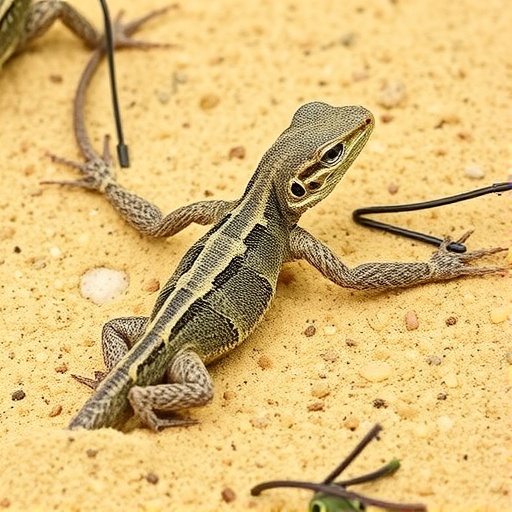
In a groundbreaking study published in Front Zool, researchers Zheng, Liang, and Shi delve into the adhesive capabilities and ecological significance of toe fringes in lizards, particularly focusing on their role in burying behaviors in highly mobile sand environments. This intriguing inquiry sheds light on how these anatomical features could be pivotal in enhancing the survival tactics of lizards, especially in habitats characterized by shifting sands.
Lizards are remarkable creatures with a diverse array of adaptations that enable them to thrive in various environments. Among these adaptations, the specialization of their limbs, particularly the toes, plays a crucial role in mobility and functionality. Tao fringes, the small projections found along the edges of their toes, have been relatively overlooked in evolutionary biology. The researchers aim to address the gap in knowledge regarding these adaptations and their ecological implications.
The study begins by detailing the specifics of the highly mobile sand ecosystems where these lizards reside. These habitats, often characterized by loose particles that shift with wind and movement, present unique challenges to terrestrial life forms. For lizards, effectively navigating and interacting with such substrates is crucial for foraging, escaping predators, and finding refuge. The significance of toe fringes in this context poses an intriguing evolutionary question: do these features provide an advantage in such environments?
To investigate this, the researchers conducted a series of field studies alongside controlled experiments to assess the efficacy of toe fringes in various burial behaviors. The methodologies employed included tracking movement patterns and observing how different species of lizards utilized their toe anatomy to either stabilize themselves or dig into the sand. This multidisciplinary approach bridging behavioral ecology and biomechanics allowed for an in-depth understanding of these processes.
Initial observations suggested that species with more pronounced toe fringes demonstrated increased proficiency in burying themselves within loose sand. The researchers noted that these lizards were able to use their fringes to grip the loose particles more effectively, facilitating quicker and deeper burrowing. Such findings underscore the potential evolutionary advantage of toe fringes in enhancing the lizard’s ability to escape from predators or extreme environmental conditions.
Moreover, the study addresses the biomechanics of toe fringes by analyzing grip strength and stability during movement. Using state-of-the-art techniques such as high-speed video analysis, the researchers examined how different toe shapes and structures contributed to the agility and performance of lizards on sandy substrates. This detailed investigation provides crucial insights into the relationship between anatomy and functional behavior, offering a clearer picture of adaptive evolution.
Keeping in mind evolutionary theory, the question arises: why did toe fringes evolve in some species but not others? The researchers propose that specific ecological pressures, including predation risk and habitat characteristics, could drive the development of these adaptations. By correlating the presence of toe fringes with survival strategies across various lizard species, they shed light on the complexities of evolutionary trade-offs faced by these reptiles.
In addition to the behavioral and ecological implications, the study also suggests a broader evolutionary narrative. The adaptation of toe fringes may represent a significant evolutionary response to the challenges posed by a fluctuating environment. These findings contribute to the understanding of evolutionary biology and offer a new perspective on how physical traits can expand the niche range of a species.
Furthermore, the researchers suggest that the insights garnered from the study could have practical applications in conservation efforts. Understanding how anatomical traits influence behavior and survival can aid in devising strategies to protect vulnerable lizard populations impacted by habitat destruction and climate change. Such knowledge is critical for efforts aimed at maintaining biodiversity and preserving ecosystems.
This comprehensive study serves as a pivotal reference point for future research into the evolutionary significance of morphological traits in reptiles. By focusing on a relatively obscure feature like toe fringes, this research highlights the necessity of examining all aspects of anatomy in the quest to understand the rich tapestry of life on Earth. These findings encourage a deeper investigation into the multifaceted relationships between structure, function, and survival.
The study’s conclusion reiterates the critical role of toe fringes in enhancing the lizard’s abilities within shifting sands, suggesting that further research on this and related subjects could unravel even more intricate aspects of reptilian biology. The implications of these results extend far beyond lizards, challenging researchers to explore similar adaptations in other organisms living in extreme environments.
The research presented by Zheng, Liang, and Shi ultimately opens up a myriad of questions about the evolutionary adaptations of species facing environmental stresses. It emphasizes the necessity for continuous exploration and understanding of nature’s intricacies, paving the way for novel insights that bridge ecological theory and evolutionary biology.
This compelling study lays the foundation for a more nuanced understanding of reptilian adaptations and offers a clear call to action for future investigations. As researchers continue to unravel the complexities of the natural world, studies like this underline the significance of even the smallest anatomical features and their far-reaching implications for survival.
In summary, the exploration of toe fringes in lizards has unveiled a remarkable aspect of evolutionary adaptation, demonstrating that seemingly minor features can have major ecological ramifications. The findings from this study not only enrich the scientific discourse but also highlight the importance of preserving the delicate balance of our ecosystems, where each species plays a vital role.
As we continue to delve deeper into the mysteries of life on Earth, research such as this underscores the fundamental interconnectedness of species and their environments, revealing the profound impact of evolutionary biology on our understanding of the natural world.
Subject of Research: Lizards and their adaptations
Article Title: Are toe fringes important for lizard burying in highly mobile sand?
Article References:
Zheng, P., Liang, T. & Shi, L. Are toe fringes important for lizard burying in highly mobile sand?
Front Zool 21, 25 (2024). https://doi.org/10.1186/s12983-024-00546-y
Image Credits: AI Generated
DOI: https://doi.org/10.1186/s12983-024-00546-y
Keywords: lizard adaptations, toe fringes, ecology, evolutionary biology, biomechanics, sand habitats, survival strategies, biodiversity, conservation.


