


In the face of accelerating climate change, understanding the intricate mechanisms behind ice melt is more critical than ever. Recent investigations led by Kari Perry and Sarah Morris at Montana State University have shed new light on the fluid dynamics governing the melting of closely packed ice structures, such as icebergs and sea ice aggregates known as mélanges. Their work, soon to be published in the journal Physics of Fluids, reveals the profound influence of meltwater interactions between neighboring ice bodies, challenging traditional assumptions of isolated iceberg melting and offering new pathways to forecast ice retreat with greater precision.
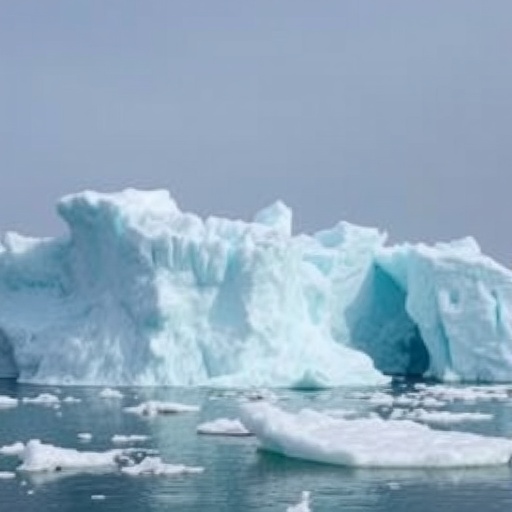
Icebergs drifting in the ocean often do not exist as singular, solitary entities; instead, they frequently cluster together, forming densely packed mixtures of ice called mélanges. These macroscale ice assemblages, particularly prevalent in regions like Greenland, exhibit complex melting behaviors driven not only by ambient water temperature but also by dynamic interactions between individual ice masses through the meltwater they produce. Perry and Morris’s study zeros in on this interplay, employing a highly controlled experimental approach to unravel the near-field hydrodynamic phenomena that dictate how meltwater from one ice body influences the melting trajectory of another.
Utilizing the towing tank facility at Montana State University, the research team conducted meticulous experiments involving pairs of cylindrical ice blocks to simulate iceberg interactions. By systematically varying the inter-cylinder spacing and towing them through water, the team was able to observe how the meltwater emanating from the upstream cylinder affected the thermal and morphological evolution of a downstream neighbor. Advanced imaging and measurement techniques captured the subtle changes in shape and melt rate over time, enabling the researchers to probe the feedback loops between meltwater flow fields and ice geometry.
Central to the study’s findings is the recognition that while the upstream ice cylinder largely behaves as it would in isolation, the downstream counterpart undergoes significant transformation in response to wake effects generated by the turbulent meltwater flow of its neighbor. When positioned in close proximity, the downstream cylinder’s leading surface is shielded from warmer ambient water by the cold meltwater “wake” from the upstream ice. This protective barrier alters heat transfer conditions, reshaping the melting profile and ultimately producing a downstream cylinder with a notably different aspect ratio than it would exhibit alone.
The phenomenon can be attributed to the trapping of frigid meltwater between the two cylinders at short interspacing distances. This trapped cold water functions as an insulating layer, dampening thermal conduction and convection from the bulk ocean water that would otherwise accelerate melt. As the gap widens, this entrapped meltwater dissipates, diminishing its insulating effect until the cylinders behave as independent melting bodies. This nuanced hydrodynamic interaction highlights how proximity within an ice mélange can nonlinearly affect local melting rates, an effect previously underappreciated in large-scale climate models.
From a fluid mechanics perspective, the study extends classical knowledge of wake interactions behind solid cylinders by introducing the complexity of moving, melting ice interfaces. These interfaces continually alter shape, creating dynamic changes in flow patterns that modify heat and mass transfer rates. Unlike solid, inert bodies, ice cylinders are subject to phase change feedbacks: the flow modulates shape, and evolving shape redefines the flow. Perry and Morris’s experiments offer one of the first controlled characterizations of this coupled system, illuminating the physical mechanisms underlying ice melt modulation in clustered environments.
The implications extend well beyond the laboratory. Ice mélanges, composed of myriad icebergs jammed in close quarters, provide a natural context where these hydrodynamic feedback mechanisms operate at scale. Variations in local melt rates driven by neighboring ice blocks could influence mélange stability, calving rates, and ultimately the mass balance of ice shelves and outlet glaciers. By elucidating how fine-scale meltwater interactions drive ice shape evolution, this research promises to refine predictive capabilities essential for assessing sea level rise and ecosystem changes linked to freshwater input.
Additionally, the redistribution of freshwater, heat, and salinity facilitated by meltwater flows has far-reaching ecological impacts. Fresh meltwater alters stratification and nutrient transport in surrounding ocean systems, impacting primary productivity and marine food webs. Understanding the spatial variability of meltwater inputs caused by local flow structures can help forecast shifts in marine habitat conditions, especially in polar regions undergoing rapid warming and ice loss.
As climate models continue to grapple with the challenges of incorporating fine-scale processes into global projections, studies like this one provide indispensable data and conceptual frameworks. By quantifying how the spatial arrangement of ice affects local melt dynamics via hydrodynamic interactions, Perry and Morris’s findings ground the behavior of complex ice–ocean systems in fundamental fluid mechanics. Future efforts to scale up these insights will likely lead to more robust and accurate models of ice sheet dynamics and their contributions to ocean circulation and climate feedbacks.
This pioneering work stands as a testament to the power of experimental fluid dynamics in unlocking the secrets of cryospheric change. By focusing on the local-scale phenomena within ice mélanges, researchers can bridge gaps between microscale processes and macroscale climate impacts. Continued interdisciplinary research combining fluid mechanics, glaciology, and oceanography will be vital for predicting the pace and consequences of melting polar ice and for informing mitigation and adaptation strategies worldwide.
News Publication Date: May 5, 2026.
Web References: https://doi.org/10.1063/5.0326595
References: Perry, K.E., & Morris, S.E. (2026). Near-field flow interactions govern local ice melting dynamics. Physics of Fluids. DOI: 10.1063/5.0326595.
Keywords
Ice melt, Ice, Water, Physical sciences, Physics, Climate change, Climate change effects
Cite Scienmag News
Bethany Barker. (May 5, 2026). Do Icebergs Melt More Slowly When They Cluster Together? Scienmag. https://scienmag.com/do-icebergs-melt-more-slowly-when-they-cluster-together/
Bethany Barker. "Do Icebergs Melt More Slowly When They Cluster Together?" Scienmag, 5 May 2026, https://scienmag.com/do-icebergs-melt-more-slowly-when-they-cluster-together/. Accessed 4 September 2026.
Bethany Barker. "Do Icebergs Melt More Slowly When They Cluster Together?" Scienmag. May 5, 2026. https://scienmag.com/do-icebergs-melt-more-slowly-when-they-cluster-together/


