


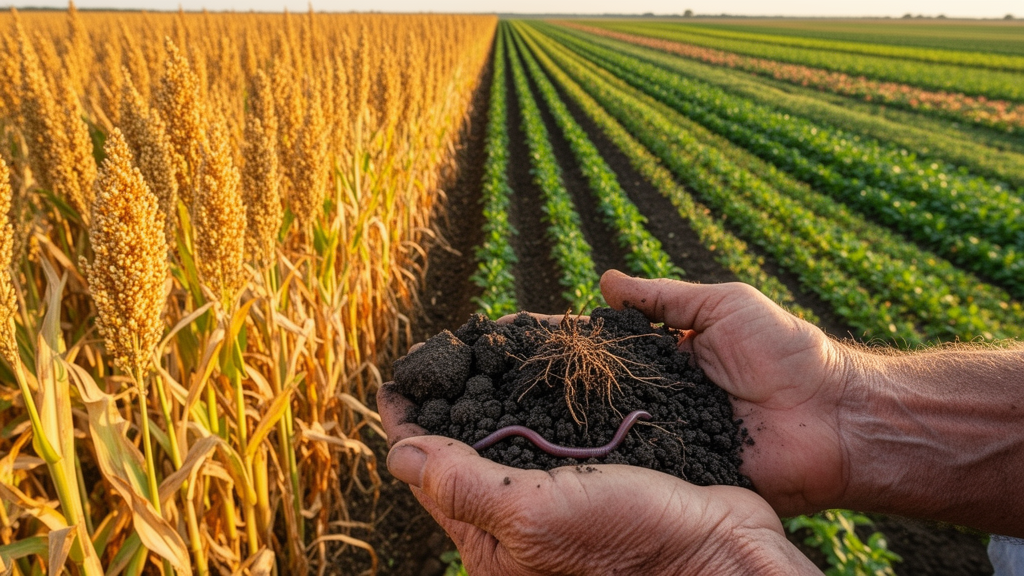
Long stretches of continuous sorghum cropping can quietly degrade the ground beneath a harvest, depleting nutrients and disturbing the soil microbiome until yields falter in what growers call continuous cropping obstacles. A new study from researchers at the Guizhou Academy of Agricultural Sciences in China set out to test whether simply changing what grows between sorghum seasons could rebuild that underground ecosystem. The team compared continuous sorghum against three rotation schemes and found that diversifying the rotation improved soil nutrients, restructured bacterial and fungal communities, and shifted microbial functions in ways associated with healthier soils.
The experiment, described in a study accepted for publication in Frontiers in Microbiology, used continuous sorghum cropping as the control treatment, labeled SSS. Against that baseline, the researchers established three rotations: sorghum-potato-sorghum (SPS), sorghum-common vetch-sorghum (SVS), and sorghum-green pea shoots-sorghum (SGS). Each rotation inserted a different companion crop between sorghum plantings, creating three distinct biological histories in otherwise comparable sorghum fields.
To read what those histories had written into the soil, the team combined two complementary approaches. First, they measured the physical and chemical properties of soil from each treatment, capturing nutrients and other physicochemical indicators. Second, they sequenced the soil microbiome using Illumina NovaSeq high-throughput sequencing, which allowed them to profile the structure and diversity of bacterial and fungal communities across all four treatments. On top of the community profiles, they applied two functional prediction frameworks: FAPROTAX for bacteria and FUNGuild for fungi, which assign ecological roles to the organisms detected in the sequencing data.
The physicochemical results pointed in a consistent direction. Compared with the continuous sorghum control, soil properties improved to varying degrees under all three rotation treatments, and the sorghum-potato-sorghum system stood out, with soil nutrient levels increasing significantly under SPS. In other words, every tested rotation left the soil chemically better off than uninterrupted sorghum, but the specific identity of the rotation crop mattered, with potato delivering the clearest nutrient gains in this system.
The microbial story was more nuanced, and it differed between bacteria and fungi. Alpha-diversity analysis, which measures richness and diversity within a sample, showed that the sorghum-common vetch rotation markedly increased the richness and diversity of soil bacterial communities. Fungal communities responded differently: their richness and diversity were significantly enhanced under the sorghum-potato-sorghum treatment. The two rotation crops that boosted bacterial diversity and fungal diversity, respectively, were not the same, suggesting that different rotation partners sculpt different branches of the soil food web.
Beta-diversity analysis, which compares community composition between samples, showed that the soil microbial structure under all three rotation treatments differed significantly from the continuous cropping control. The bacterial structures of the vetch and green pea shoot rotations resembled each other, while the fungal community structures were more similar between the potato and vetch rotations. That pattern indicates that rotation history leaves a detectable signature on both major microbial kingdoms, but the signature is not uniform across them.
Composition changes also revealed functional signals. The relative abundances of certain functionally important microbial groups increased in all three rotation soils while decreasing markedly under continuous sorghum. One cautionary detail emerged as well: the pathogenic genus Fusarium still maintained a relatively high relative abundance in the sorghum-potato-sorghum treatment, a reminder that a rotation that improves nutrients and fungal diversity does not automatically suppress every soilborne pathogen.
To identify which environmental factors best explained the microbial patterns, the researchers ran Mantel tests linking soil chemistry to community structure. Soil pH, total nitrogen (TN), total phosphorus (TP), total potassium (TK), and available potassium (AK) emerged as key factors influencing the soil microbial community, with available potassium showing the strongest correlation. That result ties the nutrient improvements seen under rotation directly to the restructuring of the microbiome, positioning potassium availability as the standout edaphic variable in this system.
Functional prediction added a layer of ecological interpretation. Nitrogen fixation and cellulose degradation were the dominant bacterial functional groups in the rotation systems, processes central to nutrient cycling and the breakdown of plant residues. On the fungal side, saprotrophic fungi and ectomycorrhizal fungi were significantly enriched in the rotation soils. Saprotrophs decompose organic matter, while ectomycorrhizal fungi form symbiotic associations with plant roots, so their enrichment points toward enhanced decomposition and root-associated partnerships in rotated fields.
Finally, co-occurrence network analysis, which maps statistical associations among microbial taxa, showed that the rotation network exhibited higher average degree, greater network density, higher modularity, and a larger connected component than the continuous cropping network. In practical terms, the microbial communities under rotation were more interconnected and more complexly organized than those under continuous sorghum. Taken together, the study’s measurements, sequencing results, functional predictions, and network analyses converge on a single message: inserting potato, common vetch, or green pea shoots into a sorghum rotation reshapes soil nutrients, microbial communities, and their functions, offering a possible route to maintaining soil health where continuous cropping has degraded it. As the authors note, the claims in the article are their own and the final formatted version is forthcoming.
Subject of Research: Effects of diversified crop rotations on soil nutrients and microbial communities in sorghum fields
Article Title: Diversified crop rotation reshapes soil nutrients, microbial communities, and functions in sorghum fields
Article References: Chen, M., Jiang, Y., Shen, J., Ren, Y., Zhou, L., Wang, C., Chen, G., & Shao, M. (2026). Diversified Crop Rotation Reshapes Soil Nutrients, Microbial Communities, and Functions in Sorghum Fields. Frontiers in Microbiology, 17, 1958119. https://doi.org/10.3389/fmicb.2026.1958119
Image Credits: AI Generated
DOI: 10.3389/fmicb.2026.1958119
Keywords: crop rotation, sorghum, soil health, soil microbiome, bacterial diversity, fungal diversity, FAPROTAX, FUNGuild, continuous cropping obstacle, soil nutrients, co-occurrence network, potassium
Cite Scienmag News
Alan Morgan. (October 27, 2026). Diversified Crop Rotations Reshape Soil Microbes and Nutrients in Sorghum Fields. Scienmag. https://scienmag.com/diversified-crop-rotations-reshape-soil-microbes-and-nutrients-in-sorghum-fields/
Alan Morgan. "Diversified Crop Rotations Reshape Soil Microbes and Nutrients in Sorghum Fields." Scienmag, 27 October 2026, https://scienmag.com/diversified-crop-rotations-reshape-soil-microbes-and-nutrients-in-sorghum-fields/. Accessed 27 October 2026.
Alan Morgan. "Diversified Crop Rotations Reshape Soil Microbes and Nutrients in Sorghum Fields." Scienmag. October 27, 2026. https://scienmag.com/diversified-crop-rotations-reshape-soil-microbes-and-nutrients-in-sorghum-fields/


