

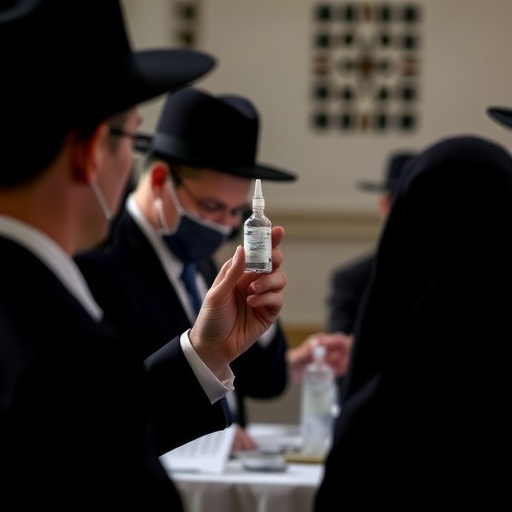
In the intricate landscape of public health, understanding vaccine hesitancy remains a formidable challenge—particularly within seemingly uniform communities where outward homogeneity masks profound internal diversity. A groundbreaking study conducted by Jacobson, Spitzer, and Edelstein, published in the International Journal for Equity in Health in 2025, unravels the complex tapestry of vaccination attitudes and behaviors amongst the Ultra-Orthodox Jewish population in Safed, Israel. This research transcends simplistic narratives of vaccine refusal or acceptance, exposing a spectrum of perspectives shaped by social, cultural, and theological factors unique to this religious enclave.
At first glance, the Ultra-Orthodox community appears as a monolith with widespread consensus on health behaviors, including vaccination. However, the study’s cross-sectional analysis reveals that beneath this veneer lies significant heterogeneity in both attitudes and actual vaccine uptake. Utilizing advanced survey methodologies alongside ethnographic insights, the researchers meticulously captured a nuanced portrait that underscores the multifactorial nature of vaccine decision-making within this population, challenging the assumptions of uniformity that often misinform public health strategies.
The study’s technical rigor is particularly notable. Employing stratified sampling, the researchers recruited participants representing diverse subgroups within the Ultra-Orthodox community, delineated by factors such as age, gender, level of religious observance, and social networks. This approach ensured that the data captured a broad scope of experiences and beliefs. Moreover, the integration of psychometric scales measuring vaccine confidence, perceived risk, and trust in health authorities allowed for a comprehensive analysis linking attitudinal profiles to actual vaccination behaviors—a critical advancement beyond mere self-reported intentions.
One of the most striking findings pertains to how theological interpretations influence vaccine perceptions. Some respondents framed vaccination as a communal responsibility rooted in religious teachings emphasizing the preservation of life (pikuach nefesh), which obligates protective health measures. Conversely, others expressed skepticism grounded in concerns about divine providence and fears of introducing foreign substances into the body, reflecting a distinct theological rationale for precaution or refusal. These divergent ideologies within the same community highlight the intricate interplay between faith and science that public health initiatives must navigate.
Social dynamics further complicate the vaccination landscape. The research illuminates the role of social conformity pressures and intra-group communication as significant determinants of vaccine uptake. In tightly knit Ultra-Orthodox neighborhoods, endorsement or skepticism from influential rabbis and community leaders drastically sways public attitudes. The study details instances where official religious endorsements led to spikes in vaccination rates, whereas conflicting messages sowed confusion and hesitancy. This underscores the crucial role of authoritative voices in fostering or hindering public health goals.
Importantly, the study also identifies demographic variables that mediate vaccination behavior. Gender emerged as a salient factor, with women often acting as gatekeepers of family health decisions and exhibiting distinct concerns shaped by maternal instincts and community expectations. Similarly, younger respondents demonstrated greater openness to vaccination, influenced by exposure to broader Israeli society and secular education, while older members adhered more strictly to traditional views. These nuances emphasize the need for tailored communication strategies that resonate with different community segments.
From a methodological standpoint, Jacobson and colleagues’ use of multivariate regression models elucidated predictors of vaccination uptake, accounting for confounders such as socioeconomic status and education level. Their findings challenge the reductionist view that vaccine hesitancy is primarily a function of access barriers or lack of information. Instead, they reveal a complex matrix where trust, religious interpretation, social influence, and demographic factors converge, dictating health behavior. This insight calls for a paradigmatic shift in designing interventions that move beyond generic messaging to culturally and socially tailored approaches.
The implications of this research extend beyond the Ultra-Orthodox population in Safed. It offers a compelling model for studying vaccine attitudes in other insular or religiously distinct communities worldwide, where visible homogeneity may mask intricate heterogeneity. The study’s emphasis on integrating sociocultural context, theological belief systems, and rigorous quantitative methods provides a blueprint for more effective public health engagement in diverse societies where one-size-fits-all solutions have repeatedly faltered.
Notably, the study addresses the pivotal role of misinformation and how social media channels have permeated even tightly controlled communication environments within the Ultra-Orthodox community. The authors document the paradox of digital isolation combined with selective digital engagement, which creates unique vulnerabilities to vaccine misinformation. The strategic engagement of trusted community figures in digital spaces emerges as a potential vector for countering misinformation while respecting community boundaries and sensitivities.
Furthermore, the research highlights the ethical challenges that arise when public health imperatives intersect with deeply held religious beliefs. Navigating this delicate terrain requires culturally competent dialogue, mutual respect, and participatory strategies that empower community members rather than imposing external mandates. The authors advocate for collaborations between health authorities and religious leaders to co-create vaccination campaigns that embody both scientific integrity and religious values, fostering sustainable trust.
From a policy perspective, the findings urge health agencies to abandon the traditional deficit model that attributes vaccine hesitancy solely to ignorance or irrational fears. Instead, policies must incorporate nuanced understandings of community heterogeneity, investing in long-term relationship building and adaptive frameworks that reflect the lived realities of religious populations. Addressing structural inequities and improving healthcare accessibility remain critical, but must be coupled with culturally sensitive engagement to achieve equitable vaccination coverage.
The role of education also emerges as a transformative element. The study notes that educational interventions within Ultra-Orthodox schools that incorporate discussions about vaccines in the context of religious texts and scientific knowledge can gradually shift perceptions. This integrative educational approach leverages the community’s respect for scholarship and tradition, creating cognitive pathways for reconciling faith with contemporary medical science.
Technological innovation in data collection and analysis further enhanced the study’s impact. By deploying mobile-assisted survey instruments tailored to accommodate the community’s cautious interaction with technology, the researchers achieved high response rates and rich data quality. Coupled with geospatial analytics mapping vaccine uptake trends across neighborhoods, the study presents a multifaceted understanding of how micro-level social geography influences health behavior.
In closing, the study by Jacobson, Spitzer, and Edelstein offers a paradigm-shifting lens on vaccine hesitancy, demonstrating that beneath the surface of apparent uniformity lies a vibrant spectrum of beliefs and behaviors. This complexity demands that public health interventions adopt sophistication, cultural humility, and partnership with community stakeholders. As global health challenges evolve, such nuanced insights are indispensable for crafting equitable and effective vaccination programs that respect diversity while safeguarding collective health.
This landmark research not only enriches academic knowledge but also holds practical relevance as policymakers and practitioners grapple with vaccine hesitancy worldwide. In a time when collective immunity is paramount, appreciating and engaging with the internal heterogeneity of communities like the Ultra-Orthodox Jews in Safed is not just a scientific necessity—it is a moral imperative. The lessons unearthed here chart a course toward more inclusive, empathetic, and ultimately successful public health endeavors.
Subject of Research: Vaccination attitudes and behaviors within the Ultra-Orthodox Jewish community in Safed, Israel.
Article Title: Heterogeneity in vaccination attitudes and behavior within an outwardly homogenous religious group: a cross-sectional study of the Ultra-Orthodox Jewish population in Safed, Israel.
Article References:
Jacobson, A., Spitzer, S. & Edelstein, M. Heterogeneity in vaccination attitudes and behavior within an outwardly homogenous religious group: a cross-sectional study of the Ultra-Orthodox Jewish population in Safed, Israel. Int J Equity Health (2025). https://doi.org/10.1186/s12939-025-02752-4
Image Credits: AI Generated


