

Sunday, July 12, 2026
Science
No Result
View All Result
  • Login
  • HOME
  • SCIENCE NEWS
  • CONTACT US
  • HOME
  • SCIENCE NEWS
  • CONTACT US
No Result
View All Result
Scienmag
No Result
View All Result
Home Science News Medicine

Diverse Symptom Burdens and Care Needs in Older Ischemic Stroke Patients

July 12, 2026
in Medicine
Reading Time: 2 mins read
0
Diverse Symptom Burdens and Care Needs in Older Ischemic Stroke Patients

Diverse Symptom Burdens and Care Needs in Older Ischemic Stroke Patients

65
SHARES
587
VIEWS
Share on FacebookShare on Twitter
ADVERTISEMENT

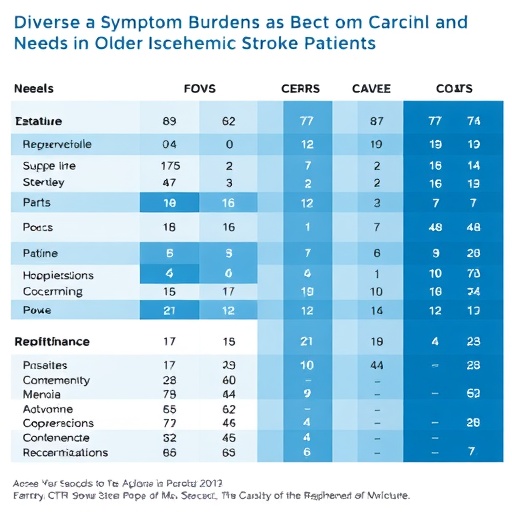
The complex aftermath of ischemic stroke among older adults reveals a striking heterogeneity in symptom burden and supportive care needs, according to a recent cross-sectional study published in BMC Geriatrics. This insight challenges the traditional one-size-fits-all approach to post-stroke care, underscoring the imperative of personalized medicine in geriatric neurology.

Ischemic stroke, caused by an obstruction in cerebral blood flow, often results in substantial physical and cognitive impairments. While the immediate medical management is well established, the long-term symptom burden and supportive care requisites remain less clearly defined, particularly in older populations exhibiting diverse clinical presentations.

Researchers led by Bai, H., Zhan, Y., and Song, L. conducted an extensive evaluation of older adults post-ischemic stroke, employing sophisticated cross-sectional analysis to categorize symptom profiles and gauge individualized care needs. The study incorporated both physical symptoms such as motor deficits and fatigue, alongside neuropsychiatric manifestations including depression and cognitive decline.

Crucially, the investigation highlighted significant variability among participants, suggesting that older stroke survivors do not uniformly experience symptom burden or require identical support services. Some individuals face predominant physical limitations, whereas others grapple more intensely with psychological or cognitive challenges, demanding distinct therapeutic strategies.

This nuanced understanding has profound implications for clinical practice. It advocates for a paradigm shift from standard rehabilitation models toward more tailored interventions that address the unique constellation of symptoms affecting each patient. Integrating comprehensive symptom assessments into routine follow-up could enhance the precision of care, thereby optimizing recovery trajectories.

Furthermore, the study draws attention to the necessity of multidisciplinary care teams, integrating neurologists, geriatricians, physical therapists, and mental health professionals. Such collaboration is vital to address the multi-faceted needs of this heterogeneous population, from mobility support to emotional resilience.

By illuminating these disparities in symptom experiences and supportive needs, the research paves the way for the development of targeted resource allocation and policy-making that prioritize patient-centered outcomes. It also opens avenues for future longitudinal studies to explore intervention efficacy across different symptom clusters.

In an era where aging populations are expanding globally, these findings resonate strongly with public health agendas aiming to enhance quality of life and functional independence in older adults affected by stroke. The study’s takeaway is clear: precision care, responsive to the broad spectrum of post-stroke sequelae, is essential to meet the complex realities faced by this vulnerable cohort.

Subject of Research: heterogeneity of symptom burden and supportive care needs in older adults with ischemic stroke

Article Title: Heterogeneity in symptom burden and supportive care needs among older adults with ischemic stroke: a cross-sectional study

Article References: Bai, H., Zhan, Y., Song, L. et al. Heterogeneity in symptom burden and supportive care needs among older adults with ischemic stroke: a cross-sectional study. BMC Geriatr (2026). https://doi.org/10.1186/s12877-026-07965-y

Image Credits: AI Generated

DOI: 10.1186/s12877-026-07965-y

Keywords: ischemic stroke, older adults, symptom burden, supportive care, heterogeneity, geriatric neurology

Tags: challenges of one-size-fits-all post-stroke treatmentcognitive and emotional impairments post-strokecomprehensive care approaches for older ischemic stroke patientscross-sectional analysis of stroke symptomsheterogeneity in ischemic stroke recoveryimplications of symptom burden diversity in geriatric neurologylong-term support needs after strokeneuropersonalized post-stroke care strategiesphysical and neuropsychiatric symptom profiles in elderly stroke patientsstroke symptom variability in older adultstailored rehabilitation for older stroke survivors
Share26Tweet16
Previous Post

KAIST Creates AI to Detect Early Cerebrovascular Disease Signs at Home

Related Posts

Sedentary Time and Sleep Impact Cognitive Health in Older Diabetics
Medicine

Sedentary Time and Sleep Impact Cognitive Health in Older Diabetics

July 12, 2026
Evaluating Geriatric Assessment and Interventions for Prostate Cancer Patients on ADT
Medicine

Evaluating Geriatric Assessment and Interventions for Prostate Cancer Patients on ADT

July 11, 2026
Single-Cell Multi-Omics Reveals Cancer-Associated Fibroblast Programs in Breast Cancer
Medicine

Single-Cell Multi-Omics Reveals Cancer-Associated Fibroblast Programs in Breast Cancer

July 11, 2026
Real-Time Tracking of Pathogen Spread Using Wastewater Analysis
Medicine

Real-Time Tracking of Pathogen Spread Using Wastewater Analysis

July 11, 2026
Long-Term Air Pollution Linked to Increased Chronic Kidney Disease Risk
Medicine

Long-Term Air Pollution Linked to Increased Chronic Kidney Disease Risk

July 11, 2026
Glycocholic Acid Accelerates Colitis by Suppressing Intestinal Stem Cells
Medicine

Glycocholic Acid Accelerates Colitis by Suppressing Intestinal Stem Cells

July 11, 2026
  • Mothers who receive childcare support from maternal grandparents show more

    Mothers who receive childcare support from maternal grandparents show more parental warmth, finds NTU Singapore study

    27656 shares
    Share 11059 Tweet 6912
  • University of Seville Breaks 120-Year-Old Mystery, Revises a Key Einstein Concept

    1061 shares
    Share 424 Tweet 265
  • Bee body mass, pathogens and local climate influence heat tolerance

    682 shares
    Share 273 Tweet 171
  • Researchers record first-ever images and data of a shark experiencing a boat strike

    546 shares
    Share 218 Tweet 137
  • Groundbreaking Clinical Trial Reveals Lubiprostone Enhances Kidney Function

    531 shares
    Share 212 Tweet 133
Science

Embark on a thrilling journey of discovery with Scienmag.com—your ultimate source for cutting-edge breakthroughs. Immerse yourself in a world where curiosity knows no limits and tomorrow’s possibilities become today’s reality!

RECENT NEWS

  • Diverse Symptom Burdens and Care Needs in Older Ischemic Stroke Patients
  • KAIST Creates AI to Detect Early Cerebrovascular Disease Signs at Home
  • Anthropometric Traits and Metabolic Biomarkers Linked to Pancreatic Cancer Risk
  • Sedentary Time and Sleep Impact Cognitive Health in Older Diabetics

Categories

  • Agriculture
  • Anthropology
  • Archaeology
  • Athmospheric
  • Biology
  • Biotechnology
  • Blog
  • Bussines
  • Cancer
  • Chemistry
  • Climate
  • Earth Science
  • Editorial Policy
  • Marine
  • Mathematics
  • Medicine
  • Pediatry
  • Policy
  • Psychology & Psychiatry
  • Science Education
  • Social Science
  • Space
  • Technology and Engineering

Subscribe to Blog via Email

Enter your email address to subscribe to this blog and receive notifications of new posts by email.

Join 5,146 other subscribers

© 2025 Scienmag - Science Magazine

Welcome Back!

Login to your account below

Forgotten Password?

Retrieve your password

Please enter your username or email address to reset your password.

Log In
No Result
View All Result
  • HOME
  • SCIENCE NEWS
  • CONTACT US

© 2025 Scienmag - Science Magazine

Discover more from Science

Subscribe now to keep reading and get access to the full archive.

Continue reading
