


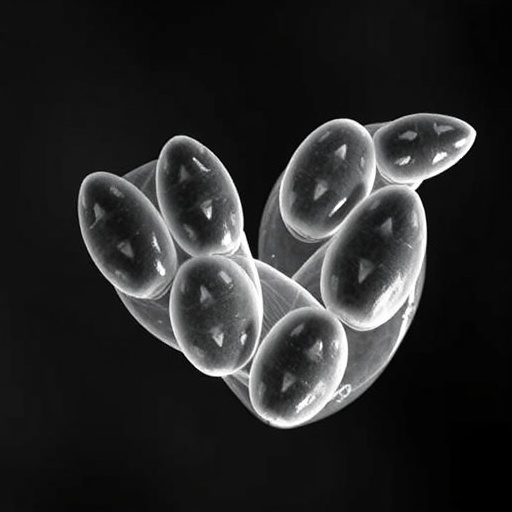
In the intricate world of embryonic development, where cells rapidly proliferate and tissues painstakingly assemble, one of biology’s longstanding puzzles has been how organisms prevent their developing tissues from catastrophically colliding as they expand. A groundbreaking study conducted by an international collaboration between Japanese and German researchers has now unraveled the evolutionary strategies that diverse fly species have adopted to resolve this fundamental problem of “tissue tectonic collision.”
During early embryogenesis, cells must not only multiply but also organize into defined structures within the spatial confines of a protective shell or maternal environment. This physical limitation imposes a significant mechanical challenge: the expanding tissues of the head and torso, growing at rapid yet different rates, risk crashing into one another. To address this, the team led by Yu-Chiun Wang at RIKEN Center for Biosystems Dynamics Research and Steffen Lemke at the University of Hohenheim delved deep into the developmental biology of various dipteran insects, including the well-studied fruit fly Drosophila and its lesser-known relative, the midge Chironomus.
A striking discovery was that many fly species employ a transient anatomical feature called the cephalic furrow, a shallow fold appearing during embryogenesis between the head and trunk regions. Although ephemeral, this furrow acts functionally as a mechanical ‘sink’ that absorbs and redistributes tissue pressure, thereby preventing the deleterious collision of expanding cellular domains. Using state-of-the-art genomic engineering and high-precision laser microscopy, co-lead author Bipasha Dey meticulously excised the cephalic furrow in Drosophila embryos. The result was illuminating: embryos lacking the furrow suffered from abnormal development and severe defects, clearly indicating that the formation of this structure is essential for normal morphogenesis.
By situating the presence of the cephalic furrow within an evolutionary framework, the researchers found that the subgroup containing Drosophila and closely related species consistently forms this furrow during gastrulation. In contrast, species outside this group, such as the midge Chironomus, lack this feature, hinting at divergent evolutionary solutions to the same mechanical dilemma. Girish Kale, another co-lead, emphasized the importance of integrating data from century-old entomological illustrations with modern genetic and imaging techniques, highlighting how this fold represents an evolutionary innovation akin to feathers in birds—an adaptive mechanism finely tuned over millennia.
Parallel research by Pavel Tomancak’s laboratory at the Max Planck Institute further corroborated these findings. Their work identified specific genetic modifications underpinning the emergence of the cephalic furrow and developed physical models demonstrating how this fold optimally alleviates mechanical stress at critical developmental junctures. This convergence of genetic, evolutionary, and biophysical data provides compelling evidence that mechanical forces are not mere bystanders but central drivers in evolutionary innovation.
The question then arises: how do embryos that do not form the cephalic furrow avoid tissue collision? The team observed that these species modulate the angle of cell division in the head region during expansion. Cells divide out-of-plane, meaning one daughter cell remains on the surface while the other is pushed inward, creating a double-layered tissue configuration. This strategy reduces the effective expansion pressure at the interface of the head and trunk, thereby shortening the duration of vulnerability to collision.
To experimentally test this hypothesis, PhD student Verena Kaul focused on Chironomus and demonstrated that this unique pattern of cell division effectively mitigates tissue collision. Moreover, when the researchers genetically manipulated Drosophila embryos to rotate their division angles to imitate the midge’s division pattern, the embryos largely bypassed the need for a cephalic furrow, confirming the functional interchangeability of these divergent developmental strategies.
These results illuminate a fundamental evolutionary principle: multiple, distinct biological solutions can arise to solve identical mechanical problems during development. As Steffen Lemke aptly stated, this discovery exemplifies evolution’s ability to find diverse answers through different molecular and cellular pathways, showcasing nature’s remarkable adaptability and resourcefulness.
Yu-Chiun Wang further emphasized the broader implications of these findings, pointing out that mechanical forces play a far more critical and sophisticated role in shaping evolutionary traits than previously appreciated. Embryos do not passively endure mechanical stress but actively manage it through specialized structural and cellular tactics, ensuring coordinated growth and avoiding catastrophic failures during critical developmental stages.
This pioneering research not only advances our understanding of developmental biology but also enriches evolutionary theory by linking physical forces and biomechanics to genetic and morphological innovation. The implications reach beyond insect embryology, potentially informing biomedical approaches to congenital defects arising from tissue mispatterning or mechanical failure.
The collaborative effort marks a milestone in developmental research, blending classical comparative biology with precise genetic engineering and advanced microscopy to solve a decades-old mystery. It underscores the importance of interdisciplinary approaches combining physics, genetics, evolutionary biology, and cutting-edge technology to unravel the complexities of life’s formative processes.
As we widen our investigative lens to look across species and evolutionary time scales, it becomes increasingly evident that anatomy, genetics, and mechanics are deeply intertwined in creating the forms and functions essential for life. This research provides a stunning example of how ephemeral embryonic structures can have profound evolutionary and mechanistic significance, highlighting the intricate dance between growth, form, and function that defines all living organisms.
Cite Scienmag News
Gavin Prescott. (September 9, 2025). Diverse Strategies Enable Fly Embryos to Resolve the Challenge of ‘Tissue Tectonic Collision’. Scienmag. https://scienmag.com/diverse-strategies-enable-fly-embryos-to-resolve-the-challenge-of-tissue-tectonic-collision/
Gavin Prescott. "Diverse Strategies Enable Fly Embryos to Resolve the Challenge of ‘Tissue Tectonic Collision’." Scienmag, 9 September 2025, https://scienmag.com/diverse-strategies-enable-fly-embryos-to-resolve-the-challenge-of-tissue-tectonic-collision/. Accessed 4 September 2026.
Gavin Prescott. "Diverse Strategies Enable Fly Embryos to Resolve the Challenge of ‘Tissue Tectonic Collision’." Scienmag. September 9, 2025. https://scienmag.com/diverse-strategies-enable-fly-embryos-to-resolve-the-challenge-of-tissue-tectonic-collision/


