


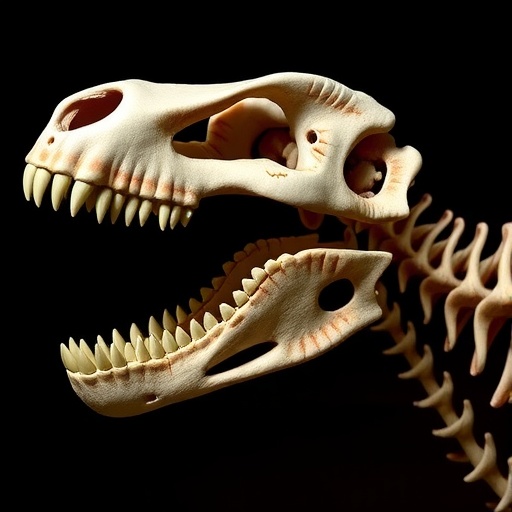
In a groundbreaking discovery, scientists have unveiled remarkable new insights into the evolutionary development of mammalian jaw joints, challenging long-held assumptions about one of the defining characteristics of mammals. The evolution of a single-dentary-boned lower jaw coupled with a secondary craniomandibular articulation between the dentary condyle and the squamosal glenoid has long been regarded as a pivotal vertebrate innovation exclusive to mammals. This distinctive jaw architecture enables complex chewing and precise jaw movements, traits integral to mammalian adaptation and survival. However, recent research identifies unprecedented variations of jaw joint structures in early mammaliamorphs, shedding fresh light on the myriad evolutionary experiments that preceded the canonical mammalian jaw.
The study, published in Nature, reports novel jaw joint morphologies discovered in two ancient mammaliamorph taxa, revealing significant diversity and complexity in secondary jaw joint evolution during the Jurassic period. The first specimen, Polistodon, belongs to the herbivorous tritylodontids, a clade known for their relatively large body size and possibly fossorial (burrowing) lifestyle. Remarkably, Polistodon exhibits a unique dentary-jugal articulation instead of the typical dentary-squamosal joint. This previously unknown configuration signals a divergent evolutionary path, demonstrating that secondary jaw joint development was far from linear or uniform among advanced cynodonts.
Contrasting with Polistodon, the second taxon studied—a Morganucodontan from the Early Jurassic—presents a dentary-squamosal joint that conspicuously lacks the conventionally bulbous condyle. This incomplete morphology supports longstanding hypotheses that the mammalian dentary condyle formed through the expansion of the lateral ridge of the dentary bone rather than emerging suddenly in its full form. The finding importantly fills morphological gaps in the transition from basal cynodonts to crown mammals and underscores the modular and gradual evolution of jaw joint anatomy.
These diverse evolutionary experiments reflect repeated, independent origins of secondary jaw joints within advanced cynodonts, a key insight that reframes how paleontologists understand the synapomorphic traits defining mammaliaforms. The presence of differing joint arrangements in closely related taxa underscores that the load-bearing dentary-squamosal articulation—currently considered a hallmark of mammalian evolution—may have arisen multiple times convergently, rather than through a single, unidirectional modification.
While prior theories often attributed the advent of the mammalian jaw joint primarily to body miniaturization, this new research argues that additional ecological and functional pressures played critical roles. Jaw-muscle reorganization, dietary specialization, and masticatory behavior are implicated as crucial influences driving the morphological diversification of jaw joints. By examining the ecologies and functional demands of these ancient species, the study highlights how changes in feeding strategies could have catalyzed innovative jaw structural adaptations, offering mammals their evolutionary edge in food processing capabilities.
The ecomorphological plasticity exhibited by these fossils points to the powerful role of phenotypic plasticity and environmentally induced morphological changes in shaping evolutionary trajectories. Such developmental flexibility, exposed to varying ecological pressures, likely created evolutionary pathways that facilitated rapid diversification and experimentation in jaw structure among early mammaliamorphs. This intersection of developmental biology and evolutionary ecology provides a nuanced understanding of how adaptive morphologies arise beyond strict genetic determinism.
The discovery also emphasizes the importance of secondary craniomandibular joints not merely as fixed anatomical milestones but as dynamic features subject to evolutionary experimentation in response to ecological demands. Complex jaw joints enabled refined occlusion patterns, which are fundamental for efficient mastication and dietary diversification essential for the success of the mammalian lineage. The identification of such variety in jaw joints among Jurassic mammaliamorphs intriguingly parallels the adaptive radiations seen in other vertebrate structures contributing to mammalian success.
Beyond implications for evolutionary biology, these findings challenge the narrative of mammalian origin by documenting previously unrecognized functional innovations and morphological diversity in early mammaliamorphs. The revealed complexity indicates that the path to the modern mammalian jaw involved multifaceted adaptations encompassing skeletal morphology, muscle mechanics, and ecological interactions over extended geological timescales. Understanding this intricate evolutionary mosaic is critical for reconstructing mammalian phylogeny and interpreting fossil data more accurately.
This research further bridges the gap between morphological and phylogenetic analysis by providing concrete morphological evidence for multiple independent origins of secondary jaw joints within mammaliamorphs, refuting simplistic linear models of jaw evolution. By integrating fossil anatomy with evolutionary developmental biology concepts, the study presents a paradigm shift in appreciating how ecological factors and developmental plasticity interplay to generate evolutionary novelty in vertebrates.
Significantly, this investigation redefines established notions by showing that fossorial lifestyles, body size variation, and feeding ecology each contributed distinct selective pressures influencing jaw joint morphology. The identification of a dentary-jugal articulation in Polistodon, coupled with variations in Morganucodontan jaw morphology, reflects evolutionary experimentation beyond mere miniaturization effects alone. This multifactorial perspective opens new research avenues that explore how diverse ecological niches drive skeletal innovation in vertebrates.
In conclusion, this landmark study transforms our understanding of mammalian jaw evolution by demonstrating the convergent and diverse origins of multiple secondary jaw joints among mammaliamorphs. It reveals how phenotypic plasticity, ecological adaptation, and functional demands coalesced to produce the distinctive mammalian jaw joint system via a series of evolutionary experiments. This work invites a re-examination of morphological fossils with an ecological and developmental lens, enriching our comprehension of one of the most crucial vertebrate evolutionary transitions.
As the fossil record continues expanding and technologies such as micro-CT scanning unlock fine morphological detail, further uncovering variants in early jaw joint structure will be possible. Such discoveries will deepen insights into the evolutionary mechanisms underlying mammalian innovations, highlighting the evolving interplay between anatomy, ecology, and behavior. Ultimately, understanding the intricate history of mammalian jaws provides a window into the broader dynamics of vertebrate evolution and adaptation.
Cite Scienmag News
Gavin Prescott. (September 24, 2025). Diverse Mammaliamorph Jaw Joints Evolved Independently. Scienmag. https://scienmag.com/diverse-mammaliamorph-jaw-joints-evolved-independently/
Gavin Prescott. "Diverse Mammaliamorph Jaw Joints Evolved Independently." Scienmag, 24 September 2025, https://scienmag.com/diverse-mammaliamorph-jaw-joints-evolved-independently/. Accessed 4 September 2026.
Gavin Prescott. "Diverse Mammaliamorph Jaw Joints Evolved Independently." Scienmag. September 24, 2025. https://scienmag.com/diverse-mammaliamorph-jaw-joints-evolved-independently/


