


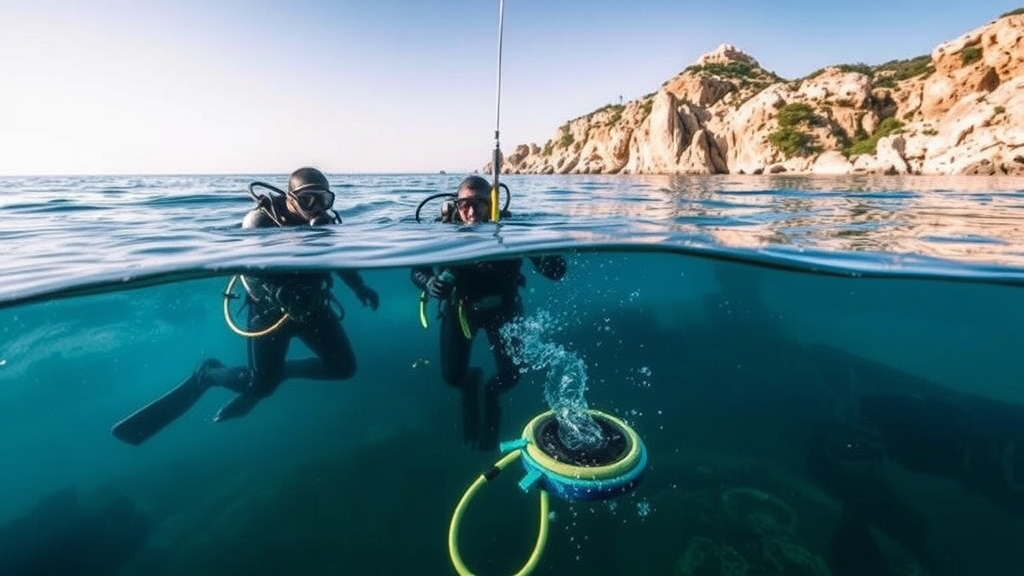
Beneath the turquoise surface of a small Croatian bay, a team of scientific divers has produced one of the most detailed chemical portraits yet of how tourism quietly reshapes coastal seawater. Working in September 2025 around Sveta Marina on the eastern Istrian peninsula in the Northern Adriatic Sea, researchers from TU Bergakademie Freiberg combined precision underwater sampling with laboratory chemistry to separate natural background signals from the fingerprints of boats, harbors, and sewage. Their findings, published in Discover Oceans, paint a reassuring but nuanced picture: the bay remains chemically healthy overall, yet it carries distinct, localized contamination hotspots that traditional ship-based monitoring would almost certainly have missed.
The study’s central innovation lies in its sampling method. Rather than lowering bottles from a vessel or relying on remote sensors, trained divers descended to specific underwater structures, including a small harbor basin, limestone drop-offs, a wooden shipwreck resting at 22 to 26 meters, and a submerged pipe extending from the shoreline to a depth of 47 meters. The pipe, officially designated as a decommissioned wastewater overflow, was a particular target of suspicion. Divers could visually identify the exact point where an effluent plume emerged, position sampling bottles directly within it, and document the surrounding environment on underwater slates, a level of spatial precision that neither autonomous vehicles nor surface-based sampling can match.
In total, the team collected 30 samples across depths ranging from half a meter to 47 meters, supplemented by four nearby reference dive sites. Every sample was brought to a mobile field laboratory within 30 minutes, where pH, salinity, and redox potential were measured before the water chemistry could shift. Trace metal samples were filtered, acidified with nitric acid, and stored cool, while samples for surfactant analysis were preserved with a small amount of acetonitrile to halt microbial degradation. Back in Germany, the metals were measured by inductively coupled plasma optical emission spectroscopy after solid phase extraction, a pre-treatment step essential for stripping away the interfering salt matrix of Adriatic seawater and concentrating the analytes to detectable levels.
The baseline hydrochemistry told a story of stability. Surface waters reached 25 degrees Celsius, with a distinct thermocline between 20 and 25 meters separating a warm, well-mixed upper layer from a cooler, more stagnant deep zone. pH held steady at 8.06, absolute salinity averaged 39.3 grams per kilogram, and redox potential of roughly 441 millivolts confirmed that the entire water column was well oxygenated, conditions that keep iron and manganese oxides stable and prevent the release of adsorbed metals from sediments.
One sample shattered that calm. At station SP05, drawn directly from the sewer pipe outlet at 47 meters, the water was turbid, yellowish-brown, and carried a distinct sewage odor. Its salinity of just 10.9 grams per kilogram marked it as freshwater-dominated effluent, its pH of 6.44 represented dramatic local acidification driven by carbon dioxide from microbial breakdown of organic matter, and its redox potential of nearly minus 99 millivolts revealed an anoxic micro-environment. That oxygen-starved plume matters chemically: the aerobic degradation of detergents requires molecular oxygen, so the plume’s own organic load effectively shields its pollutants from breakdown, allowing them to persist and spread into the stratified layers of the bay.
The surfactant results were the study’s most striking. Linear alkylbenzene sulfonates, or LAS, the world’s most widely used anionic detergents, are exclusively anthropogenic and therefore unambiguous tracers of domestic wastewater. At SP05, the divers measured a concentration of roughly 1469 parts per billion, nearly 300 times the background level. Every other sample in the bay, including the designated reference site, contained a consistent low-level signal of about 5 parts per billion. That ubiquitous background suggests either that the bay has reached a chemical steady state in which continuous inputs during the tourist season balance slow degradation, or that diffuse sources such as greywater runoff, contaminated karst groundwater, or discharges from recreational vessels are feeding the system. Because no comparable Mediterranean baseline datasets for marine surfactants exist, the authors say their values provide a critically needed reference for future monitoring along the Adriatic coast.
The trace metal analysis, by contrast, revealed contamination confined to specific spots rather than systemic pollution. Most elements were detected below 5 parts per billion, at or beneath concentrations reported for other Adriatic locations, confirming largely pristine ambient water. Zinc stood out with occasional values exceeding 20 parts per billion, consistent with antifouling paints, galvanized materials, and corrosion-protection coatings. Statistical analysis of the metal data revealed two clearly separated element clusters. An aluminum-cadmium-copper-zinc group points to maritime activity: copper and zinc leach from antifouling coatings, aluminum and zinc come from sacrificial anodes on hulls and harbor infrastructure, and cadmium travels as a characteristic impurity in zinc alloys. A second iron-manganese-nickel cluster reflects the region’s geology, where weathering of red-oxide-bearing limestone and terra rossa soils naturally releases these elements into the sea.
Principal component analysis sharpened this distinction, explaining 72 percent of the variance in two factors that separate total metal load from the contrast between the anthropogenic and geogenic clusters. The biplot flagged telling anomalies: samples taken beside the wooden shipwreck showed elevated iron, manganese, and nickel, consistent with the slow corrosion of the wreck’s iron fasteners, while a harbor sample displayed elevated copper, zinc, and cadmium, a signature of touristic boat traffic. One outlier station, where a parallel team had disturbed sediment shortly before sampling, illustrated how easily diving-based measurements in soft sediments can be skewed by resuspended pore water, a caution the authors fold into their methodological recommendations.
Crucially, the team emphasizes that none of these signals currently threatens the bay’s ecology. Outside the immediate outfall, metal concentrations and the pervasive 5 parts per billion surfactant background remain well below toxicological thresholds, and the Northern Adriatic’s high dilution capacity appears to buffer these localized pressures effectively. But the molecular warning is clear. The authors recommend modernizing the wastewater infrastructure at the submerged sewer pipe and expanding future work into multi-seasonal campaigns, mass-spectrometric separation of detergent homologs, and dive-computer-based three-dimensional mapping of sampling positions. Their broader message is that scientific diving, paired with rigorous multi-parameter chemistry, can detect subtle anthropogenic change in coastal waters long before it escalates into visible environmental damage, offering coastal managers an early-warning tool precisely where tourism pressure is growing fastest.
Subject of Research: Anthropogenic trace metal and surfactant contamination assessment of a Croatian coastal bay in the Northern Adriatic Sea using scientific diving
Article Title: Assessment of anthropogenic trace metal and surfactant influence on a coastal area in the Northern Adriatic Sea using scientific diving
Article References: Franke, E., Franke, N., Viehweger, C., & Vogt, C. (2026). Assessment of anthropogenic trace metal and surfactant influence on a coastal area in the Northern Adriatic Sea using scientific diving. Discover Oceans, 3(1), Article 47. https://doi.org/10.1007/s44289-026-00158-w
Image Credits: AI Generated
DOI: 10.1007/s44289-026-00158-w
Keywords: marine pollution, scientific diving, Northern Adriatic Sea, trace metals, linear alkylbenzene sulfonates, wastewater tracers, coastal monitoring, antifouling, principal component analysis, seawater chemistry, Croatia, tourism impact
Cite Scienmag News
Violet Maxwell. (September 13, 2026). Divers Trace Sewage and Metal Hotspots in Adriatic Coastal Waters. Scienmag. https://scienmag.com/divers-trace-sewage-and-metal-hotspots-in-adriatic-coastal-waters/
Violet Maxwell. "Divers Trace Sewage and Metal Hotspots in Adriatic Coastal Waters." Scienmag, 13 September 2026, https://scienmag.com/divers-trace-sewage-and-metal-hotspots-in-adriatic-coastal-waters/. Accessed 5 October 2026.
Violet Maxwell. "Divers Trace Sewage and Metal Hotspots in Adriatic Coastal Waters." Scienmag. September 13, 2026. https://scienmag.com/divers-trace-sewage-and-metal-hotspots-in-adriatic-coastal-waters/


