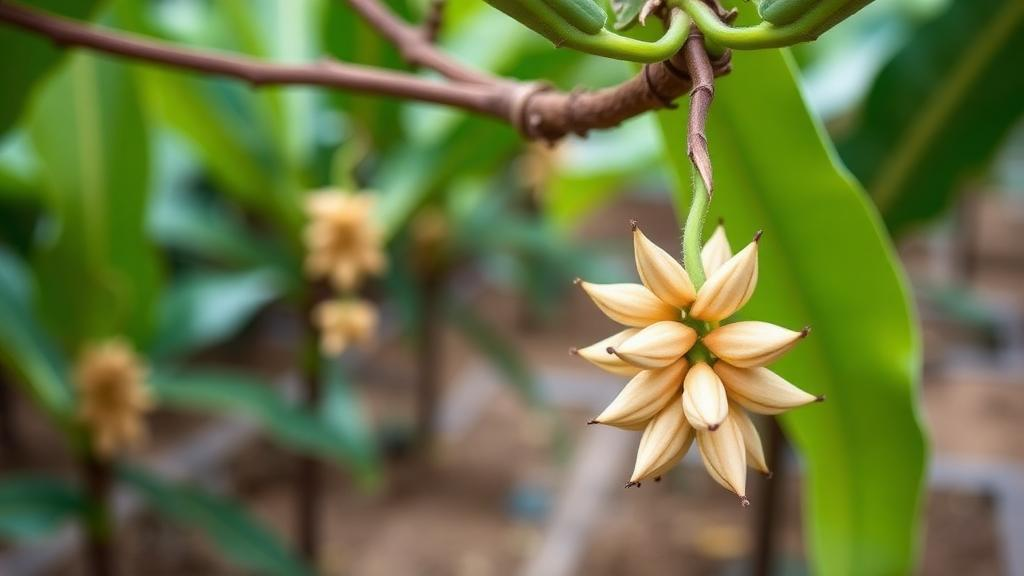
Local community members in the Colombian Andes have helped establish the presence of two wild relatives of the vanilla orchid in Otanche, Boyacá, providing the first Colombian record of Vanilla karen-christianae and extending the known range of Vanilla dressleri east of the Magdalena River. Scientists working with the residents confirmed the plants through field observations, floral measurements and comparisons with herbarium and database records. They also used the findings to produce the first conservation-status evaluations of both species under International Union for Conservation of Nature criteria. The study illustrates how participatory fieldwork can reveal overlooked crop wild relatives while supplying evidence for their protection.
Vanilla planifolia is the source of natural vanilla, a crop of major economic value whose wild relatives may help diversify the genetic base available to crop improvement. The genus Vanilla contains approximately 120 hemiepiphytic and epiphytic orchid species. Its secondary gene pool, comprising more than 40 species in the neotropical subgenus Xanata and section Xanata, includes plants naturally distributed across tropical America. These species are potentially important for rural development in tropical and subtropical regions, but their distributions, taxonomic limits and conservation needs remain incompletely understood. Vanilla is also notoriously difficult to study because many species are locally rare, flower infrequently and have historically been poorly represented in biological collections.
The conservation picture is especially incomplete. Before the present assessments, only nine Vanilla species in section Xanata had been evaluated for the IUCN Red List; one was classified as Critically Endangered, seven as Endangered and one as Data Deficient. Across the wider genus, only 11 of approximately 120 species had received formal assessments. Colombia is a centre of diversity for the crop’s wild relatives: recent work had documented 26 Vanilla species there, including 21 in section Xanata, but no national conservation-status evaluations had been completed. The new records increase the Colombian total to 27 Vanilla species, 22 of them in the section forming the crop’s secondary gene pool.
The discoveries were made in the Serranía de las Quinchas, a rugged area of approximately 860 square kilometres on the western slope of the Eastern Cordillera of the Andes. The studied locality lies in the municipality of Otanche, within the buffer zone of the Regional Forest Reserve Las Quinchas. The broader mountain range extends from 200 to 1,700 metres above sea level, while the Sub-Andean tropical life zone below 1,000 metres contains a mosaic of pastures, agricultural areas and small remnants of humid tropical forest. Historically, forest in the Magdalena River valley was more continuous, but expansion of cattle ranches and palm-oil plantations has left a highly fragmented landscape. Serranía de las Quinchas is now among the last remnants of humid tropical forest in the middle Magdalena watershed.
Residents encountered the orchids during routine work on their smallholdings. A community member found V. karen-christianae in disturbed secondary forest beside a footpath at San José de Nazareth, where a single climbing plant covered roughly 20 square metres on both sides of the path. A second community member located 15 V. dressleri plants across about 8 square kilometres of secondary forest between cacao plots at Altazor, between 400 and 950 metres above sea level. The residents contacted the researchers through iNaturalist. One of them monitored V. dressleri through flowering, while the scientists photographed and dissected flowers, measured floral structures from living material and compared diagnostic characters with published taxonomic descriptions.
The Colombian population of V. karen-christianae fills a conspicuous gap in a previously disjoint global distribution. The species, described in 2018, had 22 records from 19 localities across Nicaragua, Costa Rica and Panama, with additional records extending through the Amazon basin in Peru and Brazil. The new Boyacá population provides a trans-Andean connection between those Mesoamerican and Amazonian records. Researchers also compared the Colombian material with a proposal to synonymize V. karen-christianae with V. ensifolia. The newly studied flower has a deeply emarginate, conspicuously three-lobed lip, whereas V. ensifolia was described as having an entire, rounded lip. At the time of the assessment, the World Checklist of Selected Plant Families treated V. ensifolia as a synonym of V. odorata, and the study noted the differing characters in the available descriptions.
For V. dressleri, the Otanche find extended the range in a different direction. First described in 2010, the species had 21 records from 17 localities running from northern Costa Rica through Panama and southward through the Chocó biogeographic region on the Pacific coasts of Colombia and Ecuador. The new record is the first known east of the Magdalena River and expands the species’ Andean distribution. Together, the two records place both orchids within the Tumbes–Chocó–Magdalena and Mesoamerican biodiversity hotspots. Morphological examination also revealed differences from the original descriptions: the Colombian V. karen-christianae had larger, less intensely coloured flowers and a more clearly trilobed lip, while the V. dressleri specimen had a laxer inflorescence, a longer rachis, more separated bracts, less intense lip colouring and an entire rather than undulate, pleated lip margin.
Although both orchids have comparatively broad mapped ranges, their calculated areas of occupancy are small. GeoCAT initially produced an extent of occurrence of 4,447,442 square kilometres for V. karen-christianae, but the assessment restricted the polygon to terrestrial areas below 1,500 metres, reducing it to 3,488,798 square kilometres. Of that area, 2,484,296 square kilometres corresponded to humid tropical forest, including 421,222 square kilometres in Colombia; the area of occupancy was 88 square kilometres. For V. dressleri, the initial extent of occurrence was 539,730 square kilometres and the elevation-adjusted value was 186,235 square kilometres, of which 111,693 square kilometres comprised humid tropical forest and 52,414 square kilometres occurred in Colombia. Its area of occupancy was 80 square kilometres. The researchers considered both species Endangered under criterion B2a,b(ii,iii,iv,v), reflecting areas of occupancy below 500 square kilometres, severely fragmented populations and inferred or projected declines in habitat, number of locations and number of mature individuals.
Habitat pressures differ among the species’ wider ranges but are substantial in both. Average forest-cover loss across the countries in which they occur was 10 percent between 1990 and 2015. More than half of the remaining humid tropical forest in Colombia’s Magdalena River watershed was considered at risk of deforestation, and the mid-Magdalena region was identified as a deforestation hotspot. In the Chocó biogeographic region, 68 percent forest cover remained, but deforestation associated with illicit crops and alluvial mining had increased in recent years. The study’s national assessment inferred that both species could qualify as Critically Endangered under criterion C2a(i,ii) because fewer than 250 mature individuals were registered in total, including fewer than 50 in each subpopulation. These evaluations were preliminary, however, and the number of known individuals does not establish the complete size of every wild population.
Protection is also limited by gaps in protected-area coverage. Every recorded Colombian occurrence of both species fell outside a protected area. The tropical humid biome of the Magdalena River and Caribbean region was only 5.8 percent protected, while the Pacific and Atrato biome was 2.7 percent protected. The authors recommended further botanical exploration within the Regional Forest Reserve Las Quinchas, the Cuchilla de San Antonio, the Serranía de los Yariguies and other protected landscapes. Priority national survey areas included Los Katíos National Nature Park in the Darién region and Paramillo in the central Andean cordillera. For V. dressleri, they also identified the Utría National Nature Park, the Río Anchicaya National Forest Reserve and La Sierpe Regional Nature Park as targets along Colombia’s Pacific coast.
Conserving the species will require action in natural habitats, formal collections and inhabited landscapes. Because known populations are small and Vanilla plants can be propagated vegetatively, the researchers recommended reinforcing populations at existing localities and introducing material into neighbouring protected areas under management. They also identified ex situ conservation as a priority, noting that Colombian germplasm collections contained only Vanilla calyculata, V. planifolia and V. pompona. Participatory “circa situm” measures—conservation within the species’ native range but outside natural habitat—could include community germplasm banks, home gardens and agroforestry cultivation. This approach could connect biodiversity protection with community livelihoods, while the involvement of Indigenous people and local communities was presented as essential to effective orchid conservation and sustainable use.
Subject of Research: Participatory documentation and conservation assessment of two Vanilla crop wild relatives in Colombia
Article Title: Distribution and conservation of vanilla crop wild relatives: the value of local community engagement for biodiversity research
Article References: Flanagan, N. S., Navia-Samboni, A., González-Pérez, E. N., & Mendieta-Matallana, H. (2022). Distribution and conservation of vanilla crop wild relatives: the value of local community engagement for biodiversity research. Neotropical Biology and Conservation, 17(3), 205-227. https://doi.org/10.3897/neotropical.17.e86792
Image Credits: AI Generated
DOI: 10.3897/neotropical.17.e86792
Keywords: vanilla orchids, crop wild relatives, Colombia, citizen science, plant conservation, IUCN Red List, Serranía de las Quinchas, agrobiodiversity, tropical forests, distribution mapping, Distribution, conservation
Cite Scienmag News
Margaret Porter. (October 20, 2026). Distribution and conservation of vanilla crop wild relatives: the value of local community engagement for biodiversity research. Scienmag. https://scienmag.com/distribution-and-conservation-of-vanilla-crop-wild-relatives-the-value-of-local-community-engagement-for-biodiversity-research/
Margaret Porter. "Distribution and conservation of vanilla crop wild relatives: the value of local community engagement for biodiversity research." Scienmag, 20 October 2026, https://scienmag.com/distribution-and-conservation-of-vanilla-crop-wild-relatives-the-value-of-local-community-engagement-for-biodiversity-research/. Accessed 20 October 2026.
Margaret Porter. "Distribution and conservation of vanilla crop wild relatives: the value of local community engagement for biodiversity research." Scienmag. October 20, 2026. https://scienmag.com/distribution-and-conservation-of-vanilla-crop-wild-relatives-the-value-of-local-community-engagement-for-biodiversity-research/