


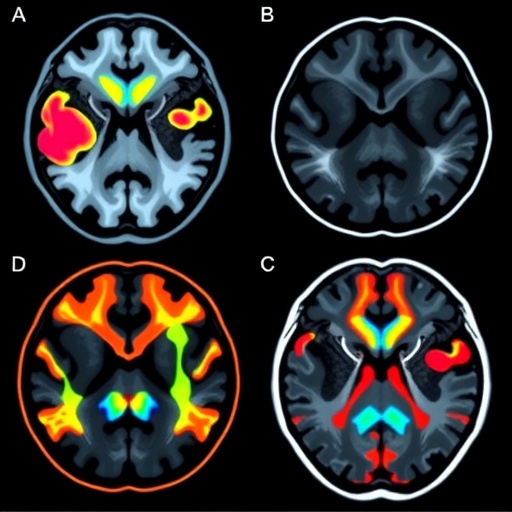
In a groundbreaking advance that promises to reshape Parkinson’s disease diagnostics, researchers have unveiled a novel neuroimaging approach capable of differentiating tremor-dominant Parkinson’s disease (PD) from essential tremor (ET), two neurological conditions historically challenging to distinguish. Utilizing cutting-edge neuromelanin-sensitive imaging combined with the T1-weighted/T2-weighted (T1w/T2w) magnetic resonance imaging (MRI) ratio, this innovative technique offers unprecedented insight into the subtle yet critical brain changes that separate these disorders. The implications for targeted treatment and improved patient outcomes are profound, marking a significant milestone in neurodegenerative disease research.
Historically, clinical differentiation between tremor-dominant Parkinson’s disease and essential tremor has posed a formidable challenge for neurologists due to overlapping symptomatology, particularly in the early stages. Tremor-dominant PD often presents with slow, rhythmic shaking primarily on one side, whereas ET typically manifests as bilateral action tremors. However, these phenotypic presentations can blur, leading to diagnostic uncertainty. Traditional diagnostic tools rely heavily on clinical observation and patient history, lacking objective neurobiological markers to solidify diagnosis. The new imaging methods developed by Fang, Zhou, Zhu, and colleagues address this critical gap.
Central to this study is neuromelanin-sensitive MRI, a relatively recent innovation that exploits the paramagnetic properties of neuromelanin—a dark pigment concentrated primarily in the substantia nigra pars compacta (SNc), a brain region severely implicated in Parkinson’s pathology. Neuromelanin accumulates in dopaminergic neurons, and its depletion is a hallmark of PD-related neurodegeneration. By highlighting neuromelanin-rich areas, this imaging modality serves as a window into neuronal integrity and loss, enabling researchers to visualize pathological changes that were previously inaccessible using conventional MRI sequences.
Complementing neuromelanin mapping is the T1w/T2w ratio imaging technique, which accentuates tissue contrast by dividing the signal intensities from T1-weighted and T2-weighted MRI sequences. This ratio has proven effective in delineating microstructural brain changes, including myelin density and iron deposition, which are altered in neurodegenerative diseases. When applied alongside neuromelanin-sensitive imaging, the combined approach enables a multidimensional characterization of brain pathology, capturing both neuronal loss and associated tissue integrity changes.
The researchers conducted a comprehensive analysis involving patients diagnosed with tremor-dominant PD and those with essential tremor, rigorously matched for clinical variables. Their neuroimaging protocol included high-resolution neuromelanin-sensitive sequences targeting the substantia nigra and locus coeruleus—another critical neuromelanin-containing area—combined with T1w/T2w ratio maps covering basal ganglia and cortical regions pertinent to motor control. Quantitative metrics were extracted, providing objective biomarkers reflective of the underlying neuropathology.
Findings revealed distinct neuromelanin signal attenuation in the substantia nigra of Parkinson’s patients compared to essential tremor subjects, consistent with selective dopaminergic neuron degeneration. Notably, the extent of neuromelanin loss showed a strong correlation with clinical measures of bradykinesia and rigidity, reinforcing its relevance as a PD-specific marker. On the other hand, essential tremor patients exhibited preserved neuromelanin signals but demonstrated subtle alterations in the T1w/T2w ratio within cerebellar regions, implicating cerebellar microstructural changes unique to ET pathophysiology.
This differential imaging signature represents a monumental leap forward in diagnosing tremor disorders. For decades, misdiagnosis between tremor-dominant PD and ET has hindered clinical trials, complicated patient counseling, and limited therapeutic precision. The ability to non-invasively visualize and quantify neurodegeneration specific to PD while concurrently identifying characteristic cerebellar abnormalities in ET equips clinicians with an invaluable tool for personalized medicine.
Beyond diagnosis, this imaging platform holds promise for tracking disease progression and response to treatment. By longitudinally monitoring neuromelanin signal intensity and T1w/T2w ratios in individual patients, clinicians may glean insights into the trajectory of neurodegeneration and the efficacy of neuroprotective interventions or symptomatic therapies. This represents a paradigm shift from symptom-centered assessment toward biomarker-guided management.
Technically, the neuromelanin-sensitive sequences harness magnetization transfer contrast and optimized inversion recovery parameters to maximize contrast-to-noise ratio of neuromelanin-rich clusters. When fused with T1w/T2w ratio maps derived from standardized brain segmentation frameworks, the protocol offers reproducible, high-resolution brain images suitable for both clinical implementation and research investigations. Future refinements may integrate machine learning algorithms to automate region-of-interest delineation and enhance diagnostic accuracy.
Importantly, this methodology also sheds light on the neurobiology underpinning tremor disorders. By delineating the topographies and extents of neuromelanin loss versus cerebellar microstructural variation, the findings support emerging views that PD and ET represent distinct neuroanatomical and pathological entities rather than variations on a spectrum. This distinction may influence future therapeutic development, emphasizing dopaminergic neuron preservation in PD and cerebellar circuitry modulation in ET.
While promising, the study acknowledges limitations, including sample size constraints and the need for multicenter validation to account for scanner variability and patient heterogeneity. Future research will be directed at expanding cohorts, refining imaging processing pipelines, and exploring correlations with genetic and clinical phenotypes. Moreover, integrating PET imaging or CSF biomarkers could further enhance diagnostic confidence and elucidate disease mechanisms.
The impact of this research extends beyond the academic sphere into clinical neurology and patient communities. Early and accurate diagnosis facilitates timely initiation of disease-modifying therapies, reduces the psychological burden of uncertainty, and enables better prognostication. For patients misdiagnosed or undertreated due to overlapping tremor presentations, this diagnostic breakthrough offers newfound clarity and hope.
In summary, the integration of neuromelanin-sensitive imaging with T1w/T2w ratio mapping enables unprecedented differentiation between tremor-dominant Parkinson’s disease and essential tremor. This innovative neuroimaging strategy captures disease-specific pathophysiological signatures, heralding a new era of precision diagnosis in movement disorders. As technology advances and data accumulates, such biomarkers could become standard components of clinical assessments, fundamentally transforming how neurologists understand, diagnose, and treat these complex conditions.
The work of Fang, Zhou, Zhu, and the team stands as a towering example of translational neuroscience, bridging advanced MRI physics, neuropathology, and clinical application. It opens pathways not only for improved diagnosis but also for guiding the development of targeted therapeutics tailored to distinct tremor etiologies. As PD and ET affect millions worldwide, innovations like these resonate deeply, illuminating the path toward better neurological health.
Cite Scienmag News
Diana Fleming. (April 28, 2026). Distinguishing Parkinson’s from Essential Tremor via Imaging. Scienmag. https://scienmag.com/distinguishing-parkinsons-from-essential-tremor-via-imaging/
Diana Fleming. "Distinguishing Parkinson’s from Essential Tremor via Imaging." Scienmag, 28 April 2026, https://scienmag.com/distinguishing-parkinsons-from-essential-tremor-via-imaging/. Accessed 4 September 2026.
Diana Fleming. "Distinguishing Parkinson’s from Essential Tremor via Imaging." Scienmag. April 28, 2026. https://scienmag.com/distinguishing-parkinsons-from-essential-tremor-via-imaging/


