


This study is led by an international team of scientists including Dr. Ci Chen (School of Automation, Guangdong University of Technology, China), Dr. Lihua Xie (School of Electrical and Electronic Engineering, Nanyang Technological University, Singapore), and Dr. Shengli Xie (Guangdong-HongKong-Macao Joint Laboratory for Smart Discrete Manufacturing, Guangdong Key Laboratory of IoT Information Technology, China), co-contributed by Dr. Yilu Liu (Department of Electrical Engineering and Computer Science, University of Tennessee, USA) and Dr. Frank L. Lewis (UTA Research Institute, The University of Texas at Arlington, USA).

Credit: ©Science China Press
This study is led by an international team of scientists including Dr. Ci Chen (School of Automation, Guangdong University of Technology, China), Dr. Lihua Xie (School of Electrical and Electronic Engineering, Nanyang Technological University, Singapore), and Dr. Shengli Xie (Guangdong-HongKong-Macao Joint Laboratory for Smart Discrete Manufacturing, Guangdong Key Laboratory of IoT Information Technology, China), co-contributed by Dr. Yilu Liu (Department of Electrical Engineering and Computer Science, University of Tennessee, USA) and Dr. Frank L. Lewis (UTA Research Institute, The University of Texas at Arlington, USA).
The concept of Reward is central in reinforcement learning and is also widely used in the natural sciences, engineering, and social sciences. Organisms learn behavior by interacting with their environment and observing the resulting rewarding stimuli. The expression of rewards largely represents the perception of the system and defines the behavioral state of the dynamic system. In reinforcement learning, finding rewards that explain behavioral decisions of dynamic systems has been an open challenge.
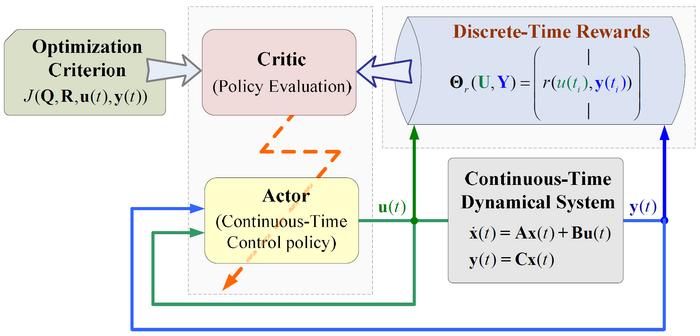
The work aims to propose reinforcement learning algorithms using discrete-time rewards in both continuous time and action space, where the continuous space corresponds to the phenomena or behaviors of a system described by the laws of physics. The approach of feeding state derivatives back into the learning process has led to the development of an analytical framework for reinforcement learning based on discrete-time rewards, which is essentially different from existing integral reinforcement learning frameworks. “When the idea of feedbacking the derivative into the learning process struck, it felt like lightning! And guess what? It mathematically ties into the discrete-time reward-based policy learning!” Chen recalls his Eureka moment and says.
Under the guidance of discrete-time reward, the search process of behavioral decision law is divided into two stages: feed-forward signal learning and feedback gain learning. In their study, it was found that the optimal decision law for continuous-time dynamic systems can be searched from real-time data of dynamic systems using the discrete-time reward-based technique. The above method has been applied to power system state regulation to achieve optimal design of output feedback. This process eliminates the intermediate stage of identifying dynamic models and significantly improves the computational efficiency by removing the reward integrator operator from the existing integral reinforcement learning framework.
This research uses discrete-time reward guidance to discover optimization strategies for continuous-time dynamical systems, and constructs a computational tool for understanding and improving dynamical systems. This result can play an important role in natural science, engineering, and social science.
This work was supported by the National Natural Science Foundation of China and the Fundamental and Applied Basic Research Fund of Guangdong Province.
See the article:
Learning the Continuous-Time Optimal Decision Law from Discrete-Time Rewards
Journal
National Science Open
Cite Scienmag News
Courtney Benton. (June 28, 2024). Discrete-time rewards efficiently guide the extraction of continuous-time optimal control policy from system data. Scienmag. https://scienmag.com/discrete-time-rewards-efficiently-guide-the-extraction-of-continuous-time-optimal-control-policy-from-system-data/
Courtney Benton. "Discrete-time rewards efficiently guide the extraction of continuous-time optimal control policy from system data." Scienmag, 28 June 2024, https://scienmag.com/discrete-time-rewards-efficiently-guide-the-extraction-of-continuous-time-optimal-control-policy-from-system-data/. Accessed 4 September 2026.
Courtney Benton. "Discrete-time rewards efficiently guide the extraction of continuous-time optimal control policy from system data." Scienmag. June 28, 2024. https://scienmag.com/discrete-time-rewards-efficiently-guide-the-extraction-of-continuous-time-optimal-control-policy-from-system-data/

