


PULLMAN, Wash. — Researchers have discovered a new mechanism of oil biosynthesis and found a way to genetically engineer a type of test plant to more efficiently produce different kinds of seed oil that it otherwise wouldn’t make.

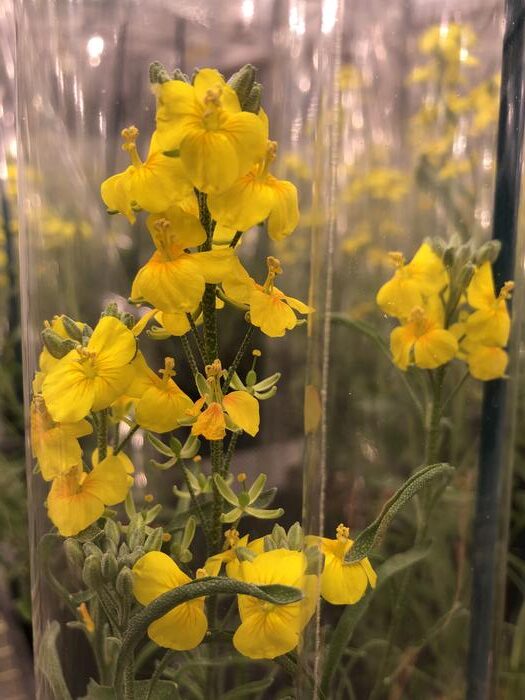
Credit: Photo courtesy Phil Bates, Washington State University
PULLMAN, Wash. — Researchers have discovered a new mechanism of oil biosynthesis and found a way to genetically engineer a type of test plant to more efficiently produce different kinds of seed oil that it otherwise wouldn’t make.
While the engineering is proof-of-concept, this discovery could lead to improved production of valuable oils used in food and by a range of industries. The study, led by Washington State University researchers, was published in the journal Nature Communications.
“Scientists have been working on producing novel seed oil compositions for decades, but most of the time you only get small amounts of the desired oil,” said Phil Bates, a WSU professor and lead author on the study.
Bates and his co-authors found that Physaria fendleri, a plant related to canola, can naturally change the fatty acid composition in its seed oil after it is already made, something nobody knew any plant could do. They discovered the genetic mechanism Physaria uses to makes those changes, then genetically engineered a related plant called Arabidopsis to make the same fatty acid changes.
The modified Arabidopsis overcame metabolic bottlenecks and produced significant amounts of an oil similar to castor oil that it doesn’t naturally produce.
Plant oils are used in food, pharmaceutical, cosmetic, industrial, chemical and biofuel industries. Plant oils’ value stems from its fatty acid composition. Around 90% of oil is valuable for industrial uses in crops like castor beans, Bates said. But if the desirable oil-making genes are transferred into another plant, only small amounts of the oil produced is usable by industry. The newly discovered mechanism of oil biosynthesis shows a way to bump that production back up.
“We’ve always thought that when plants accumulate oil during seed development, that’s the end product,” said Bates, a faculty member in WSU’s Institute of Biological Chemistry. “But we found that Physaria, after making oil, removes some of the fatty acids within the oil and replaces that with others.”
Those oils could replace the reliance of growing dangerous crops, like castor. Castor plants are banned in the U.S. because they also produce ricin, a dangerous poison. Castor oil is valuable in industrial lubricants, but expensive because only a few nations can grow the plants, either legally or environmentally.
“We can use this new biosynthetic process as a tool to change oil composition,” Bates said. “We’re at the starting point of putting this into crop plants. We want to eventually produce healthy fatty acids beyond industrial uses.”
Bates and his colleagues are also looking at other plants to see if they do similar remodeling of oils after production.
“We haven’t identified any others yet, but we’ve never looked before,” Bates said. “This is a new discovery that nobody knew plants could do. We want to see if common crop plants, like canola, can do this remodeling as well.”
Other potential uses for this process include food for people and biofuels, especially aviation fuel.
The project was a collaboration between Bates lab and the Smertenko lab both in the Institute of Biological Chemistry at WSU as well as two labs from the U.S. Department of Agriculture.
Funding for work on this paper came from the USDA National Institute of Food and Agriculture, National Science Foundation and the U. S. Department of Energy.
Journal
Nature Communications
Method of Research
Experimental study
Article Title
Identification of triacylglycerol remodeling mechanism to synthesize unusual fatty acid containing oils
Article Publication Date
26-Apr-2024
COI Statement
The authors declare no competing interests.
Cite Scienmag News
Alan Morgan. (April 30, 2024). Discovery of mechanism plants use to change seed oil could impact industrial, food oils. Scienmag. https://scienmag.com/discovery-of-mechanism-plants-use-to-change-seed-oil-could-impact-industrial-food-oils/
Alan Morgan. "Discovery of mechanism plants use to change seed oil could impact industrial, food oils." Scienmag, 30 April 2024, https://scienmag.com/discovery-of-mechanism-plants-use-to-change-seed-oil-could-impact-industrial-food-oils/. Accessed 4 September 2026.
Alan Morgan. "Discovery of mechanism plants use to change seed oil could impact industrial, food oils." Scienmag. April 30, 2024. https://scienmag.com/discovery-of-mechanism-plants-use-to-change-seed-oil-could-impact-industrial-food-oils/

