


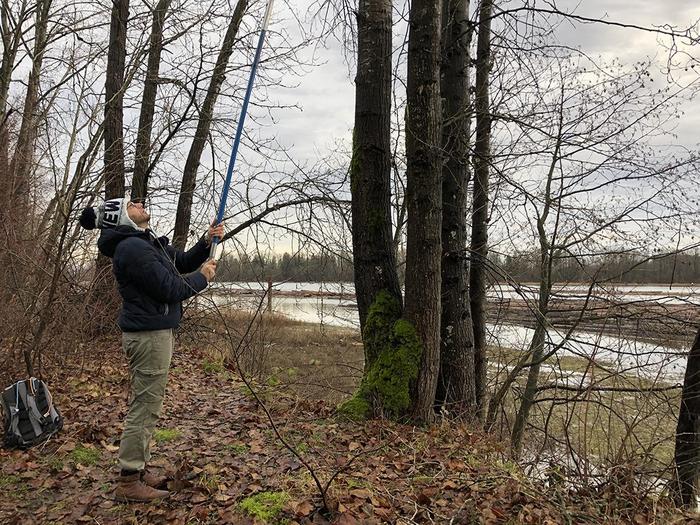
UNIVERSITY PARK, Pa. — The discovery of a hybrid population of poplar trees in western Wyoming has provided insight into how natural hybridization informs the evolution of many plant species, according to a team led by Penn State researchers. They also said their discovery suggests that genetic exchange between species may be critical for adaptation to environmental change.

Credit: Penn State
UNIVERSITY PARK, Pa. — The discovery of a hybrid population of poplar trees in western Wyoming has provided insight into how natural hybridization informs the evolution of many plant species, according to a team led by Penn State researchers. They also said their discovery suggests that genetic exchange between species may be critical for adaptation to environmental change.
The research — which described a novel lineage of hybrid black cottonwood, or Populus trichocarpa, and balsam poplar, Populus balsamifera, — was recently published in Molecular Ecology. It is just the latest study to suggest that natural hybridization has played an important role in the evolution of many plant species, according to team leader Jill Hamilton, associate professor in Penn State’s College of Agricultural Sciences.
“Hybridization between different species is occurring in nature far more frequently than we might have thought — particularly in forest trees. This is not necessarily a bad thing, because it may be a natural mechanism to facilitate adaptation in a changing climate,” said Hamilton, who is director of the Schatz Center for Tree Molecular Genetics at Penn State. “Studies like this one are critical to begin teasing apart how demographic history, gene flow and interaction across varying genomic ancestries have shaped natural hybrid zones to make better predictions for movement of germplasm and climate-assisted forest management in the future.”
Most black cottonwood tree populations exist in wet coastal regions. However, the trees began appearing in arid environments inland and eastward about 800,000 years ago, noted Constance Bolte, postdoctoral researcher for the Schatz Center who spearheaded latter stages of the research. She hypothesized that this movement was likely facilitated by acquiring genetic variation from hybridizing with the balsam poplar trees that allowed them to survive hot, dry conditions.
The hybrid lineage described in the study have “some very interesting genetic combinations,” Bolte pointed out, enabling the trees to thrive in arid habitats.
“Those coastal populations have specific adaptations to wet conditions,” she said. “But climate has been changing, and so their distribution is very limited right now, potentially because that region is drier. And so, those hybrids have been doing better because they have the genetic tools to survive in that drier climate.”
Hybridization between sister species occurs frequently in forest trees, said Bolte, adding that this study shows the value in leveraging that history of natural hybridization for forest tree breeding and management.
“Our data indicates that stable lineage formation can result from hybridization,” she said. “Historically, hybrids have not been considered in conservation efforts, and yet, if these hybrids happen to be fit for survival in arid or other extreme climates, it may be crucial to conserve and manage the natural genetic resources in these populations, especially under rapidly changing climate conditions.”
The team found the black cottonwood-balsam poplar stable hybrid lineage after analyzing the genetic makeup of 546 poplar tree cuttings collected along seven transects — or narrow swaths of territory arranged from north to south — ranging from Alaska to Wyoming, with collections in British Columbia and Alberta, Canada, in between. Such analysis, according to Hamilton, is only possible using big-data-handing techniques and enormous computing power available at facilities such as the ROAR Collaborative Cluster, available through Penn State’s Institute for Computational and Data Sciences.
Contributing to the research at Penn State were Michelle Zavala-Paez, doctoral student in ecology, and Brianna Sutara, undergraduate student majoring in biology and psychology; and Muhammed Can, faculty of Forestry, Duzce University, Turkey; Matthew Fitzpatrick, professor, University of Maryland Center for Environmental Science; Jason Holliday, professor at Virginia Tech; Stephen Keller, associate professor Department of Plant Biology, University of Vermont; and Tommy Phannareth, graduate student at Virginia Tech.
The U.S. National Science Foundation and the U.S. Department of Agriculture’s National Institute of Food and Agriculture funded this research.
Journal
Molecular Ecology
Method of Research
Experimental study
Subject of Research
Not applicable
Article Title
Genomic insights into hybrid zone formation: The role of climate, landscape, and demography in the emergence of a novel hybrid lineage
Article Publication Date
13-Jun-2024
Cite Scienmag News
Sloane Callahan. (July 17, 2024). Discovery of a hybrid lineage offers clues to how trees adapt to climate change. Scienmag. https://scienmag.com/discovery-of-a-hybrid-lineage-offers-clues-to-how-trees-adapt-to-climate-change/
Sloane Callahan. "Discovery of a hybrid lineage offers clues to how trees adapt to climate change." Scienmag, 17 July 2024, https://scienmag.com/discovery-of-a-hybrid-lineage-offers-clues-to-how-trees-adapt-to-climate-change/. Accessed 4 September 2026.
Sloane Callahan. "Discovery of a hybrid lineage offers clues to how trees adapt to climate change." Scienmag. July 17, 2024. https://scienmag.com/discovery-of-a-hybrid-lineage-offers-clues-to-how-trees-adapt-to-climate-change/

