


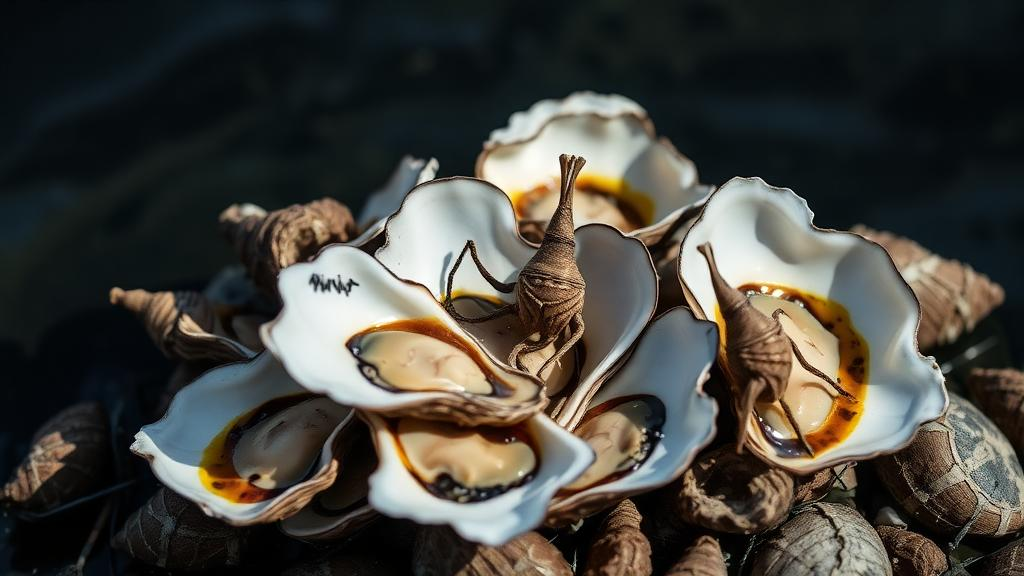
Discarded oyster shells thrown into Ukraine’s Tylihul Estuary carried alien invertebrates into a natural habitat after the shells were transported there with live oysters sold for consumption. A 2023 field survey and DNA-barcode study identified three alien macroinvertebrates associated with oysters at a tasting site: the barnacles Austrominius modestus and Semibalanus balanoides and the corophiid amphipod Monocorophium insidiosum. The observations show that seafood tasting sites and the discarded remains of their shellfish can form an overlooked route for biological invasion, linking cultured organisms with estuarine communities that may have little natural hard substrate.
The study was conducted in the northwestern Black Sea, where the European flat oyster, Ostrea edulis, was extirpated from the region in the 1970s. Commercial oyster production later shifted to the non-native giant Pacific oyster, Magallana gigas, which was introduced to Crimea for mariculture in 1980 and is now raised in Ukraine. The Tylihul Estuary is the largest and deepest estuary in the northwestern Black Sea, measuring approximately 60 km in length and draining a catchment of 5,420 km². Long sandbars, depth differences of 3–5 m in the northern part and 10–22 m in the southern part, and an artificial connecting channel complicate water exchange. Summer salinity measured during the 2023 research reached 29.7 practical salinity units.
Most of the primary material was collected in Kordon village, Odesa region, on 16 and 17 June 2023, at an oyster bar connected to the estuary’s farming infrastructure. Wooden boardwalks and piers extend into the water beside the bar, allowing visitors to eat oysters and throw their shells directly into the estuary. This creates a concentrated zone of discarded shells with a radius of up to 5 m around the structures. A second resort area at Ukrainka in Mykolaiv region was visited during a separate expedition on 16 August 2023; the investigators found neither accumulations of discarded oyster shells nor new alien species at that location. The principal comparison therefore came from three material sources around the Kordon tasting site: living organisms on dead shells in the littoral zone, epibionts attached to live oysters in the bar’s kitchen, and macroinvertebrates on nearby piers, moorings and other hard substrates.
Specimens were examined by field sampling and mitochondrial DNA barcoding. DNA was isolated with a Chelex-buffer method, while the mitochondrial cytochrome c oxidase subunit I gene was amplified and sequenced by the Sanger method. Sequences were compared in GenBank and the Barcode of Life Data System, where they were assigned to Barcode Index Numbers. A. modestus was identified as BOLD:ABX4245, and S. balanoides as BOLD:AAA3935. Two genetic lineages of M. insidiosum were detected, BOLD:AAE1628 and BOLD:AAE9749; both lineages had been recorded in native North Atlantic habitats and in invasive populations in the Pacific and Black Sea. The M. gigas sequence from Tylihul belonged to a widely distributed haplotype found in 123 sequences, among 236 sequences that together collapsed to 73 haplotypes.
The dead shells contained a mixture of alien and native fauna rather than a simple reproduction of the organisms carried on the sale oysters. A. modestus and S. balanoides were present on discarded shells, while M. insidiosum occurred in the field material at the highest recorded abundance class. Native molluscs and crustaceans also occupied the shells and neighboring structures, including the amphipod Gammarus aequicauda, the isopod Idotea balthica, the lekanisphaerid Lekanesphaera monodi and the bivalve Mytilaster lineatus. Black goby, Gobius niger, and the tentacled blenny, Parablennius tentacularis, were found settling or spawning inside the valves. By contrast, the sampled piers and moorings supported native organisms but no invasive species. A few calcareous polychaete tubes were present on discarded shells, but no living polychaetes were found in the portions opened in the laboratory. The study focused on macroinvertebrates and fish and did not fully characterize other shell inhabitants, including mites, copepods, microalgae and macrophytes.
Under the Convention on Biological Diversity pathway framework, the researchers classified the observed route as “Transport–Contaminant,” pathway 3.3, “Food contaminant (including live food).” The three alien invertebrates were not the organisms intended for consumption. They arrived at the tasting site attached to oysters and were carried into the estuary with the discarded shells. The pathway is therefore distinct from the escape of cultured oysters into nature, movement of live bait, or transport of organisms attached to animals reared at the destination. Shell recycling constitutes a related but separate route: empty shells moved for construction, including use in artificial reefs, fall under pathway 3.10, transportation of habitat material. Drying during transport may kill many aquatic invertebrates, but the authors note that microalgae and biofilms may remain viable, while transported shells can later provide a surface from which invasive organisms disperse further.
Risk assessment separated the potential invasiveness of each species from its observed biological impact. The Species-specific Biopollution Risk index considers the risk of dispersal, establishment in a new environment and ecological or negative socioeconomic effects. A. modestus scored four points, the highest rating in the study, because it has used multiple invasion pathways, tolerates a wide range of salinity and temperature, occupies diverse invaded habitats, competes with other barnacles and can alter ecosystem structure. The assessment therefore placed it at a high level of invasiveness and made it a candidate for priority management. S. balanoides scored one point, a low-risk rating, because the available evidence did not identify a high risk of establishment or harmful impacts. M. insidiosum scored two points, indicating moderate risk, based on its multiple introduction routes and establishment in different regions and habitats, but no demonstrated high impact in the index.
Observed pollution in the Tylihul Estuary was nevertheless classified as weak for all three species under the BioPollution Level index. Each received a score of one because it occurred in moderate numbers at one locality, corresponding to abundance/distribution class B. Both barnacles received C0 for impacts on native species and communities, which denotes no observable effect under the cited methodology, and H1 for habitat impact, denoting a weak impact that does not reduce the spatial extent of a habitat. A. modestus also received E1 for ecosystem functioning, indicating weak changes with no loss or addition of ecosystem functions. M. insidiosum received C0, H0 and E0 for impacts on native communities, habitats and ecosystem functioning, respectively, indicating no observable effect in those categories. These ratings describe the conditions recorded during the study rather than establishing that later impacts will remain weak. The three aliens also have contrasting climatic origins, including an Australasian barnacle and boreal-circumpolar species, factors that may influence their potential distribution under changing Black Sea conditions.
The results point to biosecurity measures that extend beyond conventional farm controls. Preliminary visual inspections found substantial variation in the fouling organisms on Pacific oysters from different commercial brands and growing regions, including barnacles, bryozoans, polychaete tubes, sponges, ascidians and hydrozoans. DNA metabarcoding and environmental DNA could help identify alien epibionts in commercial stocks, although the study did not test a monitoring system or demonstrate its effectiveness. At tasting sites, the authors propose consumer information about responsible shell disposal, periodic removal of shell deposits by divers and standards for live oysters sold for the food trade. Where shells or oysters are used in construction, they recommend quarantine, decontamination procedures and assessment of whether attached microalgae and biofilms remain viable. These proposed responses follow from the observed pathway but were not evaluated as interventions in the field survey.
The evidence comes from a limited and localized study. Its principal alien-species observations were based on two 2023 expeditions and material collected around one active Kordon tasting site; the separate August visit to Ukrainka cannot establish a broader geographic difference because it involved a different place, date and sampling design. The molecular analysis was also limited to selected organisms and genes, while the principal risk and pollution ratings were expert judgments made by the study’s authors. The finding that the Black Sea had not previously recorded two alien species on discarded oyster shells is supported by the authors’ comparison with earlier records, but the survey cannot quantify how often such transfers occur or whether the organisms already established populations in the estuary. Even with those limitations, the study documents a concrete chain of exposure: live oysters carried alien fouling organisms to a tasting site, and discarded shells placed those organisms on estuarine substrate. In a water body where natural hard surfaces are scarce and alien species concentrated around the shell deposits, this previously overlooked connection warrants focused surveillance and preventive management.
Subject of Research: Field evidence that discarded oyster shells can transport alien invertebrates into Ukraine’s Tylihul Estuary.
Article Title: Hitchhikers on dead shells: an unanticipated pathway of alien species invasion associated with discarded seafood remains at oyster tasting sites
Article References: Gabrielczak, H., Kvach, Y., & Son, M. O. (2025). Hitchhikers on dead shells: an unanticipated pathway of alien species invasion associated with discarded seafood remains at oyster tasting sites. NeoBiota, 103, 299-323. https://doi.org/10.3897/neobiota.103.154027
Image Credits: AI Generated
DOI: 10.3897/neobiota.103.154027
Keywords: biological invasion, oyster shells, Black Sea, Tylihul Estuary, fouling organisms, DNA barcoding, oyster farming, biosecurity, marine ecology, Austrominius modestus, Hitchhikers, dead
Cite Scienmag News
Patricia Pace. (October 20, 2026). Discarded Oyster Shells Carry Alien Invertebrates Into the Black Sea. Scienmag. https://scienmag.com/discarded-oyster-shells-carry-alien-invertebrates-into-the-black-sea/
Patricia Pace. "Discarded Oyster Shells Carry Alien Invertebrates Into the Black Sea." Scienmag, 20 October 2026, https://scienmag.com/discarded-oyster-shells-carry-alien-invertebrates-into-the-black-sea/. Accessed 20 October 2026.
Patricia Pace. "Discarded Oyster Shells Carry Alien Invertebrates Into the Black Sea." Scienmag. October 20, 2026. https://scienmag.com/discarded-oyster-shells-carry-alien-invertebrates-into-the-black-sea/


