

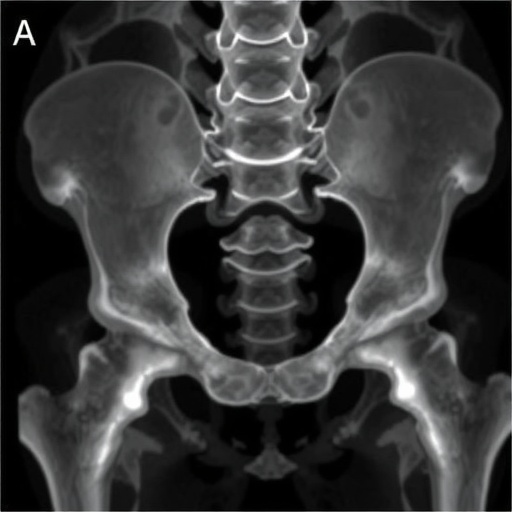
In a groundbreaking exploration that challenges long-standing assumptions in forensic anthropology, new research has brought attention to the phenomenon of directional asymmetry within the human acetabulum—a critical anatomical feature central to hip joint function and forensic age estimation. The acetabulum, a cup-shaped cavity on each side of the pelvis, facilitates hip articulation by accommodating the femoral head, yet its inherent structural asymmetries have often been overlooked in age estimation protocols that rely on skeletal morphology.
Directed by Warrier, San-Millán, and Kanchan, this pioneering study dives deeply into the prevalence and implications of subtle, yet significant, asymmetries between the right and left acetabula. Utilized extensively in legal medicine and forensic investigations, the acetabulum’s morphology serves as an indicator of biological aging; however, the revelation that these structures can exhibit consistent directional variance raises critical questions about the accuracy and reliability of conventional age estimation techniques.
The researchers embarked on a systematic examination of a large osteological sample, employing advanced morphometric analyses to quantify asymmetries present in the acetabular regions. Morphometric assessments, which involve precise measurements of size and shape, have revolutionized anatomical studies by providing quantitative frameworks beyond subjective visual assessments. Through statistical rigor, the team discerned patterns that defy the notion of perfect bilateral symmetry, highlighting a directional tendency—meaning the asymmetry shows a predictable side preference rather than occurring randomly.
This directional asymmetry introduces an additional layer of complexity in forensic assessments, where symmetrical assumptions underpin many methodological approaches. Forensic experts have traditionally relied on symmetrical landmarks to estimate age, assuming that deviations are either negligible or randomly distributed. The study’s findings suggest that these assumptions may systematically skew results, leading to under- or overestimations that could impact criminal investigations or identification processes.
Importantly, this research underscores the dynamic and adaptive nature of the skeletal system, shaped not only by genetic determinants but also influenced by biomechanical forces during an individual’s lifetime. The acetabulum endures significant load-bearing stresses and minute variations in gait, posture, and physical activity can direct asymmetric remodeling processes. These biomechanical nuances manifest in measurable anatomical disparities—an insight that links anthropology, anatomy, and biomechanics in a novel forensic context.
Moreover, the implications of acetabular directional asymmetry extend beyond age estimation alone. For instance, orthopedic surgery and rehabilitation strategies could benefit from recognizing inherent asymmetries, improving personalized treatment plans for hip disorders. More intriguingly, understanding these asymmetries may also enrich evolutionary and developmental biology research by elucidating how human skeletal asymmetry evolves in response to functional demands.
The authors caution forensic practitioners to integrate considerations of acetabular asymmetry into their analytical frameworks to refine age estimation accuracy. Incorporating directional asymmetry data could lead to the development of corrected morphometric models, enhancing the precision of biological profiling in forensic casework. These enhanced models would represent a leap forward, minimizing errors that potentially have grave legal and ethical ramifications.
Technologically, this study harnesses cutting-edge imaging modalities like 3D computed tomography scans and digital segmentation tools, which allow for unprecedented visualizations and measurements of complex pelvic anatomy. The digital morphometric approach surpasses traditional manual measurements by reducing observer bias and improving reproducibility—essential qualities in forensic science where standardization is paramount.
The research represents a fusion of classical anatomical expertise with modern computational techniques, symbolizing the trajectory of forensic science toward greater accuracy and scientific integration. Such innovation not only raises the bar for method validation but also opens new avenues for multidisciplinary collaboration, bridging forensic medicine, bioengineering, and evolutionary anthropology.
Critically, the prevalence data presented by the team offer a robust statistical foundation that future research can expand upon. By cataloging directional asymmetry across diverse populations, ages, and sexes, forensic anthropologists can develop population-specific norms, tailoring age estimation to reflect demographic variability. This customization is paramount in addressing the global and multicultural context of forensic investigations today.
The study also implicitly challenges the forensic community to reconsider the concept of skeletal symmetry as an idealized norm. Rather, it advocates for embracing biological variability as a fundamental principle, wherein asymmetry is not merely noise but a meaningful anatomical characteristic informing both individual identity and biological history.
From a practical standpoint, the implementation of findings like these into forensic laboratories could catalyze the revision of training programs and standardized protocols—ensuring that forensic scientists are equipped with the knowledge to recognize and adjust for acetabular asymmetry. This adaptation will drive forward the professionalism and forensic validity essential for judicial processes relying on skeletal evidence.
Furthermore, the findings stimulate discourse about the broader implications of skeletal asymmetry in forensic contexts, such as its potential impact on sex estimation, stature reconstruction, and trauma analysis. Since asymmetry is a multifactorial phenomenon influenced by genetics, environment, and lifestyle, a comprehensive approach could enhance all facets of skeletal analysis.
In summation, Warrier and colleagues deliver a compelling and innovative perspective on acetabular asymmetry, revealing how overlooked anatomical nuances can reshape age estimation methodologies. Their work prompts a paradigm shift in forensic anthropology, encouraging scientific communities to recalibrate assumptions and embrace complexity in the quest for ever more accurate human identification techniques.
As forensic science continues to refine its tools and integrate new knowledge systems, the investigation of directional asymmetry exemplifies the profound gains achieved when traditional models are scrutinized through the lens of emerging evidence and technology. It is a watershed moment that promises to enhance justice through improved scientific rigor and nuanced understanding of human anatomy.
With forensic cases increasingly relying on skeletal remains, particularly in disaster victim identification and historical investigations, the significance of such anatomical subtleties cannot be overstated. The ability to detect and account for directional asymmetry within the acetabulum may become a cornerstone in the future of forensic age estimation and biological profiling worldwide.
This research, now published in the International Journal of Legal Medicine, thus marks an essential advancement in forensic medicine, reinforcing the critical role of multidisciplinary research in refining the science underpinning legal investigations. It sets a precedent for ongoing inquiry into skeletal asymmetries and their forensic consequences, heralding a new era of precision and detail in age estimation.
Subject of Research: Prevalence of directional asymmetry within the acetabulum and its implications for forensic age estimation.
Article Title: Prevalence of directional asymmetry within the acetabulum and its implications for age estimation.
Article References:
Warrier, V., San-Millán, M. & Kanchan, T. Prevalence of directional asymmetry within the acetabulum and its implications for age estimation. Int J Legal Med (2025). https://doi.org/10.1007/s00414-025-03657-1
Image Credits: AI Generated


