

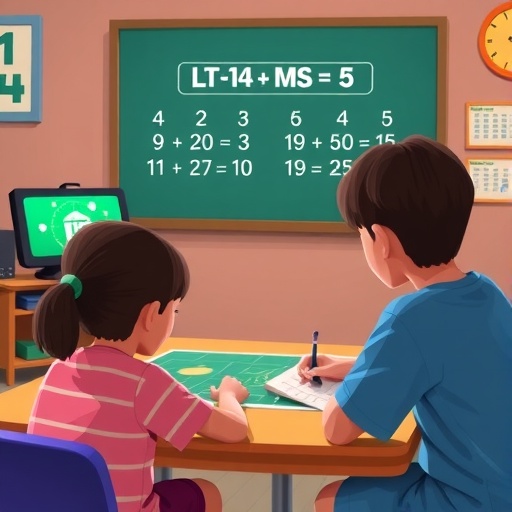
In a groundbreaking development in the field of educational neuroscience, researchers from the University of Barcelona and the University of Vic – Central University of Catalonia (UVic-UCC) have unveiled a pioneering digital intervention designed to support children grappling with developmental dyscalculia. This serious game, named NeurekaNUM, represents a significant stride toward addressing the multifaceted challenges posed by dyscalculia—a neurodevelopmental disorder marked by impaired numerical understanding and calculation skills that affect approximately 5 to 7 percent of the population worldwide.
Developmental dyscalculia is notoriously complex, implicating a constellation of cognitive deficits beyond mere mathematical difficulties. These include impairments in attention, spatial working memory, and processing speed, factors that collectively hamper a child’s ability to engage successfully with numerical tasks. Recognizing this, the research team embarked on creating a nuanced tool capable of simultaneously assessing, identifying, and remediating these deficits through gameplay — all tailored to the linguistic contexts of Spanish and Catalan speakers, filling a critical gap in available resources.
NeurekaNUM is rooted in cognitive neuroscience theories related to numerical processing, and it is strategically implemented to target three core objectives. First, it automates numerical representations to enable faster and more accurate recognition of numbers. Second, it enhances access to the mental number line, a spatial representation thought to be essential for quantity comprehension and arithmetic reasoning. Third, the game focuses on training arithmetic operations and fostering higher-order numerical reasoning, effectively bridging concrete numerical understanding with abstract problem-solving skills.
This comprehensive approach integrates tasks that engage symbolic, non-symbolic, and combined stimuli to cultivate proficiency across verbal, visuospatial, executive, and magnitude processing domains. Importantly, the game incorporates an adaptive progression mechanism: levels of difficulty heighten in response to the player’s ongoing performance metrics, harnessing machine learning algorithms to personalize intervention paths in real time. Initially, researchers manually adjusted difficulty based on accuracy and speed; however, current iterations autonomously refine challenge levels to optimize learning outcomes dynamically.
The research team conducted a rigorous experimental study involving 19 children diagnosed with developmental dyscalculia, spanning first to third grade. Over a concentrated four-month intervention period, each child participated in approximately five sessions per week, with session durations kept to between 15 and 20 minutes to maintain engagement without inducing fatigue. This intensive yet manageable regimen yielded statistically significant improvements across multiple dimensions of mathematical performance, except for a specific task involving digit transcription under dictation.
In striking contrast, a control group of typically developing peers, who received no special intervention, did not demonstrate any measurable progress in their mathematical abilities over the same timeframe. This disparity underscores the effectiveness of the NeurekaNUM program and discount the possibility that observed gains could be attributed merely to maturation or incidental learning. The findings offer robust scientific evidence supporting early, targeted intervention through serious games as a viable means to remediate basic numerical deficits in children.
The implications of these results extend beyond immediate educational contexts. Serious games like NeurekaNUM incorporate motivational design features—interactivity, adaptive feedback, and contextualized learning scenarios—that are essential in capturing and maintaining the engagement of children facing cognitive and behavioral challenges. This intersection of gaming technology and cognitive rehabilitation opens new trajectories for personalized learning solutions that can be scaled and tailored across diverse educational settings.
Recognizing the broader applicability of their work, the developers structured NeurekaNUM to be accessible via multiple digital platforms commonly found in classrooms, including laptops, tablets, and desktop computers. This flexibility allows educational institutions to integrate the tool seamlessly into existing curricula without disrupting pedagogical methodologies. Rather than supplanting traditional math instruction, NeurekaNUM serves as a complementary screening and intervention resource that can help educators tailor support to individual student needs.
Beyond schools, versions of the game have been developed for home use by families as well as a professional variant designed to aid clinical diagnosis. This holistic approach acknowledges that developmental dyscalculia can often be obscured by overlapping conditions such as ADHD or dyslexia, complicating identification and treatment. By equipping parents, teachers, and clinicians with validated digital tools, the program aims to foster earlier detection and more effective remediation strategies, ultimately preventing long-term academic failure and associated psychosocial difficulties.
Moreover, the research group is concurrently advancing complementary tools targeting other cognitive domains and learning challenges, including reading difficulties and attention disorders. Integrated within the broader framework of Neurekalab, the spin-off enterprise that commercializes these innovations, this suite of digital cognitive assessments offers comprehensive coverage for the varied neurodevelopmental profiles encountered in primary education. This multifaceted ecosystem stands poised to revolutionize how learning disorders are screened, monitored, and addressed in real-world educational and clinical environments.
The publication of these findings in the peer-reviewed journal Applied Neuropsychology: Child marks a milestone in evidence-based intervention for dyscalculia. It highlights the potential of digital serious games not only as engaging educational experiences but as scientifically validated therapeutic tools that can substantially enhance the cognitive trajectories of children profoundly affected by specific learning disorders.
As educational technology continues to evolve, the fusion of neuroscience, machine learning, and game design embodied by NeurekaNUM heralds a promising future for personalized learning interventions. By capitalizing on motivational engagement strategies and adaptive feedback loops, such tools can address unmet needs in neurodiverse populations, providing timely and tailored support precisely when and where it is needed most.
In conclusion, the University of Barcelona and UVic-UCC’s collaborative project underscores the transformative potential of technology-driven remediation to empower children with developmental dyscalculia. Their work exemplifies how interdisciplinary research can translate into pragmatic solutions that improve quality of life and academic outcomes, paving the way for similar innovations across various learning disabilities worldwide.
Subject of Research: People
Article Title: Design and evaluation of a serious game for developmental dyscalculia remediation
News Publication Date: 15-Nov-2025
Web References:
https://doi.org/10.1080/21622965.2025.2587271
https://neurekalab.es/lang/es/
References:
Serra-Grabulosa, J. M., Grau, S., et al. (2025). Design and evaluation of a serious game for developmental dyscalculia remediation. Applied Neuropsychology: Child. DOI: 10.1080/21622965.2025.2587271
Image Credits: University of Barcelona (UB) and the University of Vic – Central University of Catalonia (UVic-UCC)
Keywords: Diseases and disorders, Developmental dyscalculia, Neurodevelopmental disorders, Educational technology, Serious games, Cognitive remediation, Learning disabilities


