

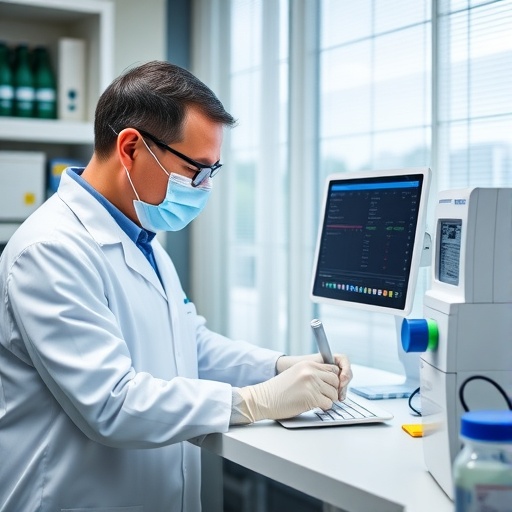
In a groundbreaking advancement poised to revolutionize pharmaceutical development, a team of interdisciplinary scientists has introduced a novel platform that dramatically accelerates drug formulation and manufacturing. Detailed in a recent publication in Nature Communications, the research led by Abbas, Salehian, Hou, and colleagues unveils a seamless integration of a digital formulator with a self-driving tableting data factory. This innovative convergence exploits artificial intelligence, automation, and physics-based simulations to drastically shorten the timeline from molecular discovery to final tablet production, addressing a long-standing bottleneck in drug development pipelines.
Traditional drug development has historically been hindered by laborious formulation cycles, extensive trial-and-error experimentation, and the inherent complexities of translating chemical compounds into stable, efficacious, and manufacturable solid dosage forms. The introduction of a digital formulator—a computational tool that models and predicts multiple formulation parameters such as excipient compatibility, powder flow, compressibility, and dissolution kinetics—marks a pivotal shift towards mechanistic drug design. By simulating these critical formulation attributes in silico, researchers are empowered to screen and optimize pharmaceutical blends before physical production, cutting costs and reducing material waste.
However, the real innovation emerges when the digital formulator is paired with an autonomous manufacturing environment dubbed the “self-driving tableting data factory.” This setup employs robotic operators, real-time analytics, and closed-loop feedback systems to produce and test tablet batches iteratively. The outcome is an intelligent platform that not only synthesizes data from formulations but actively uses it to inform and refine subsequent manufacturing conditions autonomously. Such a system can adapt process parameters like compression force, speed, and granulation moisture in real time to meet predefined quality attributes robustly, representing a significant leap toward Industry 4.0 in pharmaceutical production.
This convergence of digital design and automated manufacturing is underpinned by advanced machine learning models trained on extensive datasets encompassing powder characteristics, process variables, and final product quality metrics. These models enable predictive capabilities that transcend traditional empirical approaches, facilitating a rational design of experiments with accelerated iteration cycles. By harnessing such data-driven frameworks, the platform can identify subtle correlations and nonlinear effects between formulation components and manufacturing conditions that would be challenging or impossible to elucidate manually.
Furthermore, the closed-loop nature of the platform ensures continuous improvement and adaptation. Data collected from each manufacturing run are fed back into the digital formulator, refining model accuracy and expanding its predictive power over time. This symbiotic relationship between computational simulation and experimental execution greatly enhances process understanding and reliability, ultimately ensuring that final tablets exhibit optimal therapeutic performance and manufacturability.
The implications of this research reach far beyond accelerating individual drug programs. The platform’s modular and scalable architecture caters to rapid pivoting between different drug molecules and dosage forms, thus enabling pharmaceutical companies to respond swiftly to emergent health crises or shifting market demands. For instance, in pandemic scenarios where vaccine and antiviral supplies must be scaled up urgently, such adaptive and fully integrated manufacturing ecosystems could be game-changing.
Importantly, this approach also aligns with regulatory trends emphasizing quality by design (QbD) and continuous manufacturing. By systematically incorporating mechanistic insights, robust data analytics, and automated control, the digital formulator coupled with the self-driving factory offers an unprecedented level of transparency and control over production processes. Regulatory submissions informed by comprehensive real-time datasets and predictive models are expected to streamline approval pathways and facilitate post-market quality monitoring.
On the technical front, the digital formulator employs a multiscale modeling strategy integrating molecular-level interactions, particle mechanics, and macroscopic flow properties to simulate the behavior of complex powder mixtures. This holistic framework captures the interplay between excipient properties, active pharmaceutical ingredient characteristics, and environmental factors such as humidity. Complementing this, advanced imaging techniques like X-ray computed tomography and near-infrared spectroscopy are utilized to characterize powder morphology and tablet microstructure, feeding back into the model for enhanced fidelity.
In terms of the self-driving tableting data factory, the manufacturing line consists of robotic powder handling systems, high-precision tablet presses equipped with sensor arrays, and inline process analytical technologies that monitor parameters such as tablet hardness, weight uniformity, and dissolution profiles in real time. An overarching AI controller orchestrates this ecosystem, dynamically modifying process conditions based on predictive outputs, ensuring consistent production quality and minimizing human intervention.
The research team also highlights the sustainability benefits of this integrated platform. By reducing experimental material consumption, energy use, and waste generation, the technology supports greener pharmaceutical manufacturing practices. This is particularly relevant in an era demanding increased environmental responsibility within industrial sectors.
Despite its transformative potential, the development and deployment of such automated, AI-driven drug manufacturing frameworks must navigate challenges related to data security, intellectual property, and workforce training. The authors acknowledge that close collaboration between technology developers, pharmaceutical scientists, regulatory agencies, and policymakers will be critical to address these issues and foster widespread adoption.
Looking ahead, this pioneering digitalization and automation approach could catalyze a paradigm shift from linear, batch-oriented drug production to agile, continuous, and personalized pharmaceutical manufacturing. The ability to rapidly tailor formulations and adjust manufacturing parameters on demand opens the door to customized medicines optimized for individual patient needs, heralding a new era in precision healthcare.
In conclusion, the integration of a digital formulator with a self-driving tableting data factory represents an unprecedented leap forward in pharmaceutical science and engineering. By marrying computational prowess with autonomous manufacturing, Abbas, Salehian, Hou, and their team have laid the groundwork for accelerated, efficient, and smarter drug development. This breakthrough not only promises to reduce the time and cost barriers traditionally plaguing drug production but also sets a robust foundation for the future of medicine manufacturing in the digital age.
As pharmaceutical organizations worldwide strive to meet escalating demands for innovative therapies delivered at speed and scale, this research offers a compelling vision of a future where AI-powered, self-regulated factories drive the creation of safer, more effective medicines in record time. The publication in Nature Communications marks a seminal milestone in the ongoing digital transformation of healthcare industries, poised to influence scientific, industrial, and regulatory landscapes globally.
Subject of Research:
Accelerated drug formulation and manufacturing through digital simulation and autonomous production systems
Article Title:
Accelerated drug development using a digital formulator and a self-driving tableting data factory
Article References:
Abbas, F., Salehian, M., Hou, P. et al. Accelerated drug development using a digital formulator and a self-driving tableting data factory. Nat Commun (2026). https://doi.org/10.1038/s41467-026-71204-6
Image Credits: AI Generated


