


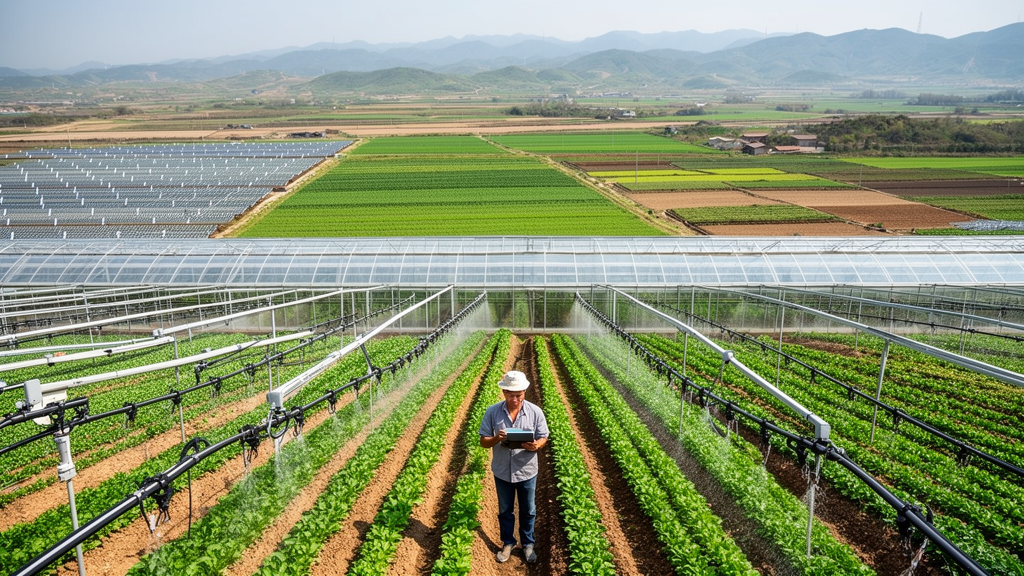
China’s integration of the digital economy with agriculture increased from an index value of 0.166 in 2013 to 0.342 in 2022, according to a province-level study that combined an evaluation index, dynamic panel analysis, inequality measures, and geographically and temporally weighted regression. The finding indicates that digital technologies and services are becoming more deeply connected with agricultural production, distribution, and sales, but the national level remained relatively low and substantial geographic differences persisted. The eastern region continued to lead, while central and western provinces recorded improvements that narrowed the gap between regions without eliminating it.
The study defines the integration of the digital economy and agricultural industry through two linked processes. Agricultural digital industrialization, or ADI, covers the commercialization of digital infrastructure, technologies, products, and services for agriculture, including infrastructure construction and the large-scale application of digital solutions. Agricultural industrial digitalization, or AID, describes the use of modern information technologies by farmers, enterprises, and other operators to transform the agricultural value chain, encompassing production, circulation, and sales. Data are central to both processes: digital enterprises supply infrastructure and technical services, while agricultural operators generate practical demand and application scenarios for those services. The authors argue that this arrangement creates a feedback loop in which digital-economic development enables agricultural transformation and agricultural transformation stimulates the commercialization of digital products.
To quantify this integration, the researchers constructed an indicator system from data for all 31 provincial-level administrative regions in China. The indicators covered rural communications, broadband and mobile-phone access, fiber-optic networks, telecommunications services, electronic-information manufacturing, information-sector employment and income, rural e-commerce participation, agricultural machinery power, facility agriculture, postal services, and online purchasing and sales. They weighted the indicators with the CRITIC objective weighting method, which accounts for the variation, contrast, and correlations among measures, and calculated weights from the aggregated sample so scores remained comparable across years. Missing observations were filled through linear interpolation. This composite approach is important because digitalization is not represented by a single technology: it includes physical infrastructure, commercial digital services, the capabilities of agricultural actors, and changes across the wider industry chain.
The temporal results showed a fluctuating but sustained increase in the national integration index. ADI rose from 0.073 in 2013 to 0.192 in 2022, while AID increased from 0.093 to 0.150. Across the four major economic regions, eastern China advanced from 0.224 to 0.399, the central region from 0.141 to 0.324, the western region from 0.141 to 0.320, and the northeastern region from 0.122 to 0.275. The study also divided the country into three functional grain zones. The main grain-consumption area increased from 0.239 to 0.416, the main grain-production area from 0.150 to 0.331, and the balanced production-consumption area from 0.139 to 0.309. These scores describe the study’s constructed index rather than an official measure of agricultural digitalization, and their absolute level was characterized as relatively low even after the decade-long increase.
Spatial analysis found persistent clustering but evidence of gradual convergence. Guangdong, Zhejiang, Jiangsu, Beijing, and Shanghai were identified as relatively high-integration provinces, while the northeast, parts of central China, and the mountainous southwest generally lagged. The authors linked the eastern advantage to stronger digital-technology capacity and more favorable economic conditions, whereas weaker infrastructure and high-tech industries constrained some western and southwestern areas. Tibet and Qinghai improved substantially, which the study partly attributes to relatively abundant per-capita public facilities and services, lower population pressure, and participation in China’s “East Data, West Computing” initiative. The spatial autocorrelation of the index declined: Moran’s I fell from 0.436 in 2013 to 0.296 in 2022, indicating that clustering remained significant but weakened. The calculated center of gravity moved 45.7 kilometers northwest, consistent with faster relative growth in central and western provinces.
Regional inequality declined overall, with the national Gini coefficient for the integration index falling from 0.152 to 0.098. The decomposition identified differences between regions, rather than differences within them, as the principal source of overall disparity. For the four economic regions, the mean intergroup contribution was 70.78%; for the three grain zones, it was 65.57%. Within the eastern region, the Gini coefficient averaged 0.108 and showed a fluctuating decline, while the central, western, and northeastern averages were 0.045, 0.053, and 0.041, respectively. Among grain functional areas, the main consumption area had the highest average coefficient, 0.095, the main production area averaged 0.072, and the balanced area averaged 0.058. The pattern therefore combines a narrowing national gap with continuing internal variation in some economically advanced or production-oriented regions.
A dynamic panel model indicated that ADI and AID reinforce each other, but not at the same speed. ADI lagged by two periods had a significant positive association with AID, with a coefficient of 0.735, suggesting that the enabling effect of digital industrialization on agricultural digital transformation may emerge with a delay. The authors relate this lag to technical barriers, investment costs, and infrastructure constraints. AID, in turn, had an immediate positive association with ADI, with a coefficient of 0.164, consistent with agricultural digitalization creating demand and application opportunities for digital products and services. In the one-period lag terms, the coefficient for ADI was 0.746 in the AID equation, while the coefficient for AID was 1.067 in the ADI equation, emphasizing that improvements accumulate over time. Diagnostic tests supported the model specification: first-order autocorrelation was present, while second-order autocorrelation and the Hansen test indicated no evidence of the respective problems.
For the analysis of factors associated with integration, the researchers used geographically and temporally weighted regression, a method designed to allow relationships to vary across location and time. Five influences were examined: technological innovation, represented by high-tech research-and-development expenditure; market demand, represented by rural online retail sales of physical goods; government guidance, represented by fixed-asset investment in agriculture; financial services, represented by the Digital Inclusive Finance Index; and scale operation, represented by the number of agricultural cooperatives per 10,000 rural residents. The model’s adjusted R-squared was 0.930, compared with 0.823 for ordinary least squares, and its corrected Akaike information criterion was −156.690, compared with −4.550. These results favor the geographically and temporally weighted specification within this dataset, although they do not establish that the measured factors cause the observed changes.
The strongest and most consistent positive association involved technological innovation. In the 2022 example, its mean regression coefficient was 0.439, and high-value clusters shifted from southeastern toward southwestern areas over the study period. Market demand was also positively associated with integration, with its mean coefficient rising from 0.095 to 0.115 and strong clusters expanding from the southeast toward central and northeastern China. Government guidance showed a positive relationship, with its coefficient increasing from 0.022 to 0.175; stronger clusters were concentrated in the northwest and northeast, regions that have received attention through national development strategies. Financial services initially reinforced integration but weakened after 2018 and became nearly neutral in the 2022 mean estimate, falling from 0.089 to −0.001. The authors suggest that regulation, risk aversion, reduced effective financing demand, and pandemic-related balance-sheet pressures may have contributed, but the observational design cannot isolate these explanations.
Scale operation was negatively associated with integration in the baseline model, with its mean coefficient moving from −0.020 to −0.094. The authors caution that this relationship may be nonlinear and do not interpret the result as evidence that larger farms or agricultural organizations generally reduce digitalization. Instead, they note that China remains dominated by small-scale farming, while digital transformation involves high fixed costs, technical barriers, long return periods, and limited profitability. The study also identifies important limitations: it focuses on the development path of the integrated system rather than fully analyzing the separate trends and coupling of ADI and AID; it treats IDEAI mainly from an industrial perspective, leaving macroeconomic and enterprise-level influences less developed; and its proxy indicators, constrained by available data, may introduce measurement error. The results suggest that closing the geographic divide will require more than infrastructure alone, with technological capability, market demand, public guidance, cross-regional cooperation, and effective financing all showing geographically and temporally varying associations with digital agricultural integration.
Subject of Research: Digital economy and agricultural industry integration across Chinese provinces
Article Title: Spatiotemporal patterns, regional differences, and influencing factors of the integration of digital economy and agricultural industry in China
Article References: Wu, D., & Ai, W. (2026). Spatiotemporal patterns, regional differences, and influencing factors of the integration of digital economy and agricultural industry in China. Frontiers in Sustainable Food Systems, 10, Article 1985406. https://doi.org/10.3389/fsufs.2026.1985406
Image Credits: AI Generated
DOI: 10.3389/fsufs.2026.1985406
Keywords: digital agriculture, digital economy, China, regional disparities, agricultural industrialization, geographically weighted regression, rural infrastructure, technological innovation, rural e-commerce, agricultural policy, Spatiotemporal, patterns
Cite Scienmag News
Alan Morgan. (October 21, 2026). Digital Agriculture Integration Rises but Regional Gaps Persist in China. Scienmag. https://scienmag.com/digital-agriculture-integration-rises-but-regional-gaps-persist-in-china/
Alan Morgan. "Digital Agriculture Integration Rises but Regional Gaps Persist in China." Scienmag, 21 October 2026, https://scienmag.com/digital-agriculture-integration-rises-but-regional-gaps-persist-in-china/. Accessed 21 October 2026.
Alan Morgan. "Digital Agriculture Integration Rises but Regional Gaps Persist in China." Scienmag. October 21, 2026. https://scienmag.com/digital-agriculture-integration-rises-but-regional-gaps-persist-in-china/


