


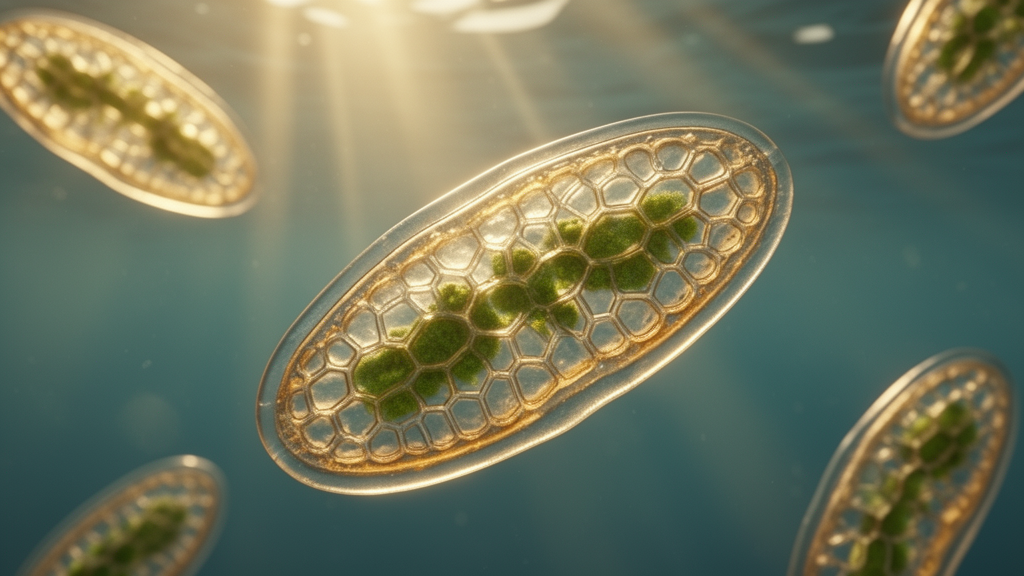
Marine diatoms are among the most successful phytoplankton groups in the ocean, and a new study suggests their glass-like cell walls do far more than provide armour. Researchers at the University of Technology Sydney have found that the centric diatom Thalassiosira oceanica thickens its silica frustule when grown under high irradiance, a morphological adjustment that appears to work in concert with the cell’s physiology to modulate the amount of light reaching its photosynthetic machinery. The findings, published in Frontiers in Photobiology, reveal that these microscopic algae may actively sculpt their own internal light environment to optimise growth.
The research team, led by Katherina Petrou, cultivated T. oceanica across a gradient of six light levels ranging from 25 to more than 700 µmol photons per square metre per second. The strain was isolated from surface seawater collected at the Port Hacking oceanographic time series station off the coast of New South Wales, Australia. After allowing the cultures to acclimate for three to four weeks, the scientists measured growth rates, cell stoichiometry, chlorophyll pigment concentrations, photosynthetic performance and cell-specific silica incorporation rates using the fluorescent dye PDMPO, which binds to newly formed silica in the frustule.
The results showed that T. oceanica grew fastest at irradiances of 250 µmol photons per square metre per second and above, reaching specific growth rates of approximately 1.7 days⁻¹ in the three highest light treatments. Growth was significantly slower at the lowest irradiances, where cells exhibited extremely low total yields indicative of severe light limitation. Cell volume showed no directional change across the light gradient, but chlorophyll a content declined significantly with increasing irradiance, a classic photo-acclimation response that reduces the risk of self-shading among densely packed pigments.
Photophysiological measurements using pulse amplitude modulated fluorometry revealed striking differences in how cells acclimated to different light levels managed excess energy. Low-light acclimated cultures showed high non-photochemical quenching (NPQ), the rapid dissipation of excess absorbed energy as heat, which activated immediately upon illumination. In contrast, high-light acclimated cultures displayed delayed and diminished NPQ responses, with maximum NPQ values falling below 0.10 compared with 0.25 to 0.31 in low-light cells. The maximum quantum yield of photosystem II declined from above 0.70 in the lowest light treatments to below 0.55 in the highest, suggesting a shift in how the cell handles excitation pressure.
The most compelling finding emerged when the researchers examined silica incorporation. Cell-specific silicification, measured as area-adjusted PDMPO fluorescence per cell, remained stable between 60 and 250 µmol photons per square metre per second before increasing by 15 to 23 percent at irradiances above 250 µmol photons per square metre per second. This step-wise jump suggests that frustule thickening is not a passive consequence of faster growth but rather a regulated response to a specific light threshold.
Crucially, the heavier silicified cells showed reduced excitation pressure and a higher proportion of excitation energy directed toward photochemistry rather than photoprotection when exposed to high light. The regression models linking silicification with excitation pressure and the photochemistry-to-photoprotection ratio were statistically significant, explaining approximately 20 percent of the variation. This co-adjustment of frustule thickness and photophysiological state implies that the silica shell functions as an optical filter, restricting incoming irradiance while the reduced chlorophyll content enables the cell to propagate and homogenise light across its pigment molecules more efficiently.
The researchers propose that by increasing frustule thickness, high-light acclimated cells restrict the incoming irradiance, while their reduced chlorophyll content minimises the risk of overexcitation. This coordination allows the cell to maximise photochemistry through the propagation and homogenisation of the internal light field across available pigment molecules. The cells grown at 250 µmol photons per square metre per second presented a particularly nuanced profile, sharing high growth rates and low chlorophyll c content with the highest light treatments while maintaining chlorophyll a levels and silica production consistent with lower-light acclimated cells, suggesting a light optimum where incoming irradiance is neither heavily filtered nor excessively concentrated.
The authors acknowledge that alternative mechanisms could explain the increased frustule synthesis under high light. One possibility is that silicification acts as an alternative structural sink for energy dissipation, where the cell channels excess reduced energy into frustule biosynthesis to avoid metabolic damage, akin to the theory of carbon overflow during nutrient limitation. Another consideration is that increased silica deposition would increase cell ballast, promoting sinking below the mixed layer and escape from high surface irradiance. These mechanisms are not necessarily mutually exclusive with the optical shield hypothesis.
The ecological implications of these findings are significant for natural diatom assemblages in shallow mixed coastal environments where light exposure is highly dynamic. The ability to adjust frustule architecture in response to growth irradiance could represent an effective strategy to avoid photoinhibition or minimise damage from ultraviolet radiation. As diatoms are responsible for a large proportion of global marine primary production and carbon export, understanding how they coordinate cellular and morphological changes to optimise photosynthesis under varying light conditions advances our knowledge of the mechanisms underpinning their ecological dominance in the contemporary ocean.
Subject of Research: Diatom cell-specific silica production as a morphological adjustment to high growth irradiance
Article Title: Diatom cell-specific silica production as a morphological adjustment to high growth irradiance
Article References: Petrou, K., Ceapa, H., Cakmakci, L. M., Lim, N., Leach, M., Pickworth, A. P., & Nielsen, D. A. (2026). Diatom cell-specific silica production as a morphological adjustment to high growth irradiance. Frontiers in Photobiology, 4, Article 1912296. https://doi.org/10.3389/fphbi.2026.1912296
Image Credits: AI Generated
DOI: 10.3389/fphbi.2026.1912296
Keywords: Diatom, cell-specific, silica, production, morphological, adjustment, high, growth, irradiance, scientific research
Cite Scienmag News
Drew Townsend. (October 16, 2026). Diatoms thicken their silica shells to shield themselves from too much light. Scienmag. https://scienmag.com/diatoms-thicken-their-silica-shells-to-shield-themselves-from-too-much-light/
Drew Townsend. "Diatoms thicken their silica shells to shield themselves from too much light." Scienmag, 16 October 2026, https://scienmag.com/diatoms-thicken-their-silica-shells-to-shield-themselves-from-too-much-light/. Accessed 16 October 2026.
Drew Townsend. "Diatoms thicken their silica shells to shield themselves from too much light." Scienmag. October 16, 2026. https://scienmag.com/diatoms-thicken-their-silica-shells-to-shield-themselves-from-too-much-light/


