
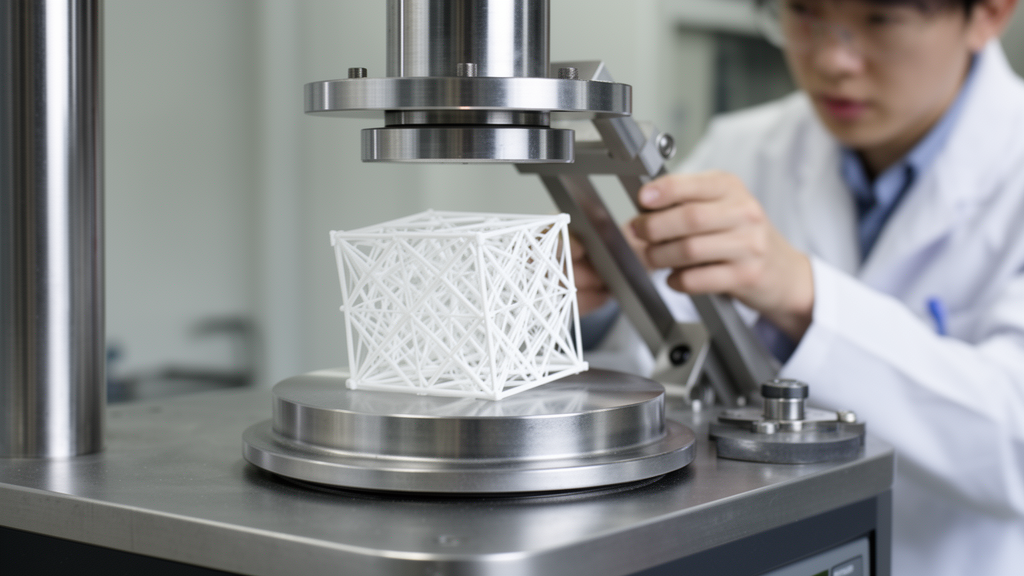
Engineers searching for lightweight materials that can soak up impact energy have turned increasingly to triply periodic minimal surfaces, mathematical geometries that repeat through space and include the well-known Diamond lattice. A new research article in Frontiers in Bioengineering and Biotechnology examines how these Diamond structures behave when the direction of the load applied to them changes, and how deliberately varying their internal porosity alters that response.
The study, authored by a team from Dalian University of Technology and its affiliated hospitals, generated two families of Diamond structures: uniform versions with a consistent porosity throughout, and gradient versions in which porosity changes either along the loading axis or across it, described as axial and transverse porosity distributions. The researchers then subjected these configurations to quasi-static compression tests and finite element simulations to track how energy absorption characteristics and deformation and damage modes evolve during compression.
The central finding is that both the loading orientation and the direction of the porosity gradient strongly influence how much energy these structures can absorb. For the uniform Diamond structure, the specific energy absorption rose to approximately 8 kJ/kg when the load was applied at a 30-degree angle, an increase of about 33 percent compared with the 0-degree and 15-degree configurations. At that same 30-degree angle, the plateau stress reached approximately 105 MPa.
That advantage did not persist at steeper angles. When the loading angle increased to 45 degrees, the specific energy absorption fell to approximately 4 kJ/kg, which the authors attribute to earlier densification of the structure.
The gradient designs told a more nuanced story. Axially graded structures, in which porosity varies along the loading direction, showed increased plateau stress and slightly enhanced specific energy absorption relative to comparable uniform designs. However, their maximum energy-absorption efficiency remained below approximately 35 percent, compared with roughly 40 percent for the uniform structures, indicating that the efficiency metric did not follow the plateau stress upward.
Transverse-gradient structures, with porosity varying across the loading direction, behaved differently again. Their plateau stresses were comparable to those of the uniform structure built with the corresponding average porosity, but they tended to densify earlier in the compression process, and that earlier densification resulted in reduced specific energy absorption. Taken together, these results suggest that the benefit of a porosity gradient depends heavily on which direction that gradient runs relative to the applied load.
The methods combined physical testing with numerical modeling. Quasi-static compression experiments were performed on the uniform structures, while finite element simulations were used to investigate the mechanical and energy-absorption responses of both the uniform and the gradient configurations. This pairing allowed the team to analyze changes in energy absorption characteristics and in deformation and damage modes throughout the compression process.
The work sits within a broader engineering context. The authors note growing demand for high energy absorption in biomedical, aerospace, automotive and marine engineering, and they position TPMS structures such as Diamond lattices as promising candidates because of their light weight and strong energy absorption performance. The article was received on 24 July 2026 and accepted on 12 October 2026, and it appears in the journal’s Biomaterials section.
The authors frame their conclusions as design guidance: understanding how loading orientation and gradient direction interact can inform the optimization of Diamond structures for energy absorption under varied loading conditions, and the mechanical design principles may be relevant to future development of TPMS structures for biomedical applications.
For researchers and engineers working on mechanical metamaterials, the practical takeaway is that porosity grading is not automatically beneficial. An axial gradient raised plateau stress and modestly improved energy absorption in this study, but at the cost of peak energy-absorption efficiency, while a transverse gradient preserved plateau stress yet shortened the useful deformation range. Matching the gradient direction to the expected loading angle therefore emerges as a key design variable for Diamond lattice energy absorbers.
Subject of Research: Energy absorption performance of Diamond TPMS lattice structures with axial and transverse porosity gradients under different loading angles
Article Title: Research on the energy absorption performance of diamond structures with axial and transverse porosity gradients under different load-bearing angles
Article References: Wang, Z., Hassan, A., Qiu, X., Lan, Y., Lyu, Y., & Liu, Y. (2026). Research on the energy absorption performance of diamond structures with axial and transverse porosity gradients under different load-bearing angles. Frontiers in Bioengineering and Biotechnology, 14, Article 1947630. https://doi.org/10.3389/fbioe.2026.1947630
Image Credits: AI Generated
DOI: 10.3389/fbioe.2026.1947630
Keywords: Diamond lattice, TPMS structures, energy absorption, porosity gradient, quasi-static compression, finite element simulation, plateau stress, mechanical metamaterials, additive manufacturing, specific energy absorption, Research, energy
Cite Scienmag News
Gregory Coleman. (October 29, 2026). Diamond Lattice Structures Show Angle-Dependent Energy Absorption in Compression Tests. Scienmag. https://scienmag.com/diamond-lattice-structures-show-angle-dependent-energy-absorption-in-compression-tests/
Gregory Coleman. "Diamond Lattice Structures Show Angle-Dependent Energy Absorption in Compression Tests." Scienmag, 29 October 2026, https://scienmag.com/diamond-lattice-structures-show-angle-dependent-energy-absorption-in-compression-tests/. Accessed 1 November 2026.
Gregory Coleman. "Diamond Lattice Structures Show Angle-Dependent Energy Absorption in Compression Tests." Scienmag. October 29, 2026. https://scienmag.com/diamond-lattice-structures-show-angle-dependent-energy-absorption-in-compression-tests/