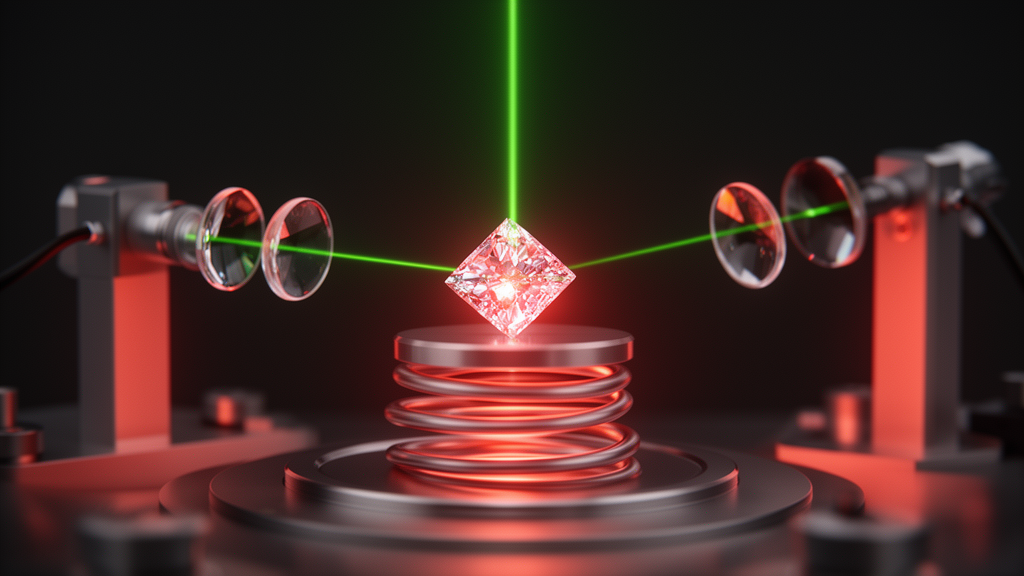
Researchers at the Fraunhofer Institute for Applied Solid State Physics IAF have demonstrated a laser-enhanced quantum sensor that measures magnetic fields with a combination of qualities that has long eluded conventional designs: high magnetic-field sensitivity and a large dynamic range at the same time. Using an approach known as laser threshold magnetometry, the team improved the ratio of sensitivity and dynamic range by a factor of up to 590 compared with state-of-the-art approaches. The achievement, published in the journal Nature Communications, rests on a first in the field of diamond-based magnetometry: the demonstration of 100 percent optical contrast, delivered together with strong laser readout signals rather than the weak fluorescence that researchers have traditionally had to rely on.
Magnetic-field sensors based on nitrogen-vacancy centers in diamond are among the leading solid-state quantum sensors available today. These centers, atomic-scale defects in the diamond crystal lattice, allow the material to act as a magnetic probe with remarkable properties. Sensors built around them operate at room temperature, can be integrated into compact devices, and enable vector magnetometry, meaning they can measure both the magnitude and the direction of a magnetic field rather than just its strength. Recent advances have pushed their sensitivity into the sub-pT/Hz range, a regime relevant for detecting cardiac signals, where the faint magnetic fields produced by the human heart must be distinguished from noise.
Until now, however, anyone designing such a sensor has had to make a difficult trade-off. Sensors with very high sensitivity offer only a very limited dynamic range, which restricts the span of field strengths they can usefully measure. More robust variants with a large dynamic range were considerably less sensitive. Because the ratio of the sensitivity limit to the dynamic range is crucial for real-world applications, and because improvements in one of these quantities typically come at the expense of the other, this trade-off has shaped what diamond magnetometers could realistically be used for. The Fraunhofer IAF team set out to dissolve that constraint rather than simply shift it.
The solution lies in laser threshold magnetometry, an approach that mitigates the trade-off by combining high sensitivity with a large dynamic range. In this scheme, the nitrogen-vacancy centers in diamond are not merely illuminated and observed from the outside. Instead, they are directly integrated into a laser cavity as an optical element, where they act as a magnetic-field-dependent loss channel. Rather than measuring the NV fluorescence, as conventional magnetometers do, the researchers use the system’s laser signal itself as the readout. The magnetic field thus influences the operation of an actual laser, and the resulting changes in the laser output carry the measurement information.
In their latest publication, the researchers demonstrate such a two-media laser threshold magnetometer. The strong coupling of the NV centers to the cavity field enhances the sensor’s response to changes in the magnetic field. The laser system thereby achieves 100 percent optical contrast, rather than the few percent that is typical for NV magnetometry. In practical terms, this means the laser output can be driven fully between its on and off states by changes in the magnetic field, a dramatic departure from the marginal signal changes that conventional fluorescence-based readout must detect. The system also delivers a coherent laser readout signal with an output power of up to 50 mW, substantially higher than that of conventional NV-fluorescence readout.
The combination of full contrast and a strong signal translates directly into measurement performance. If photon shot noise is the dominant noise source, this combination yields a sensitivity below 400 fT/Hz for each of the three components of the magnetic-field vector. That figure places the sensor in the ultra-sensitive regime needed for detecting the faint biomagnetic fields generated by the human body. Beyond the headline numbers, the study also provides the first experimental demonstration that the attainable sensitivity improves more than linearly as optical contrast approaches 100 percent, a relationship that had been anticipated theoretically and now has direct experimental support.
Compared with conventional fluorescence-based NV sensors and with vapor-cell magnetometers, another established class of magnetic-field sensors, the NV-diamond laser system improves the ratio of the sensitivity limit to the dynamic range by up to a factor of 590, while maintaining vector magnetometry capability. This means the sensor retains its ability to determine the direction of a magnetic field even as it gains in both sensitivity and usable measurement span. For applications ranging from medical diagnostics to navigation and resource exploration, the ability to measure weak fields across a wide dynamic range without sacrificing directional information is a significant practical advance.
The researchers themselves emphasize the broader significance of the result. “Our approach could resolve a trade-off that has long limited the development and application of magnetic-field sensors. It could pave the way for a new generation of mobile, highly sensitive magnetic-field sensors,” says Florian Schall, first author of the paper and a quantum-sensing researcher at Fraunhofer IAF. The work is also the fruit of a long-term research effort. A decade ago, Dr. Jan Jeske, head of the Quantum Sensing Group at Fraunhofer IAF, was the first to develop a theoretical model for a magnetic-field-dependent laser system based on a diamond containing NV centers. “The prospect of substantially improving sensing performance motivated us to pursue laser threshold magnetometry over the long term. I am very pleased that we have now experimentally demonstrated the magnetic-field-dependent shift in the lasing threshold,” says Jeske.
Potential applications for these quantum sensors span several fields. They include detecting biomagnetic signals from the heart, muscles, and brain; enabling magnetic-field-based navigation; and identifying magnetic anomalies, for example in resource exploration and security applications. The sensor development was carried out as part of the flagship project “Laser Threshold Magnetometers for Neural Communication Interfaces” (NeuroQ), funded by the German Federal Ministry of Research, Technology and Space. The NeuroQ consortium is developing quantum sensors intended to eventually detect brain activity and transmit corresponding signals to exoskeletons via a brain-computer interface, a technology aimed at enabling people with paralysis to control exoskeletons with their thoughts and regain some mobility.
The paper, titled “Laser-enhanced quantum sensing boosts sensitivity and dynamic range,” was published in Nature Communications under DOI 10.1038/s41467-026-78386-z. The study involved researchers from Fraunhofer IAF, Twenty-One Semiconductors GmbH, the College of Staten Island (CUNY, USA), the National Institutes for Quantum Science and Technology (Japan), and RMIT University (Australia). With 100 percent optical contrast now demonstrated experimentally, together with a coherent laser readout signal far stronger than fluorescence and a sensitivity below 400 fT/Hz per vector component, laser threshold magnetometry has moved from theoretical proposal to working sensor principle, offering a route toward mobile, highly sensitive magnetometers that no longer force a choice between sensitivity and dynamic range.
Subject of Research: Laser threshold magnetometry using nitrogen-vacancy centers in diamond for quantum magnetic field sensing
Article Title: First magnetic-field sensing with 100% optical contrast using an NV-diamond laser system
Article References: First magnetic-field sensing with 100% optical contrast using an NV-diamond laser system. Original publication (Bibliographic details unavailable.)
Image Credits: AI Generated
DOI: Not provided
Keywords: quantum sensing, magnetometry, NV centers, diamond, laser threshold magnetometry, optical contrast, magnetic field sensors, Fraunhofer IAF, Nature Communications, biomagnetic signals, navigation, resource exploration
Cite Scienmag News
Bethany Barker. (October 29, 2026). Diamond Laser Sensor Achieves Full Optical Contrast in Magnetic Field Detection. Scienmag. https://scienmag.com/diamond-laser-sensor-achieves-full-optical-contrast-in-magnetic-field-detection/
Bethany Barker. "Diamond Laser Sensor Achieves Full Optical Contrast in Magnetic Field Detection." Scienmag, 29 October 2026, https://scienmag.com/diamond-laser-sensor-achieves-full-optical-contrast-in-magnetic-field-detection/. Accessed 29 October 2026.
Bethany Barker. "Diamond Laser Sensor Achieves Full Optical Contrast in Magnetic Field Detection." Scienmag. October 29, 2026. https://scienmag.com/diamond-laser-sensor-achieves-full-optical-contrast-in-magnetic-field-detection/