


□ Professor Kyung-In Jang’s research team from the Department of Robotics and Mechatronics Engineering at DGIST (President Kunwoo Lee) has succeeded in developing a highly stable stretchable electronic device, which overcomes the mechanical limitations of conventional inorganic materials and enhances their stretchability and durability. In collaboration with Professor Taeho Park’s team from the Department of Chemical Engineering at POSTECH (President Seong-Keun Kim), the research team has developed a stretchable hybrid polymer and applied it to electronic devices, enabling them to operate stably even under deformation or external impacts. This technology is expected to be used in various industries, such as displays, healthcare, and wearables.

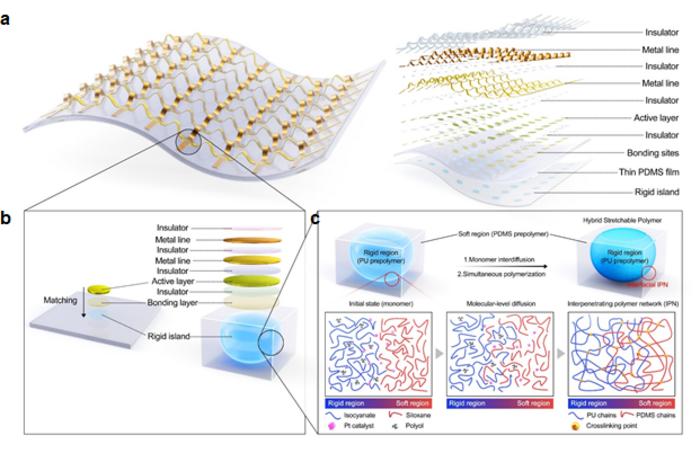
Credit: Interpenetrating Polymer (IPN)-based Stretchable Substrate and Integrated Electronics System
□ Professor Kyung-In Jang’s research team from the Department of Robotics and Mechatronics Engineering at DGIST (President Kunwoo Lee) has succeeded in developing a highly stable stretchable electronic device, which overcomes the mechanical limitations of conventional inorganic materials and enhances their stretchability and durability. In collaboration with Professor Taeho Park’s team from the Department of Chemical Engineering at POSTECH (President Seong-Keun Kim), the research team has developed a stretchable hybrid polymer and applied it to electronic devices, enabling them to operate stably even under deformation or external impacts. This technology is expected to be used in various industries, such as displays, healthcare, and wearables.
□ The “stretchable electronic device” technology is a promising technology applicable to various industries, such as displays, wearables, and healthcare. However, when subjected to deformation, such as stretching and bending, or external impacts, maintaining stable electrical functionality in these components becomes challenging. To address this issue, various research efforts are underway. Against this backdrop, the DGIST-POSTECH joint research team has developed a “stretchable hybrid polymer” and introduced a new strain isolation strategy to integrate [1]stretchable inorganic electronic devices with high efficiency, creating a new “stretchable electronic device” that operates stably even under deformation or external impacts.
□ First, the research team developed the “stretchable hybrid polymer” through “Interpenetrating Polymer Network (IPN) cross-linking.” The IPN is a 3D polymer structure formed by physically and chemically cross-linking two or more polymers, maintaining each polymer’s features while reinforcing each other. It can maintain high stability and performance even under deformation by inducing physical entanglement between polymers, which forms an excellent mechanical interface. The research team created a “stretchable hybrid polymer” using silicone-based polymers with different elastic moduli, polydimethylsiloxane (PDMS) and polyurethane (PU).
Subsequently, the team built a substrate with the developed stretchable polymer and combined it with the high-efficiency stretchable electronic component made from inorganic materials to complete the “stretchable electronic device.” The newly created electronic device is designed to distribute strain that occurs at a single point when subjected to stretching or bending, thus reducing mechanical strain on the device and maintaining its high stability. This significantly reduces physical damage and performance degradation that can occur in existing stretchable electronics.
Professor Kyung-In Jang from the Department of Robotics and Mechatronics Engineering said “We are pleased to have developed the stretchable electronic device system that maintains the performance of inorganic materials, which are mechanically vulnerable, even under various deformations and physical damages.” He also added, “We confirmed the system’s stability in applications such as stretchable micro-light emitting devices and heaters through verification, and we will further enhance this research to apply it in various industries such as healthcare and wearables as well as stretchable displays.”
The results of this research have been published online in ACS Nano, the renowned international journal in the field of nanoscience.
– Corresponding Author E-mail Address : finns0220@dgist.ac.kr
[1] Stretching: The phenomenon where an object elongates when a force acts outward parallel to its central axis.
2 IPN, Interpenetrating Polymer Network: A polymer composite in which two or more polymers are physically mixed and interpenetrate each other but do not chemically bond with each other.
3 PDMS: An abbreviation for polydimethylsiloxane, a type of silicone elastomer.
Journal
ACS Nano
Article Title
Rugged Island-Bridge Inorganic Electronics Mounted on Locally Strain-Isolated Substrates
Article Publication Date
9-May-2024
Cite Scienmag News
Denise Maddox. (June 25, 2024). DGIST-POSTECH joint research team developed next-generation impact-resistant stretchable electronic component. Scienmag. https://scienmag.com/dgist-postech-joint-research-team-developed-next-generation-impact-resistant-stretchable-electronic-component/
Denise Maddox. "DGIST-POSTECH joint research team developed next-generation impact-resistant stretchable electronic component." Scienmag, 25 June 2024, https://scienmag.com/dgist-postech-joint-research-team-developed-next-generation-impact-resistant-stretchable-electronic-component/. Accessed 6 September 2026.
Denise Maddox. "DGIST-POSTECH joint research team developed next-generation impact-resistant stretchable electronic component." Scienmag. June 25, 2024. https://scienmag.com/dgist-postech-joint-research-team-developed-next-generation-impact-resistant-stretchable-electronic-component/

