A team of computational materials scientists has reported the first theoretical characterization of three lanthanum- and gold-based halide double perovskites, A2LaAuCl6, where the A-site cation is potassium, rubidium, or cesium. Using density functional theory implemented in the WIEN2k code with the full potential linearized augmented plane wave plus local orbitals (FP-LAPW + lo) method, the researchers calculated the structural, electronic, optical, elastic, and thermoelectric properties of the compounds from first principles. The work, published in Gold Bulletin, provides new reference data for a family of lead-free perovskites that had been largely unexplored in the lanthanide branch of the perovskite family.
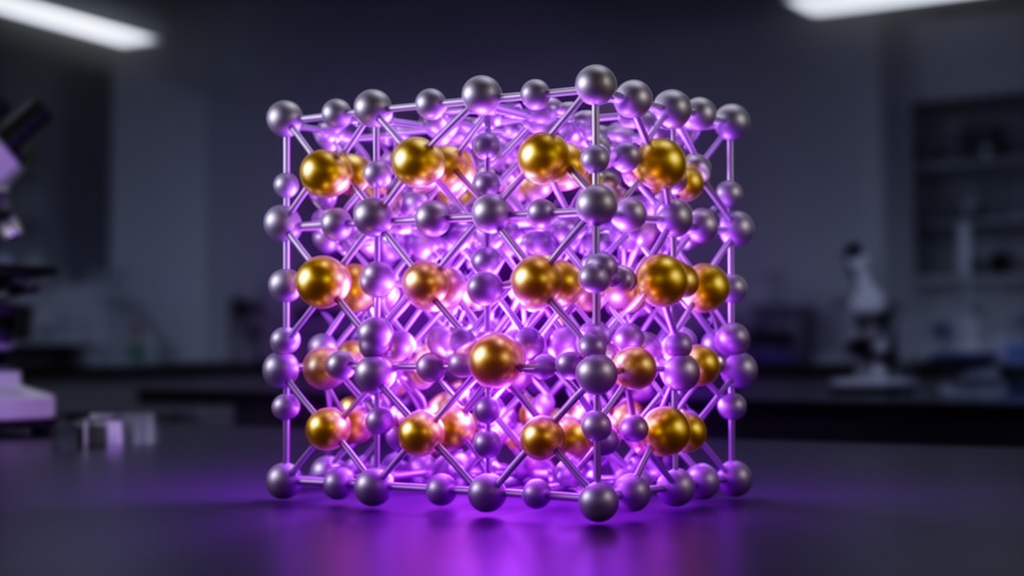
The compounds adopt the cubic halide double perovskite structure with space group number 225, Fm-3m, in which the A site is a larger cation and the B and B-prime sites host two different smaller cations, here lanthanum and gold, surrounded by chloride anions. The authors optimized the crystal structures by fitting total energies computed at different unit cell volumes to the Murnaghan equation of state, extracting lattice constants, bulk moduli, pressure derivatives of the bulk modulus, and ground-state energies. The lattice constant was found to increase steadily as the A-site cation grows heavier, moving from potassium to rubidium to cesium, a trend consistent with the increasing atomic radii along that series.
Structural stability was assessed through several independent indicators. The formation energies of all three compounds came out negative, which the authors take as evidence that the examined compounds are stable. Tolerance factors calculated from ionic radii fell between 0.80 and 0.83 for the three materials, a range associated with a cubic crystal structure, and the octahedral factor was evaluated alongside bond lengths to further characterize the geometry. Together, these geometric descriptors and the Born stability criteria satisfied by the computed elastic constants support the picture of robust cubic lattices across the series.
On the electronic side, the band structures computed along high-symmetry directions revealed indirect, wide band gaps for all three compounds. Using the Tran-Blaha modified Becke-Johnson potential, which corrects the well-known band-gap underestimation of the standard Perdew-Burke-Ernzerhof generalized gradient approximation, the team obtained gaps of 3.046 electronvolts for K2LaAuCl6, 3.019 electronvolts for Rb2LaAuCl6, and 2.912 electronvolts for Cs2LaAuCl6. The gap narrows as the A-site cation is exchanged from potassium to rubidium to cesium. Density of states analysis showed that lanthanum and gold atoms dominate the bands between zero and six electronvolts, while the valence band from minus six to zero electronvolts arises mainly from chlorine p states with smaller contributions from the alkali atoms. Gold d states contribute strongly near the Fermi level, and lanthanum d and f states dominate the conduction band, with strong p-d hybridization observed throughout.
The wide gaps place the strongest optical activity in the ultraviolet. The static dielectric constant ranges from about 2 to 2.4 across the series, indicating a low response to electromagnetic radiation at low frequencies, while the real part of the dielectric function peaks between roughly 4.9 and 6 electronvolts before turning negative, a signature of metallic-like conductive behavior at those photon energies that the authors link to potential uses in electromagnetic shielding, filters, super-lenses, and fiber optics. The static refractive index lies between 1.45 and 1.53, and the compounds remain transparent as energy increases because the refractive index never turns negative. Optical absorption is strongest in the far ultraviolet, the threshold energy for optical absorption sits between 2.22 and 2.30 electronvolts, close to the calculated electronic gaps, and static reflectance is around 13.26 percent, with reflectance maxima in the far ultraviolet region of the examined spectrum from zero to fourteen electronvolts.
Mechanically, the elastic constants C11, C12, and C44 were computed with the IRElast code and satisfied the Born-Huang stability criteria, confirming mechanical stability of the cubic phases. The materials are elastically anisotropic, with shear anisotropy values of 0.26, 0.61, and 0.31 for the potassium, rubidium, and cesium compounds respectively, deviating substantially from the isotropic value of one. Poisson’s ratios of 0.37, 0.32, and 0.37, together with Pugh’s ratios above the ductility threshold of 1.75, indicate that the compounds are inherently ductile rather than brittle. Positive Cauchy pressures and electronegativity differences point to predominantly ionic bonding between the alkali, lanthanum, and chlorine atoms, while the charge density around gold is distorted from spherical, indicating polar covalent gold-chlorine bonding of the dumbbell type.
The study also reports derived thermo-physical quantities, including longitudinal, transverse, and mean sound velocities, Debye temperatures, melting temperatures, and Gruneisen parameters. The Kleinman parameter, computed at 0.48, 0.51, and 0.49 for the three compounds, suggests that bond stretching rather than bond bending is minimized under volume-conserving strain. The authors interpret the low Gruneisen values as indicating higher thermal conductivity and low anharmonicity, and the Debye temperature results as suggesting the compounds could be reliable at elevated temperatures in device settings.
Thermoelectric transport was evaluated with the BoltzTraP code within the semi-classical Boltzmann transport theory, assuming a constant carrier relaxation time and using a dense mesh of ten thousand k-points. The Seebeck coefficient is positive for all three compounds, signaling p-type conduction. It reaches 172, 182, and 183 microvolts per kelvin at 200 kelvin for the potassium, rubidium, and cesium compounds respectively, then decreases gradually to 148, 152, and 141 microvolts per kelvin at 800 kelvin. Electrical conductivity rises with temperature, as expected for a semiconductor, reaching 0.79, 0.79, and 0.57 times ten to the eighteen inverse ohm-meter-seconds at 800 kelvin, with the rubidium compound showing the highest conductivity, attributed to its larger charge carrier population.
Electronic thermal conductivity also climbs with temperature, from roughly 0.76 to 0.88 times ten to the fourteen watt-per-meter-kelvin-seconds at 200 kelvin up to between 3.67 and 5.09 times ten to the fourteen at 800 kelvin, while the lattice thermal conductivity estimated with the Slack formula remains ultralow, between 0.022 and 0.026 times ten to the fourteen watt-per-meter-kelvin-seconds, so its effect on thermoelectric efficiency is negligible. The calculated power factors at 800 kelvin are 2.944, 2.99, and 2.20 times ten to the ten watt-per-kelvin-squared-meter-seconds, and the resulting dimensionless figures of merit reach 0.53, 0.54, and 0.47 at 800 kelvin for the potassium, rubidium, and cesium compounds respectively. The authors note that the Seebeck coefficients fall short of the roughly 200 microvolts per kelvin regarded as ideal, so the thermoelectric performance is favorable but not optimal.
Because the entire study is computational, the reported properties are predictions that await experimental synthesis and measurement, and the constant relaxation time assumption embedded in the transport calculations is a recognized simplification. Nevertheless, the authors argue that the combination of wide indirect band gaps, strong ultraviolet absorption, ductile mechanical behavior, structural stability, and respectable high-temperature figures of merit makes A2LaAuCl6 a promising candidate for photovoltaic, thermoelectric, and high-frequency device applications, and that the dataset offers a theoretical foundation for future experimental work on lanthanide-based, lead-free double perovskites.
Subject of Research: First-principles prediction of the electronic, optical, mechanical, and thermoelectric properties of the lead-free halide double perovskites A2LaAuCl6 (A = K, Rb, Cs)
Article Title: Exploring the electronic structure, mechanical, optical, and thermoelectric performance of A₂LaAuCl₆ (A = K, Rb, Cs) via FP-LAPW + lo calculations
Article References: Israr, N., Khan, S., Jehangir, M. A., Bahajjaj, A. A. A., Murtaza, G., & Saeed, M. (2025). Exploring the electronic structure, mechanical, optical, and thermoelectric performance of A₂LaAuCl₆ (A = K, Rb, Cs) via FP-LAPW + lo calculations. Gold Bulletin, 58(2), Article 13. https://doi.org/10.1007/s13404-025-00364-y
Image Credits: AI Generated
DOI: 10.1007/s13404-025-00364-y
Keywords: halide double perovskites, density functional theory, FP-LAPW, wide band gap, thermoelectrics, ultraviolet optics, lead-free perovskites, elastic anisotropy, BoltzTraP, WIEN2k, lanthanum, gold
Cite Scienmag News
Denise Maddox. (October 29, 2026). DFT Study Predicts Wide-Gap Gold-Based Double Perovskites for UV and Thermoelectric Use. Scienmag. https://scienmag.com/dft-study-predicts-wide-gap-gold-based-double-perovskites-for-uv-and-thermoelectric-use/
Denise Maddox. "DFT Study Predicts Wide-Gap Gold-Based Double Perovskites for UV and Thermoelectric Use." Scienmag, 29 October 2026, https://scienmag.com/dft-study-predicts-wide-gap-gold-based-double-perovskites-for-uv-and-thermoelectric-use/. Accessed 29 October 2026.
Denise Maddox. "DFT Study Predicts Wide-Gap Gold-Based Double Perovskites for UV and Thermoelectric Use." Scienmag. October 29, 2026. https://scienmag.com/dft-study-predicts-wide-gap-gold-based-double-perovskites-for-uv-and-thermoelectric-use/