


Deep in central Hungary, a forest tells a story of patience and deception. In the Peszér Forest, a protected forest-steppe of roughly 1,000 hectares near the Danube–Tisza interfluve, four non-native tree species — tree of heaven (Ailanthus altissima), common hackberry (Celtis occidentalis), black cherry (Prunus serotina) and boxelder (Acer negundo) — have been quietly waiting for the right moment to strike. A new study published in the journal One Ecosystem has now reconstructed their invasion history in remarkable detail, and the findings read like detective work: the trees arrived in the 1930s and 1940s, remained essentially harmless for 60 to 70 years, and then suddenly exploded across the landscape around the turn of the millennium. Understanding why is crucial for conservation everywhere, because it shows that an invader can lurk in plain sight for generations before becoming a crisis.
Reconstructing invasions at a local scale is notoriously difficult. Historical data are scattered, incomplete and often contradictory, and most research on invasion biology works at national or continental scales, where patterns blur the details. The research team, working within the OAKEYLIFE conservation project, therefore combined six independent data sources: a literature review of digitised forestry journals dating back to the 1860s, the archived records of Hungary’s National Forestry Database spanning 1958 to 2016, a full-coverage field survey conducted over 510 field days, mapping and felling of the largest tree specimens for annual ring counts, a statistical hotspot analysis of abundance data, and structured collection of local knowledge from twelve key informants aged between 40 and 85. Each source filled gaps the others could not, and the researchers argue that this mixed approach is essential wherever data density is low.
The literature delivered the most striking early clues. A 1964 journal article described a 25-year-old tree of heaven specimen at a specific location on the north-western edge of the forest, implying the species was already present in the 1930s. For black cherry, the evidence was even sharper: a short communication from 1954 documented that the first experimental stand was established in 1937 in an arboretum set up by a leading forest engineer, a date confirmed by a later publication identifying the exact forest subcompartment. The other two species left no paper trail at all — no literature source recorded their first introduction. That is where the forestry database and the trees themselves had to speak.
Hungary’s National Forestry Database requires standard data sheets for every forest subcompartment, updated roughly every decade. The researchers processed 1,686 of these sheets across six survey periods, extracting every mention of the four species and converting the records into chronological GIS layers. The earliest record belonged to boxelder, listed in 1958 as a major species in an 18-year-old seed-origin stand — evidence that the species had been present since at least the 1940s. Yet the database told a story of long silence: black cherry, despite its documented 1937 planting, did not appear in the database until 2002, when it suddenly showed up in 45 subcompartments at once. Tree of heaven first appeared in 1971 in a single subcompartment, and common hackberry in 1982 in four.
The field survey revealed how badly those records understated reality. Covering 910 hectares in 16,056 grid-based survey units of 625 square metres each, the team directly counted 98,136 adult specimens (diameter at breast height at least 5 cm) and estimated around 2,175,000 saplings in the smaller size class. All four species turned out to be two to three times more prevalent and abundant than the currently valid 2016 database entries indicated. Tree of heaven was found in 82 percent of the 300 forest subcompartments and hackberry in 95 percent, with mass presence — density thresholds that make the trees impossible to miss — in more than a quarter of subcompartments for both species. Black cherry and boxelder occupied 64 and 36 percent of subcompartments respectively.
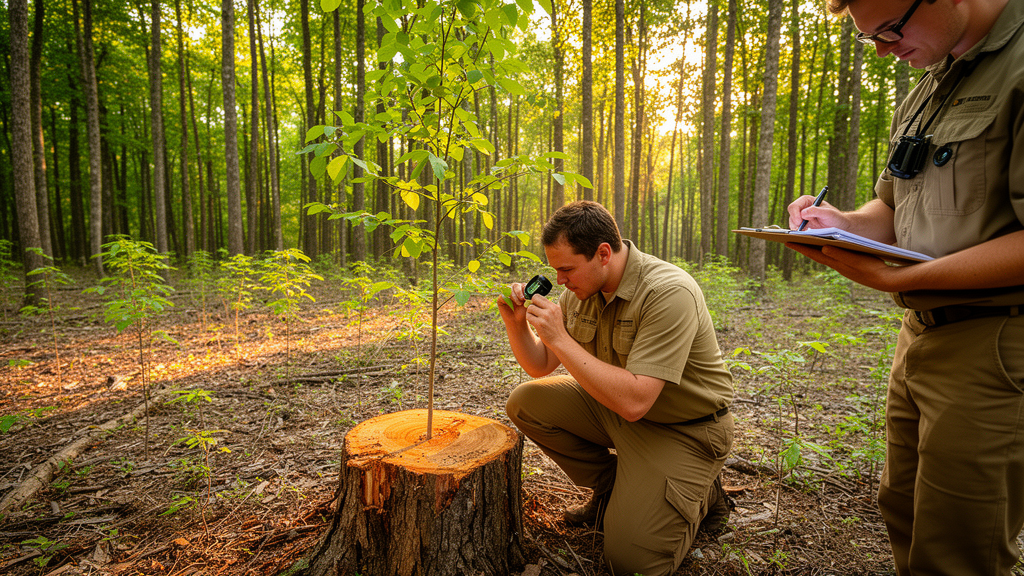
Annual ring counts turned old trees into living archives. The largest tree of heaven, with a diameter over 50 cm, proved to be 48 years old. Three enormous common hackberry trees, between 50 and 65 cm across, were found arranged in neat rows beneath the northern forester’s house — a signature of deliberate planting — and all three proved to be the same age, roughly 75 years, pushing the species’ presence back to at least the 1940s. More surprising still, a separate group of planted hackberries on a sand dune turned out to be 30 years old, proving that foresters were still planting the species after the 1980s, decades after its wood was considered worthless.
The hotspot analysis, using local Gi* statistics on the survey grid, added a spatial dimension to the detective work. For tree of heaven and boxelder, the primary hotspots — the survey units in the top 1 percent of Z-scores — coincided almost perfectly with their first known locations of occurrence. Eighty years after introduction, these species are most abundant exactly where they were first established. For hackberry and black cherry, however, the primary hotspots sat elsewhere. Local knowledge resolved the puzzle: the former two species had been ignored and avoided since the 1950s, while the latter two continued to be planted as admixed species in black locust and grey poplar plantations until the early 1990s, especially on the least productive sandy soils. Their primary hotspots most likely mark those undocumented plantations, not the original introductions.
The deepest mystery was the lag. Why would four species introduced decades apart sit essentially dormant for 60 to 70 years and then erupt simultaneously? Genetic change can be ruled out — at most 10 to 15 generations had elapsed, and a simultaneous genetic shift across all four species is implausible. Simple exponential growth also fails to explain the synchrony. Instead, the evidence points to a prolonged lag ended abruptly by three environmental changes that happened to coincide around the turn of the millennium. First, after Hungary’s 1989–1990 regime change, the intensity of forest management declined: the frequent treatments that once suppressed unwanted vegetation in socialist-era plantations and coppice forests largely ceased, allowing dense shrub layers — and invasive saplings — to develop. Second, the fallow deer population, kept at around 100 animals into the late 1990s, was reduced to nearly zero within a couple of years, removing browsing pressure and disturbance; notably, hackberry is the one invasive species deer actually favour. Third, droughts became markedly more frequent from 2000 onwards, with hot summers and mild winters that eliminated the frost damage to which tree of heaven seedlings are famously sensitive.
One informant captured the shift vividly, recalling that after the brutal drought years of 2000 and 2003, seedlings of tree of heaven appeared everywhere in very large numbers for the first time. The researchers frame this as a classic case of a prolonged lag phase, in which the species had gradually built up enough presence in the forest — steadily appearing in new subcompartments over decades — that the changed environmental conditions could trigger synchronous outbreaks. The study also notes that Hungarian mean annual temperature sits near 11°C, a threshold identified in Mediterranean research above which tree of heaven can no longer spread, a coincidence that may matter as the climate continues to warm. Other work predicts substantial range shifts for black cherry and hackberry in North America and increasing invasion pressure from black cherry in Europe.
The broader lesson is sobering. Official databases, essential as they are for national research and policy, can understate local invasions by a factor of two or three, and a species can be documented as planted nearly 70 years before it appears in any record. For protected areas of high conservation value, such as the Peszér Forest, which hosts more than 10 percent of the Carpathian Basin’s priority Eurosiberian steppic oak woods habitat, fine-grained local data are the only reliable basis for targeting control. The six-source methodology is replicable in virtually any forested area in Hungary and beyond, and the authors emphasise that eradication across a country the size of Hungary remains unthinkable even if small-scale successes are achievable. The most labour-intensive work — removing seedlings and saplings — requires no specialised skill, and the study makes the case that telling these species’ hidden histories is itself a tool: it turns scattered archives, old stumps and the memories of retired foresters into an argument that everyone, from park managers to garden-store customers, can act on before the next silent invader wakes.
Subject of Research: Historical reconstruction of the local-scale invasion history of four non-native tree species in a Hungarian forest
Article Title: Historical reconstruction of the invasions of four non-native tree species at local scale: a detective work on Ailanthus altissima , Celtis occidentalis , Prunus serotina and Acer negundo
Article References: Erdélyi, A., Hartdégen, J., Malatinszky, Á., & Vadász, C. (2023). Historical reconstruction of the invasions of four non-native tree species at local scale: a detective work on Ailanthus altissima, Celtis occidentalis, Prunus serotina and Acer negundo. One Ecosystem, 8, Article e108683. https://doi.org/10.3897/oneeco.8.e108683
Image Credits: AI Generated
Keywords: invasive species, Ailanthus altissima, Prunus serotina, Celtis occidentalis, Acer negundo, forest-steppe, lag phase, dendrochronology, hotspot analysis, local knowledge, Hungary, forest management
Cite Scienmag News
Margaret Porter. (October 19, 2026). Detective Work Reveals Four Invasive Trees Lurked Silently for Decades Before Exploding. Scienmag. https://scienmag.com/detective-work-reveals-four-invasive-trees-lurked-silently-for-decades-before-exploding/
Margaret Porter. "Detective Work Reveals Four Invasive Trees Lurked Silently for Decades Before Exploding." Scienmag, 19 October 2026, https://scienmag.com/detective-work-reveals-four-invasive-trees-lurked-silently-for-decades-before-exploding/. Accessed 19 October 2026.
Margaret Porter. "Detective Work Reveals Four Invasive Trees Lurked Silently for Decades Before Exploding." Scienmag. October 19, 2026. https://scienmag.com/detective-work-reveals-four-invasive-trees-lurked-silently-for-decades-before-exploding/


