


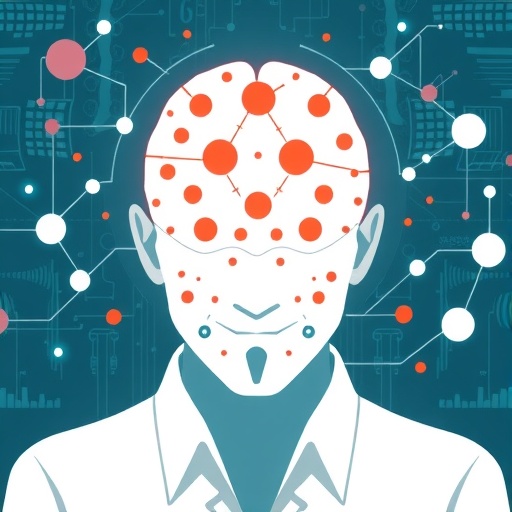
In a groundbreaking advancement poised to transform the landscape of mental health diagnostics, researchers have unveiled a novel non-contact method to detect psychological crises through behavioral data analysis. This pioneering study, recently published in BMC Psychology, signals a significant leap in the integration of technology with mental health monitoring, offering a pathway to timely intervention that does not rely on traditional, often subjective, clinical assessments.
The heart of this innovative research lies in the extraction and interpretation of subtle behavioral cues that individuals unconsciously exhibit. By leveraging state-of-the-art machine learning algorithms, the study meticulously processes diverse behavioral datasets that can indicate early signs of psychological turmoil. These might include changes in speech patterns, facial micro-expressions, physiological signals, and movement dynamics, all captured remotely without any need for physical contact or invasive procedures.
Central to this approach is the utilization of non-intrusive sensors and advanced computational models that together form a comprehensive system capable of continuous psychological state monitoring. Unlike conventional methods that often require self-reporting or clinical observation, this technology dynamically adapts, continuously learning from behavioral patterns to increase predictive accuracy. This real-time analysis is crucial for identifying individuals at risk of acute psychological distress before symptoms escalate to crises, potentially saving lives through early intervention.
The researchers’ methodology involved collecting extensive behavioral data under controlled conditions, subsequently training deep neural networks capable of discerning patterns indicative of stress, anxiety, or depressive states. These networks were fine-tuned using vast datasets comprising multimodal inputs—encompassing visual, auditory, and kinematic information—enabling nuanced detection that transcends superficial behavioral indicators.
One of the remarkable technical challenges addressed by the team was managing the heterogeneity and variability inherent in human behavior. Psychological manifestations are notoriously individualized; thus, calibrating models to account for personal baseline behaviors while maintaining sensitivity to pathological changes was paramount. To achieve this, the system employed adaptive learning techniques and personalized modeling, accommodating the dynamic nature of mental health status across diverse populations.
Moreover, the ethical implications of non-contact psychological assessment were rigorously considered. The study outlines protocols ensuring privacy and data security, emphasizing that the technology serves as an augmentation to professional diagnosis rather than a solitary diagnostic tool. This approach fosters trust and acceptance, critical factors for the widespread deployment of such systems in clinical, educational, and workplace environments.
Beyond its immediate clinical applications, this technology holds promise for integration into everyday devices, such as smartphones and wearable technology, broadening accessibility and enabling ubiquitous monitoring. Such integration could empower users to track their mental wellness unobtrusively, prompting healthy coping strategies before crisis points are reached.
Another transformative aspect highlighted is the system’s scalability and portability. Unlike traditional diagnostic equipment that may be confined to clinical settings, this behavioral analysis methodology can be adapted for remote or underserved regions, where access to psychiatric professionals is limited. Consequently, it may help bridge the global mental health care gap, offering early crisis detection in varied socio-economic contexts.
Interestingly, the research also opens new avenues for understanding psychological phenomena through high-resolution behavioral data mining. By continuously monitoring and analyzing data, the system contributes to longitudinal mental health studies, revealing patterns and triggers previously inaccessible through conventional means. This could revolutionize psychiatric research, fostering personalized treatment regimens grounded in empirical behavioral evidence.
However, the authors caution that the technology is not a panacea but a complement within a holistic mental health care framework. Integration with clinical judgment, patient history, and other diagnostic tools remains essential. Future development will focus on enhancing sensitivity, minimizing false positives, and tailoring interventions that align with individual psychological profiles.
The implications for healthcare policy are profound. Incorporating such technologies could facilitate preventative strategies, reducing the burden on emergency services and psychiatric facilities. Early detection and management of psychological crises may virtually decrease hospitalization rates and improve overall public health outcomes.
Notably, the multi-disciplinary nature of this research underscores the convergence of psychology, data science, and engineering. It exemplifies how cross-sector collaboration can catalyze innovation to tackle complex societal challenges such as mental health disorders, which affect millions worldwide.
In conclusion, this advance ushers in a new era of mental health diagnostics: one defined by empathy integrated with cutting-edge technology, enabling proactive care through unobtrusive, real-time monitoring. As this approach moves from research into practical application, it offers hope for more timely, accurate, and accessible mental health support, fundamentally reshaping how psychological crises are detected and managed in the future.
Cite Scienmag News
Glenn Wilkins. (December 12, 2025). Detecting Psychological Crises via Non-Contact Behavioral Data. Scienmag. https://scienmag.com/detecting-psychological-crises-via-non-contact-behavioral-data/
Glenn Wilkins. "Detecting Psychological Crises via Non-Contact Behavioral Data." Scienmag, 12 December 2025, https://scienmag.com/detecting-psychological-crises-via-non-contact-behavioral-data/. Accessed 3 September 2026.
Glenn Wilkins. "Detecting Psychological Crises via Non-Contact Behavioral Data." Scienmag. December 12, 2025. https://scienmag.com/detecting-psychological-crises-via-non-contact-behavioral-data/


